A US Trade Strategy for Latin America

There are ways in which the United States can reshape its economic relationships with Latin American nations to the mutual benefit of all parties.
The United States’ relationships with the thirty-three countries encompassed under the United Nations’ phrase “Latin America and the Caribbean” have experienced more than their fair share of ups and downs. The Monroe Doctrine’s implicit claim of U.S. oversight over the Western Hemisphere, for example, involved more than just a desire on Washington’s part to limit the political influence of European powers throughout the region. It also reflected a view of Latin America as a source of potential destabilization for American interests and full of opportunities for enterprising Americans.
Though many twenty first century Americans presently think about Latin America in terms of the problem of illegal immigration, this is a relatively new phenomenon. For most of the twentieth century, for example, the United States perceived Latin America through a prism primarily shaped by two factors.
The first were Cold War priorities: combatting indirectly—and occasionally directly—radical leftist and highly anti-American movements as well as preventing the Soviet Union from establishing footholds throughout the region. The second factor concerned the desire to protect American economic interests in Latin America. More often than not, these economic and strategic priorities overlapped. We see this dynamic at work today in ongoing American attention to the question of who controls the Panama Canal in light of China’s efforts to expand its influence in the region.
One commonality shaping these two priorities was a profound awareness on American policymakers’ part of the seemingly endemic internal political instability that has, to varying degrees, characterized most Latin American nations since they achieved independence in the early nineteenth century. While aware of the immense economic potential of a region so rich in natural resources and a consumer market presently consisting of approximately 660 million people, many Americans have long been hesitant about investing in and trading with the region because of concerns about problems like the weak protections for property rights and the mediocre quality of rule of law that marks most Latin American countries.
There is little that the United States can do to resolve the deep-seated problems in the economic culture and institutional settings that prevail throughout Latin America, beyond being very direct with Latin American governments about how these difficulties severely limit Americans’ willingness to engage economically in the region. The choice to embrace and live out the norms that underpin the rule of law ultimately has to be made by Latin Americans. Alas, there is no evidence that a cultural and lasting revolution in Latin American political and economic dynamics will likely occur soon.
That said, there are ways in which the United States can reshape its economic relationships with Latin American nations to the mutual benefit of all parties. First, America could seek to liberalize further existing trade agreements that it already has with Latin American countries and increase the number of such trade agreements throughout the region.
The economic possibilities created by existing bilaterial trade agreements that America has with countries like Chile, Colombia, Peru, Panama, Costa Rica, the Dominican Republic, El Salvador, Guatemala, Honduras, and Nicaragua have been limited by persistent hindrances to more expansive trade, many of which are written into these agreements. Likewise, the NAFTA and now USMCA agreements that have mediated America’s biggest Latin American trading relationship—that with Mexico—since 1994 are full of conditions and restrictions that reflect the efforts of US and Latin American businesses, unions, and NGOs to protect specific interests at everyone else’s expense. Nor has the new tariff regime announced by the Trump Administration on April 2 helped matters.
Overcoming the ability of these interests, their lobbyists, and their political allies to obstruct trade liberalization as well as the influence of committed protectionists is extremely difficult at the best of times. Still, there remain some ways for Washington to free up trade between the United States and Latin American nations to everyone’s benefit in the future.
First, the United States could offer to reduce tariffs on those goods and services in which many Latin American countries specialize, such as coffee and textiles, and ask Latin American governments in return to decrease their tariffs on goods like high-tech products where the United States presently leads the world. The advantage of pursuing such a strategy is that the industries in these countries have a strong interest in getting wider access to foreign markets. There would subsequently be less domestic opposition to such liberalizing measures.
Second, the United States could prioritize updating its trade relationships with two of Latin America's biggest economies: Argentina and Brazil. Presently, America has a Trade and Investment Framework Agreement (TIFA) with Argentina and an Agreement on Trade and Economic Cooperation (ATEC) with Brazil. These primarily serve as fora for discussing trade issues, exchanging information, and providing advance notice of laws and regulations that might affect trade relations. But there is no reason why they could not become a means of broader discussions on how to free up trade relations between the United States and these two large regional economies.
Trade agreements are usually years in the making. However, a gradual liberalization of trade relations between the United States and Brazil and Argentina has the potential to expand American access to two of the three largest Latin American economies, and vice versa. Though this would not automatically translate into better political relationships for the United States with these two countries, it would create a greater commonality of economic interests than presently exists.
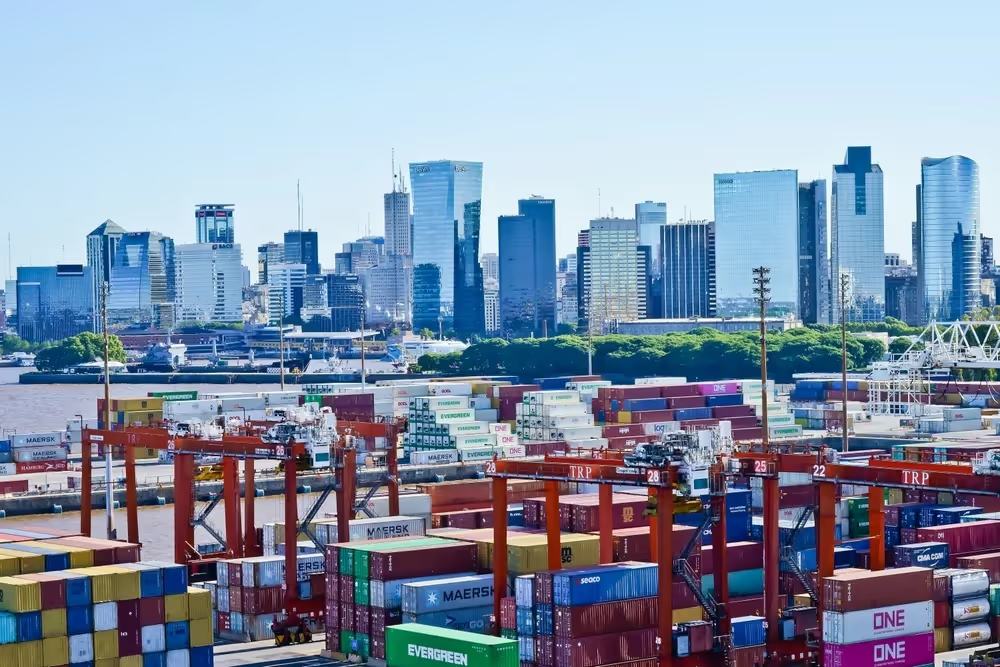
The other advantage of seeking to liberalize US trade with Argentina and Brazil is that it may help to “de-Mexicanize” the way many American policymakers and citizens approach US-Latin American trade relations. Mexico looms extremely large in American thinking about trade with Latin America, partly because of geographical proximity, and partly because Mexico accounted for 77 percent of U.S. imports from the region and 62 percent of U.S. exports to Latin America in 2023.
But this also means that American trade policy towards Latin America is unduly overshadowed by two very real problems that have increasingly burdened US-Mexican relations: specifically, illegal immigration and drug trafficking. To be sure, the reasons why these problems exist owe as much to American policy failures as they do to specifically Mexican challenges. Yet, there is little doubt in my mind that the persistence of these problems has contributed to the turn of politically influential circles against trade liberalization in the United States.
Expanding U.S. trade with Latin American economies as large as those of Argentina and Brazil will not resolve these challenges. But it may help broaden Americans’ perspective about trade with Latin America and help them consider the very real benefits for Americans likely to ensue from expanding US commercial connections and exchanges south of the Rio Grande. At a time of rising protectionist and populist sentiment in the United States and other nations, this can only be a positive development.
Samuel Gregg is the Friedrich Hayek Chair in Economics and Economic History at the American Institute for Economic Research. He is a contributing editor to Civitas Outlook.

The Twilight of Free Trade
Contrary to what is often believed—especially in Latin America—these countries stand to gain the most from a closer relationship with the United States.


Enhancing Trade, Security, and Peace in the Americas: The Role of Think Tanks
We need to achieve more effective collaboration between leaders and organizations working for trade, security, and peace in the Americas.
A US Trade Strategy for Latin America
There are ways in which the United States can reshape its economic relationships with Latin American nations to the mutual benefit of all parties.



.png)
Get the Civitas Outlook daily digest, plus new research and events.
Get the Civitas Outlook daily digest, plus new research and events.