
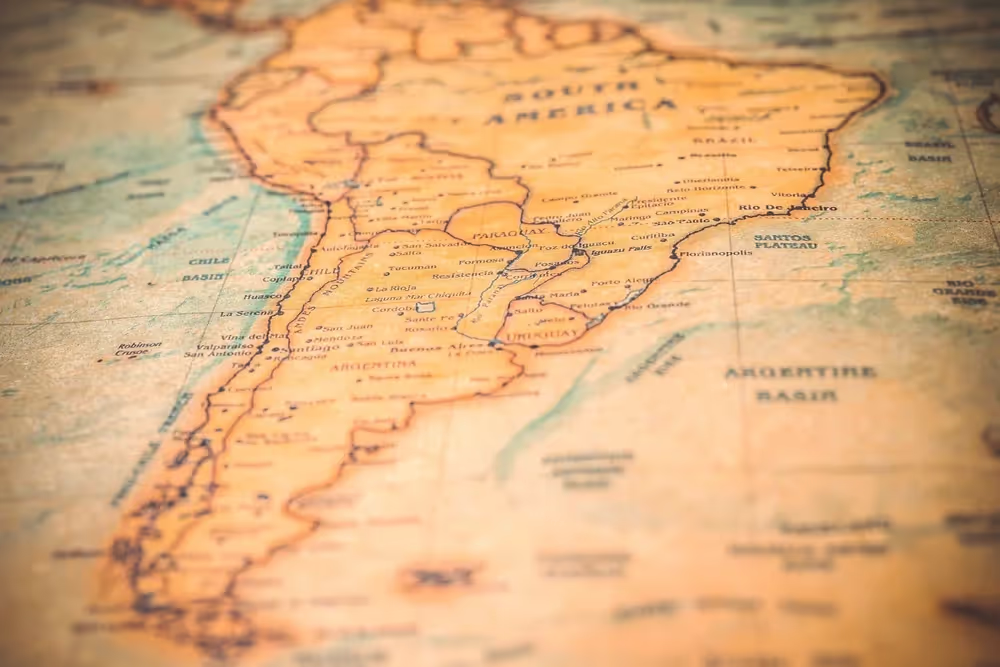
The Young Americas Need Each Other

He should ignore Greenland and Canada and do something concrete and forceful in Venezuela instead.
Washington’s Farewell Address began the non-interventionism that has long shaped American foreign policy. This non-interventionism is supposed to be a key pillar of the new administration’s approach to Europe and possibly Taiwan. But what exactly does putting America first rather than other nations’ interests mean? Trump has emphasized Europe’s geographical distance from the U.S. and noted that the Old World plays little role in our security concerns. Latin America, however, is neither distant nor irrelevant. It’s imprudent to surround yourself with angry, hostile regimes. James Monroe started the American political leaders’ policy of recognizing that we have a special interest in “our” part of the world.
It’s not merely because we’re geographically close to our neighbors; all the Western Hemisphere’s nations are part of the New World. These relatively young nations are still characterized by widespread religious practice, ethnically and racially mixed cultures, and a populist streak, especially recently. Their immigrant populations are significant, and while their colonial pasts vary, they are all former colonies working to construct new governing and living institutions.
As the Trump administration looks south, the U.S. needs to identify its friends—or potential friends—and its obvious enemies. Liberation theology, dependency theory, and myths of exploitive capitalism have long polluted the region, and there are factions, particularly in these countries’ leadership classes, that reflexively dislike America.
Yet working people, young laboring classes, are hungriest for economic advancement. They risk their lives to come to America. Even though they view America as a boorish and sometimes crass neighbor, many of the region's people still dream of living there. They long for the opportunity to escape Latin America’s relatively inflexible social and economic systems. Empowering the region’s working and middle classes should be the top goal of any administration, but it should be Trump’s especially, despite his confrontational rhetoric.
Four neighbors—Mexico, Panama, Venezuela, and Argentina—should be the main focus during the next four years, and perhaps beyond. How should a committed “America First” administration approach these four nations? To begin with, free trade is preferable to Trump’s current approach, but apart from that, what else should be done to improve our neighborhood?
Let’s begin in Panama. To all appearances, this situation has already been resolved to the extent that anything needed resolving in the first place. Panama might be the world’s most pro-American country, since the U.S. basically created it. Walk anywhere in the small nation and you’ll see American professional baseball team hats worn everywhere. A contact told me recently that, should the Panamanian government ever hold a referendum on joining the U.S. as another state, the vote would be 90-10 in favor. Many American expats live there, and the U.S. dollar is the nation’s de facto currency.
Most media sources report what my contacts in Panama told me months ago: the Trump Administration wanted an American business running two warehouses, currently owned by Hong Kong-based CK Hutchison, on either end of the Canal. Secretary of State Rubio conveyed that message when he visited Panama, and the Canal Authority heard it and responded by acting in accordance with U.S. interests. Blackrock now has a deal in place to purchase the warehouses. As Panama’s “founder” and primary protector in the decades since, America is still its most important ally. In this instance, Trump’s business background was the appropriate way to nudge Chinese influence out of the Canal zone.
The second is Argentina, where Javier Milei, the outsider who wields a chainsaw and resplendent sideburns, is trying to remake the nation from a bloated, parasitic Peronist state into something leaner, more pro-market, and not coincidentally more pro-U.S. Milei and Trump met and became fast friends. Milei’s chief economist responsible for shrinking the state even communicates with Elon Musk and the DOGE team.
Argentina is blessed with abundant natural resources. The Pampas, a vast agricultural grassland, is South America’s breadbasket. Argentina boasts a well-educated workforce, a renowned cattle industry, and a cosmopolitan capital, Buenos Aires. It is also cursed with an exploitative political class and arguably the world’s worst central bankers outside of Zimbabwe. The most commonly discussed permanent solution to the central banking problem has been replacing the Argentine peso with a more stable currency, probably the U.S. dollar.
Is there a more Trumpian policy than expanding U.S. international business influence through more widespread adoption of the U.S. dollar? It’s not just Panama that uses it: Ecuador and Peru also have dollar pegs, and Latin America circulates dollars widely. “Investing” U.S. funds in Argentina to pay off some of its debts (negotiations with the I.M.F. and World Bank are ongoing) would help Argentina adopt the dollar. Recently discovered shale reserves, however, known weirdly as the Vaca Muerta (the dead cow), could jumpstart a mineral deal negotiation while also giving Trump a victory as he works towards cheaper U.S. energy long term. This could be a much less confrontational U.S. power expansion than forcibly annexing Greenland or Canada. Rather than sending the Marines to Panama to take over the Canal, send the Greenback to Buenos Aires and gain economic benefits and prestige.
What about Mexico? Claudia Sheinbaum is currently president, but former president Manuel Lopez Obrador, known simply as AMLO, is still in control. Like Trump, AMLO is an avowed economic nationalist and populist prone to unscripted, sometimes rambling press conferences. He is his party’s undisputed leader and someone whose support is strongest in rural areas. In some ways, he is Mexico’s Trump. He did not merely threaten to impeach a judge who disagreed with one of his policies; he changed Mexico’s constitution to abolish judicial appointments and replace the process with judicial elections. Neither man shows respect for the longstanding institutions and the rule of law. With this list of similarities, it’s unsurprising that their personal relationship is cordial.
Illegal immigration through (and predominantly from) Mexico was one of Trump’s winning campaign issues in 2024. He has staged mass deportation flights, sent I.C.E. into various sanctuary cities, and even begun revoking Green Cards from some legal residents in a show of force to “control the border.” As a committed classical liberal, I find this approach unproductive, but the Biden administration allowed far more illegal immigrants into the country than any previous administration had. The character of those immigrants was also different. Instead of mostly young Mexican males who worked illegally before typically returning home, the new group included whole families and children, who place different demands on U.S. public services.
If you are old enough to remember Richard Nixon, then you probably remember that “it took Nixon to go to China.” Nixon was focused on foreign policy and had hawkish anti-communist credentials stretching back decades. It was Nixon who, surprisingly, reopened relations between the U.S. and China. Could Trump leverage his personal relationship with AMLO to pull off a similar feat and pass a long-sought immigration bill through the U.S. Congress? Republican margins in both houses are slim, and it might seem odd to his base so that the task wouldn’t be easy.
But the Democratic Party can plainly see that Latinos are now trending towards the GOP. They envisioned that waves of immigrants would become members of their permanent Democratic majority. That is not happening. Would they oppose a reform bill? Republicans would likely want to give Trump a policy victory that could solve a major headache and continue broadening the G.O.P.’s base.
Regarding immigration, the administration’s final Latin America policy challenge is Venezuela. One of the biggest national tragedies in the world right now is the one in what was formerly the region’s most prosperous country. What began as an army officer Hugo Chavez’s attempted coup in the 1990s, became the establishment of Chavezmo—the movement that confiscates and redistributes property, imprisons hundreds of thousands of citizens, and introduces Cuban security forces throughout the nation. Now, millions of Venezuelans have fled their homeland and settled in the U.S., Panama, Spain, and elsewhere in one of recent history’s largest diasporas.
Domestic hope’s last gasp might have occurred just last year when a united, democratic, liberty-oriented opposition defeated Chavez’s successor in an election all reasonable international observers agreed they won. Instead, Maduro ordered his police to take to the streets, beat protestors, and imprison many opposition leaders. No country recognizes Maduro's “victory outside China and Russia.”
The Monroe Doctrine has long observed that the Western Hemisphere is the U.S.’s domain. It’s our responsibility, rightly or wrongly, to maintain the sovereignty of our fellow “Americans,” even those in the Latin part. We invaded Panama to overthrow Noriega’s dictatorship. We did the same in Grenada. As a principled non-interventionist, it’s painful to say, but the Maduro regime has shown it will not leave peacefully. It’s a brutal dictatorship in our neighborhood that Cuba (i.e. Russia and China) finances and supports.
If Trump wants to establish American power, he should ignore Greenland and focus on Venezuela. Deals negotiated with the odious Maduro regime that allow Chevron to pump oil are morally repugnant and contradict Trump’s stated international policy goals. He should apply significant economic and diplomatic pressure to the regime and then ramp up his always hysterical rhetoric.
But he has to mean it this time. If the Maduro regime continues to cling to power, Trump should send the U.S. military to dislodge the Cubans, Maduro, and all the outside forces that prop up this dictatorship. Because of the Venezuelan diaspora’s nature and the country’s vast oil reserves, a pro-U.S. government in Caracas will kill multiple birds with one stone. Millions of Venezuelans will return home, cheaper energy will be closer, and Trump will be a popular hero. He should ignore Greenland and Canada and do something concrete and forceful in Venezuela instead.
G. Patrick Lynch is a Senior Fellow at Liberty Fund and a Contributing Editor at Law & Liberty.

The Twilight of Free Trade
Contrary to what is often believed—especially in Latin America—these countries stand to gain the most from a closer relationship with the United States.

Enhancing Trade, Security, and Peace in the Americas: The Role of Think Tanks
We need to achieve more effective collaboration between leaders and organizations working for trade, security, and peace in the Americas.
A US Trade Strategy for Latin America
There are ways in which the United States can reshape its economic relationships with Latin American nations to the mutual benefit of all parties.



.jpg)
.png)
Get the Civitas Outlook daily digest, plus new research and events.
Get the Civitas Outlook daily digest, plus new research and events.