

Disruptions and Challenges in the Middle East

Significant challenges await the Trump administration’s attention.
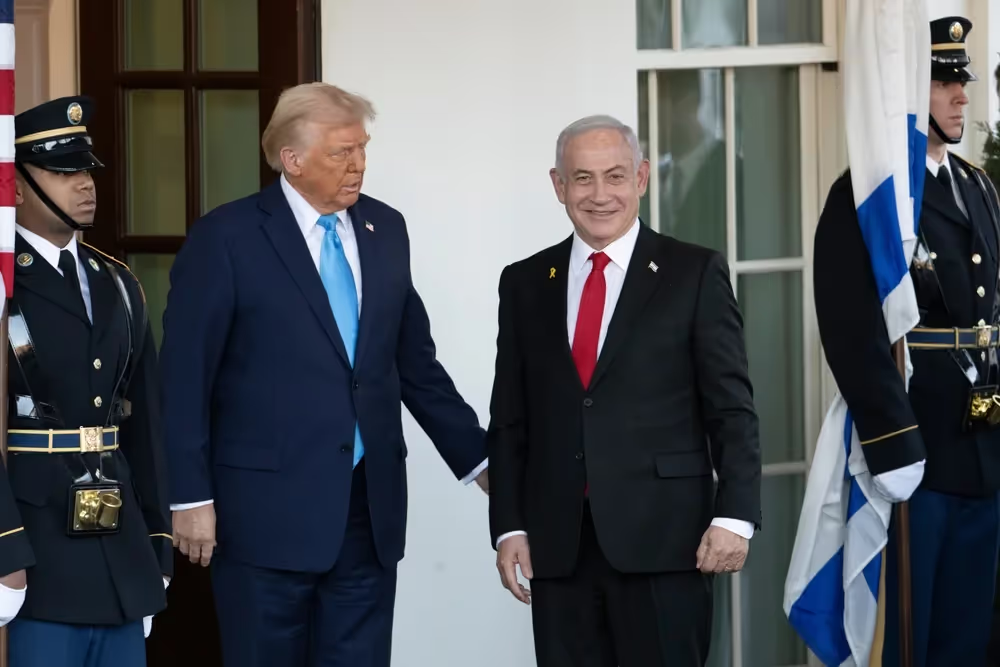
The world widely expects Donald Trump’s White House return to bring change to the Middle East. Former President Joe Biden looked on helplessly as the war that Hamas launched on October 7, 2023, dragged on for more than fifteen months. After his election to a second term, Trump threatened “hell to pay” if Hamas and its Tehran patrons failed to end the war immediately. That threat spurred Hamas to release Israeli hostages in a tenuous ceasefire deal that still holds. This, coupled with Trump’s track record of tough policies on Iran—from killing IRGC Quds Force chief Qassem Soleimani to maximum sanctions pressure—has most of the region (the Sunni states and Israel) cheering for his return.
In many ways, other regional powers have already done much of the heavy lifting. The Israelis have eviscerated Hamas in the Gaza Strip. They hammered Hezbollah to the point that the Lebanese terror group yielded to a ceasefire agreement. Late October’s lethal Israeli air strikes left Iran without air defenses or ballistic missile production capabilities. And the Turkish-backed Hayat Tahrir Al-Sham (H.T.S.) lightning offensive collapsed the Assad regime and disrupted the Shi’ite Crescent that once enabled Iran to deliver cash, materiel, and weapons to its Levant allies by way of a contiguous land bridge. One sees that the October 7 multifront war could be losing steam.
Other significant challenges, however, await the Trump administration’s attention. Some will look familiar. But none will be simple to solve.
For one, a nuclear Iran threatens. True, the regime appears defeated and weak. But for that very reason, the regime may elect to dash for the bomb – even a crude one. A nuclear weapon is Tehran’s ultimate insurance policy. A policy of hypervigilance and pressure will be crucial. The temptation for Trump to broker a revised nuclear deal to replace the fatally flawed 2015 Joint Comprehensive Plan of Action (JCPOA) will be great, especially for a man who sees himself as the ultimate deal maker. Trump is likely to realize that there is no acceptable deal to make with the current regime and that regime change—brought about through the Iranian people’s support—is the only viable option. Enacting such a policy will require the Trump team’s strategic patience and deft diplomacy.
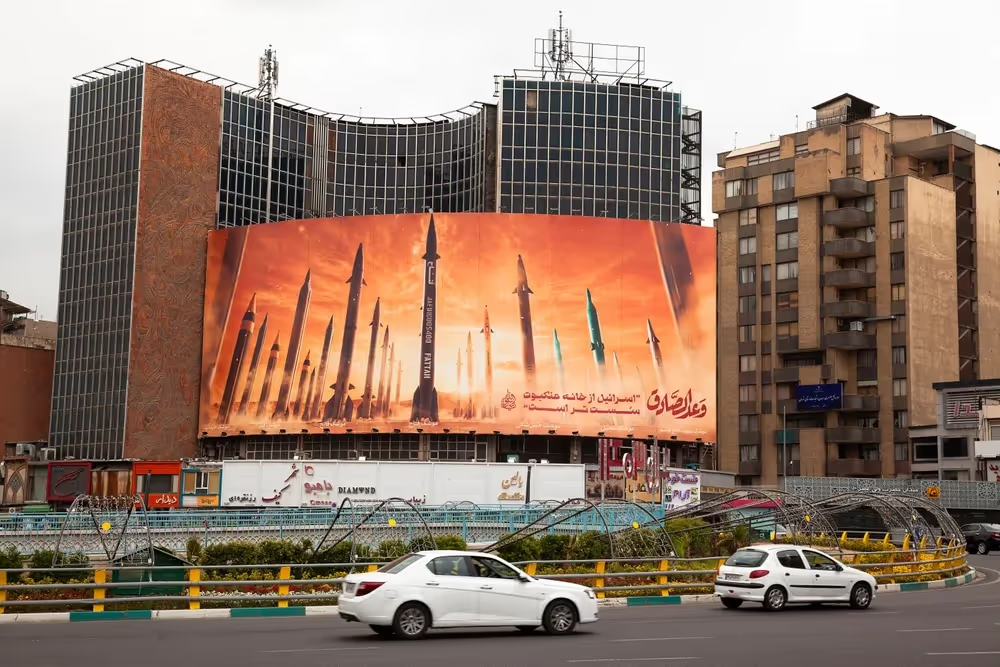
Of all the Iranian proxies that activated in Hamas’s October 7 attack’s wake, it is now the Houthis in Yemen that may pose the greatest challenge to regional security. The Houthis, until very recently, were firing ballistic missiles at Israel. This is the first terrorist group to maintain such a capability. Allowing the Houthis to maintain this capability sets a dangerous precedent. More importantly, however, the Houthis have all but shut down the Red Sea, impeding maritime trade in a corridor that typically sees an estimated twelve percent of global shipping trade annually. Biden failed to address this threat, which now falls on Trump. American military brass have, for a year or more, stood ready to face the Houthi threat head-on. They now await orders from their new commander-in-chief.
Trump will also contend with a Turkish regime very different from the one he knew during his last term in office. The Recep Tayyip Erdogan government is now the power broker behind Syria’s new al-Qaeda government. Quietly and methodically, Erdogan armed and trained H.T.S.—the al-Qaeda affiliate group formerly known as the Nusra Front. Turkey is a NATO ally that supports the strategic Incirlik air base for the Western alliance, but this government’s track record includes supporting terrorist groups like H.T.S., Hamas, and the Islamic State. Curbing the Turkish government’s malign policies and placing a check on the aspirations for a Neo-Ottoman imperial resurgence will be no simple matter for Trump, who has long considered Erdogan to be an ally, if not a friend.
In Syria, a wicked cocktail of challenges awaits. H.T.S. and its leader, Abu Mohammed Al-Jolani, purport to be moderate forces, but we should approach that claim with a healthy dose of skepticism. The group knows that its survival requires curbing its violent, Islamist impulses. And the region’s leaders are willing to give H.T.S. the benefit of the doubt if it means avoiding another Middle East war. Accordingly, Trump will come under pressure from Arab allies (the U.A.E., Egypt, and others) to repeal U.S. sanctions on both Syria and H.T.S. The early Trump policies will likely hinge on H.T.S.’s actions—from preventing aggression toward Israel to minority rights protection to the Kurdish question. The Kurdish issue may prove the thorniest, as the Turkish regime sets its sights on dismantling Kurdish armed groups while Iran reportedly prepares to use weapons to ply them. After internecine conflict spanning more than a decade, a regional proxy war in Syria may be brewing.
In neighboring Lebanon, Israeli military strikes have weakened Hezbollah, but the group maintains a formidable arsenal. Iran’s top proxy’s (not just south of the Litani River) complete demilitarization is an imperative. With mid-January’s election of Lebanese Armed Forces (L.A.F.) chief Joseph Aoun as president, a modicum of hope now exists for a political solution in Lebanon that leads to Hezbollah’s demilitarization, a weapons monopoly for the government, and the country’s stabilization after decades-long decay. The L.A.F. recently took control of one small section of southern Lebanon with the goal of expanding its control. There’s not much room for optimism right now: it all hinges on Hezbollah’s willingness to cooperate and Iran’s willingness to allow a new Lebanese power structure— one without Iranian malign influence—to emerge.
To make matters even more complicated, Jordan and Egypt’s governments are operating on economic fumes and their populations are growing restless. To be clear, there are no immediate warning signs. But after the Assad regime’s collapse in Syria, the Middle East is on high alert for a domino effect. After all, this is exactly what occurred during the Arab Spring.
Admittedly, the Middle East is not entirely mired in challenges; there are also opportunities. Israel has hammered Iran’s proxies and even weakened the Iranian regime. This, coupled with Trump’s return, offers a window to broaden the Abraham Accords—the normalization agreements he brokered between Israel and pragmatic Sunni states U.A.E., Bahrain, and Morocco. Saudi Arabia is Trump’s top target for a new agreement. Should Riyadh agree, this could pave the way for scores of other agreements with Arab and Muslim states that are known to follow the Saudis’ lead.
This, in turn, could help create the Middle East Security Alliance, or “Arab NATO” as it was known when the previous Trump administration announced it. Empowering regional actors to work together against common threats is an American interest. So is integrating regional air defenses under U.S. Central Command’s coordination. CENTCOM, Arab, and Israeli air defenses activated to neutralize a formidable ballistic missile threat last May and October, making such coordination’s upside readily apparent during two Iranian aerial assaults on Israel.
History will not likely judge the Biden administration’s policies in the Middle East kindly. Biden failed to end the Iran-backed war, and whatever gains occurred were largely Israeli. Trump is now taking the reins, with the region already plunged into crisis. The challenges are vast, but the opportunities for significant course correction are also plenty.
Jonathan Schanzer, a former terrorism finance analyst at the U.S. Treasury, is executive director at Foundation for Defense of Democracies, a nonpartisan think tank in Washington, DC. Follow him on X @JSchanzer.


.jpg)
.png)
Get the Civitas Outlook daily digest, plus new research and events.
Get the Civitas Outlook daily digest, plus new research and events.