Enhancing Trade, Security, and Peace in the Americas: The Role of Think Tanks

We need to achieve more effective collaboration between leaders and organizations working for trade, security, and peace in the Americas.
My professional expertise lies in creating and nurturing think tanks and other organizations as means to influence policy changes. Increasing the quantity and quality of these organizations’ work (including finding ways to work with sympathetic government officials) will help to enhance collaboration for improved trade, security, and peace in the Americas.
During the 1960s and 1970s, the threat of communism helped unite the anti-socialist camp behind security issues. One of the oldest efforts was the American Security Council Foundation, founded in 1958 and headed by John Fisher, which trained Latin American defense experts and officials. Its motto was “Peace through strength.” Another was the Council for Inter-American Security, founded in 1976 and led by Lynn Bouchey, which organized security-focused programs in the Americas. I knew and collaborated with both Fisher and Bouchey, but since the early 1980s, and especially after the collapse of the Soviet Union, I have focused on promoting economic freedom.
I entered the US free-market movement through the network of the Foundation for Economic Education (FEE, founded in 1946), which has promoted economic freedom since its founding. FEE did not have great international reach, but during my college years, I had the good fortune to meet Leonard Read, its founder and leader, when he traveled to Argentina in the late ‘70s.
The 1970s and 1980s saw a proliferation of think tanks in the Americas focusing on economic policy. The two groups I have worked for in the past 40 years — the Atlas Economic Research Foundation (founded in 1981) and the Acton Institute (1990) — have paid close attention to the Americas. Since 1991, I have been a trustee of the Fraser Institute (founded in 1973), which also promotes free trade in the Americas. My first job at Atlas was helping organize a workshop for Latin Americans in 1987, and Michael Walker of Fraser was one of the main speakers.
This increased focus on economics had the disadvantage of neglecting work on other topics, such as the institutions of justice, culture, and even national security. It did, however, have the advantage of leaving divisive issues of values to our conscience. But over the past three decades, most socialists have abandoned the agenda of total economic communism and focused on the cultural battle, creating a division among free society promoters. Before the 21st century, for instance, there was an implicit working arrangement between conservatives and libertarians. Both promoted a free economy, trade, rule of law, and national security, but questions about life in the womb, family, gender, and sexual preferences were left to the individual. When governments began to push a specific cultural agenda regarding these issues, many libertarians started to side with leftists on extra-economic topics. Some of us witnessed how US government agencies, tax-supported German foundations, and other foreign actors began promoting what is usually called a “woke agenda.” Very few of us, however, had accurate knowledge of the enormous amount of funding being channeled in that direction. The efforts by the DOGE team within the Trump administration have lifted the veil, and the long-term impact of this transparency remains to be determined.
I have witnessed the battle between conservatives and libertarians in several countries. In Brazil, for instance, we saw an unlikely coalition bring Jair Bolsonaro to power in 2019. He remained loyal to an agenda of economic freedom and promoted an anti-woke agenda in areas such as human rights and the environment. On the other hand, centrist governments in the region, such as those led by Felipe Calderón in Mexico, Mauricio Macri in Argentina, and Sebastián Piñera in Chile, aligned themselves with the UN’s Agenda 2030. This alienated many conservative voters. Political losses in Argentina (2019), Brazil (2023), Chile (2022), Colombia (2022), and other countries encouraged new efforts from US and foreign actors concerned by the left-wing cultural surge.
One example of these actors is the Heritage Foundation. Earlier this year, senior figures of Heritage traveled to Argentina, Chile, Peru, Paraguay, and Panama to build better ties and understanding in the region. Heritage is also a leading force behind the “Carvalho Dialogue,” bringing together US groups and policy experts focusing on the Americas. “The Way Forward,” its guiding document, was inspired by the work of Olavo de Carvalho, a popular Brazilian philosopher who warned, as few others did, of the dangers posed by the Foro de São Paulo, the Bolivarian Alliance of the Americas, and the Grupo de Puebla. The fifteen points of “The Way Forward” include the promotion of an economy based on the private sector, rejection of the woke agenda in matters of life, gender, family, and climate, a call for strong national security to counter “the malicious power, influence, and actions of China, Iran, and Russia in the Western Hemisphere,” and an endorsement of the principles undergirding both the Monroe Doctrine and the “Roosevelt Corollary,” which declares that the United States is the security guarantor for the hemisphere, in cooperation with willing partners. Heritage’s recent alignment with the America First policies, especially regarding tariffs, might hinder its efforts to become more active and influential in the Americas.
Another effort, launched at the end of June 2024, which members refer to as “The Lima Meeting,” is named after the location of its inaugural gathering. It is a network of freedom-minded leaders, including certain donors from across the Americas, who meet to discuss ways to enhance their effectiveness. In addition to an annual in-person program, the group holds regular online meetings. The leader of this network is Hon. Dario Paya, former Chilean OAS Ambassador and one of the first Latin American trainees, and later trustee, of the Leadership Institute (founded in 1979 by Morton Blackwell). The Institute has played an essential role in the Americas.
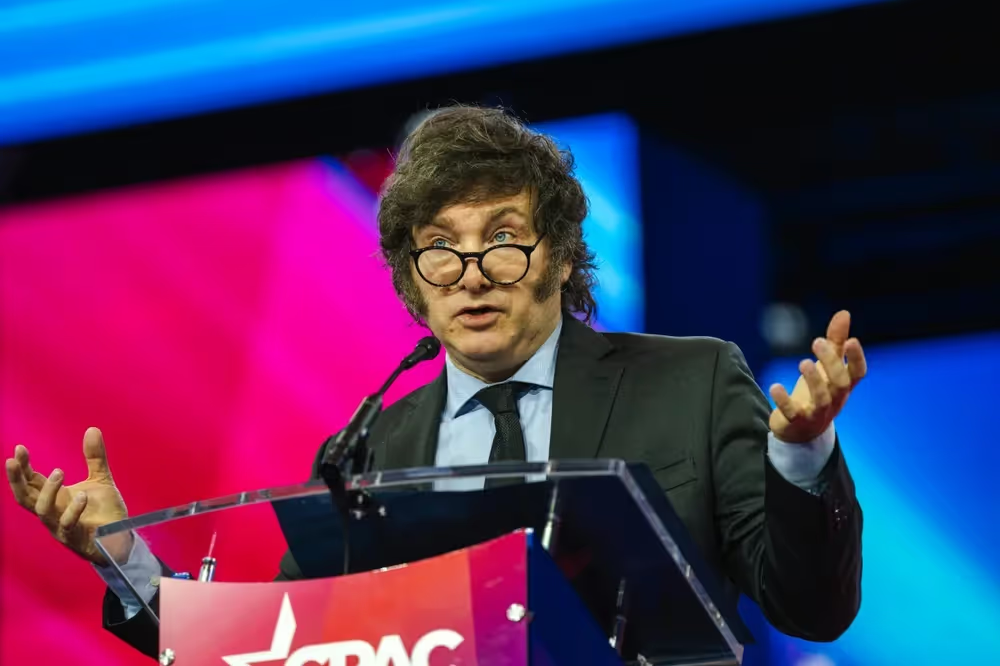
These examples above are just a few of the new or expanded efforts. The victory of Argentinean Javier Milei, an advocate of the free economy and national defense and an opponent of the 2030 agenda, has encouraged many like-minded groups not to give up on Latin America. CPAC, the organizer of the largest conservative meetings in the United States, has organized events in Argentina, Brazil, and Mexico. During the most recent CPAC, President Milei met with President Trump and announced that he was ready to pursue a free-trade agreement based on the reciprocity principles of the Trump administration.
Beyond the US, several organizations, especially those collaborating with Fundación Disenso and the Foro de Madrid (connected with the Vox party in Spain), and CEFAS, a University-based think tank also in Spain, are helping strengthen conservative groups.
To achieve better and more effective collaboration between leaders and organizations working for trade, security, and peace in the Americas, I recommend the creation of high-level diplomatic and strategic coordinator positions in the US government, tasked with identifying and collaborating with civil society actors that align with these principles. In addition, we need to help build a new consensus between conservatives and libertarians, respecting national and cultural differences while focusing more on what unites them. To work towards this goal in the United States, libertarian groups should adopt a less ideological and more bottom-up and pragmatic approach, and conservatives should pay closer attention to developments in Latin America. I am cautiously optimistic that we are moving in that direction.
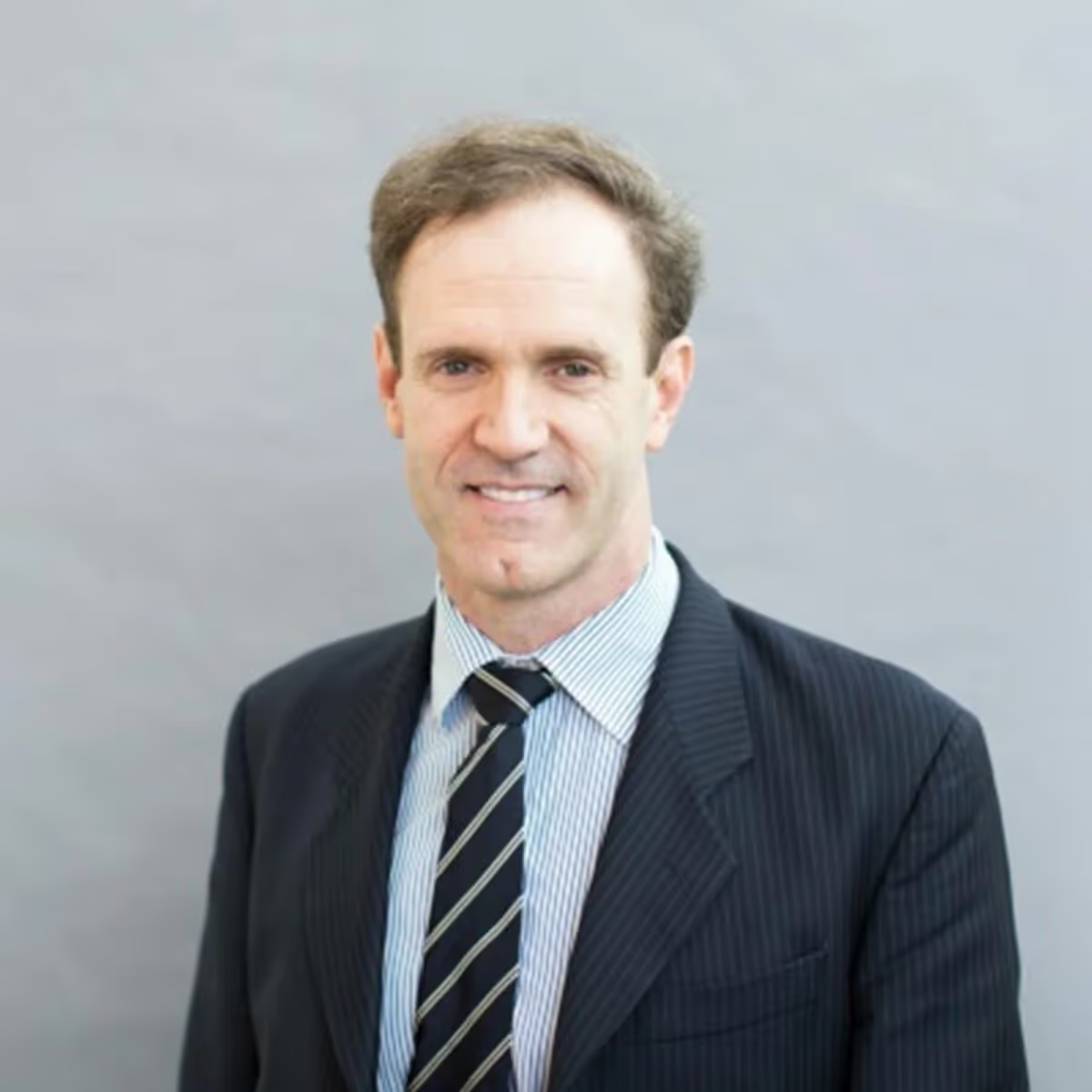
Alejandro A. Chafuen is Managing Director, International at the Acton Institute. He was president and CEO of Atlas Network from 1991-2018 and is Chairman of the Board of the Chase Foundation of Virginia.

The Twilight of Free Trade
Contrary to what is often believed—especially in Latin America—these countries stand to gain the most from a closer relationship with the United States.
Enhancing Trade, Security, and Peace in the Americas: The Role of Think Tanks
We need to achieve more effective collaboration between leaders and organizations working for trade, security, and peace in the Americas.
A US Trade Strategy for Latin America
There are ways in which the United States can reshape its economic relationships with Latin American nations to the mutual benefit of all parties.


.png)
Get the Civitas Outlook daily digest, plus new research and events.
Get the Civitas Outlook daily digest, plus new research and events.