Anger Management

The key concern that animates Turley’s Rage and the Republic is a fear of “democratic despotism.”
As we approach the official day marking America’s 250th, there is no shortage of new reading material on the Declaration of Independence and the American Revolution. Jonathan Turley’s Rage and the Republic stands out as a worthwhile addition to the growing list of books on the Revolution, despite its shortcomings, for its provocative presentation of the American Founding and its juxtaposition of the American and French Revolutions.
The key concern that animates Rage and the Republic is a fear of “democratic despotism.” In Turley’s view, this fear and the revolutions which give rise to it, are born of universal causes, embedded in human nature. This leads Turley to generalize more broadly than he probably should. In his words, we are all born with “the Saturn gene. We are all Saturn’s children with an inherent impulse that rests within each of us: the capacity of all mortals to become monsters.”
Turley is probably correct to identify an innate capacity of all human beings towards monstrosity. But he goes further: “All revolutions begin with noble aspirations of a people seeking ‘certain unalienable rights.’ If civil society is based on a ‘social contract,’ revolutions reflect a terminal breach of that contract in the failure of a government to perform its most essential obligations.” When that breach occurs, and leads to a revolution, an inherently unstable situation is created. Revolutions establish
not just the release of existing bonds but also the unleashing of pent-up anger, ambition, and avarice…The challenge is to put away the bayonets once the idea has taken hold. All too often in history, the rage has overwhelmed the reason for revolution as citizens are led forward at the tips of those very bayonets.
In too many cases, a revolution that starts with noble aspirations ends up in despotism, especially despotism of a democratic variety, as the revolution’s momentum causes its most radical adherents to wipe out all opposition to its singular idea.
As a historical matter, Turley is probably wrong in asserting that all revolutions are born of noble aspirations to secure unalienable rights. It is not necessary for him to argue this boldly, because Turley is really interested in two specific revolutions: the American and the French. Turley’s juxtaposition of the two revolutions is gripping and insightful. His central goal in discussing these two revolutions is to show how the tendency towards democratic despotism can be mitigated. Turley’s project, therefore, is Tocquevillian, a fact which he acknowledges throughout the book.
Turley begins with the American Revolution. Surprisingly, his account of the Revolution revolves around Thomas Paine, whom he identifies as its father. This actually turns out to be a pleasant surprise. Turley does not agree with John Adams’s famous description of Paine as “a poor, ignorant, malicious, short-sighted, crapulous mass.” Giving him his due, Turley paints Paine as an ultimately flawed but deeply principled thinker who played a central role in the American Revolution, though he was eventually carried away by his revolutionary ardor.
Thankfully, for Turley, Paine’s ardor was moderated by his soberer contemporaries. The most important of these contemporaries was James Madison. Paine “knew what it would take to turn a nation into a rebellion while [Madison] knew what it would take to turn a rebellion back into a nation,” according to Turley. “Where Paine was righteous rage, Madison was pious reason.” The key to the Madisonian design was moderating democracy’s excesses through a system that embraced faction and directed it “toward compromise and moderation.” The American Constitution managed to implement the Declaration’s ideals in practice by fitting them within a political structure that preserved minority rights and allowed political interests to check and balance each other.
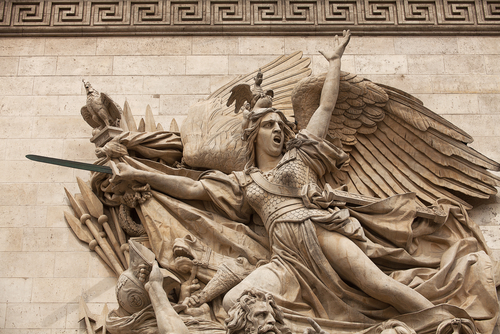
By contrast, the French Revolution followed “the very historical pattern that the framers sought to avoid and confirmed their worst expectations” about democracy. Provocatively, Turley argues that the Paine-Madison divide in the American Revolution was mirrored in France by “a similar dichotomous divide between two towering figures: Rousseau and Voltaire.” The problem in France is that Voltaire lost, and Rousseau won.
Turley’s account of the French Revolution is the peak of Rage and the Republic. He paints in fascinating and sometimes gruesome detail the excesses to which the people were carried by their revolutionary spirit. He also weaves Thomas Paine’s story into the narrative, showing how quickly a radical revolutionary can become a suspicious conservative “counter-revolutionary” when movements spiral out of control. Paine’s imprisonment and near-execution for the audacity to suggest exiling rather than executing Louis XVI offer a tragic illustration of the broader problems of Revolution itself. For Turley, the French Revolution was ultimately doomed because it did not incorporate Madison’s restraints on majority rule and protection of minority rights and factions.
After tracing the American and French Revolutions, persuasively describing the reasons for the former’s success and the latter’s tragedy, the third part of Rage and the Republic considers whether and how America can avoid democratic despotism in this century. It is understandable that Turley would want to apply the lessons of these two great revolutions to the problems of our own day, but this third part is less successful than the first two. At times, the diagnoses are insightful, especially the concerns about transnational governance and the economic threat of AI (a fear which preoccupies the author). Other times, however, the treatment is trite and formulaic: a vigorous defense of free speech, a few pages on Kelo, and a very thin discussion of the Constitution’s “structural elements.”
Turley’s gloss in this last part is distinctly libertarian. He criticizes those such as Mary Ann Glendon who argue that absolutist treatments of rights like free speech prevent dialogue and consensus-building, enabling people to assert their rights rather than offer reasons to persuade others. “The anti-free speech movement,” Turley argues, “is part of a rejection of classic liberalism that has long been the touchstone of American legal thought with its emphasis on individual liberty.” Turley claims that the First Amendment “was a rejection of the fluid Blackstonian views of free speech that allowed for the criminalization of harmful speech.” The current assault on free speech, in Turley’s view, constitutes a clear and present danger that must be combated: “the emphasis on individual rights will be even more important in the coming decades. Those ‘excessively individualistic’ rights are precisely what can protect against tyranny of the majority….We must, in other words, re-embrace ‘big, fierce’ rights to withstand the regressive efforts of many in our society.” Interestingly, Turley’s emphasis on “big, fierce rights” approximates Paine more than Madison. Rather than emphasizing structural restraints, Turley’s legal focus downplays the constitutional structure and goes straight for the fundamental rights.
Turley similarly emphasizes the influence of Adam Smith’s “laissez-faire economics” which served as “the perfect fit for a system that emphasized individual choice and rights.” He advocates a “liberty-enhancing economy,” though in the case of economics, he seems more open to government interventions and an economic safety net. His primary concern is what will happen when AI and robots make it such that “fewer humans are involved in production or industry.” A society of people who are “largely idle, primarily consumers rather than producers” can lead to “static, idle citizens” who become a “kept citizenry.” In order to prevent this, Turley advocates, “we must explore avenues for exploration and identification for citizens,” especially in education and the arts. He does not anticipate that AI could lead to more jobs in areas and tasks that we haven’t considered or understand yet, which has been the typical path of economic innovation. Instead, he predicts that “this new revolution may not see the same shifting of labor as much as the elimination of labor” altogether.
Ultimately, Turley’s policy prescriptions feel a bit out of place compared to the loftier and more gripping discussion of the great revolutions that occupy the first two parts of Rage and the Republic. Rage and the Republic offers an excellent account of the American and French Revolutions that emphasizes both their similarities and critical differences. While those revolutions do not offer clear policy programs that directly address our twenty-first century problems, they are worth reflecting upon, especially as we near the 250th anniversary of the first Revolution in which Thomas Paine played a central part.
Joseph Postell is Associate Professor of Politics at Hillsdale College.

Anger Management
Jonathan Turley’s 'Rage and the Republic' stands out as a worthwhile addition to the growing list of books on the Revolution.
.jpg)
Ivy League Miseducation
Stefanik is not wrong at all in pointing out what ails higher education. However, her scope is extremely limiting, and her approach rather superficial.
.jpeg)
The Declaration Is a Metaphysical and Political Triumph
It is the nature of genuinely lasting great texts that we observe new things in them that fit our moment.




Get the Civitas Outlook daily digest, plus new research and events.
Get the Civitas Outlook daily digest, plus new research and events.