From Milton Friedman to Alexander Hamilton: Why J.D. Vance’s Economic Vision Needs James Madison
.avif)
The alternative to Friedman cannot simply be Hamilton without Madison.
“American economic policy on the right is now much more Alexander Hamilton than it is Milton Friedman,” Vice President J.D. Vance recently said in an interview with Michael Knowles. The claim matters because it points to a deeper change in how many conservatives think about markets, government, and the economic foundations of national life.
Milton Friedman, who received the Nobel Memorial Prize in Economic Sciences in 1976, was one of the twentieth century’s most influential economists and the leading public voice of the Chicago School. He defended markets partly because they allocate resources well, but also because they disperse power. Markets allow people with different values and ways of life to cooperate without reaching political agreement about shared ends. They reduce the number of choices made through politics and limit the ability of political majorities and officials to impose their will on others.
Alexander Hamilton represents a different economic tradition, one that gives government a larger, more energetic role in shaping the country’s productive structure. As Secretary of the Treasury, he sought to strengthen the new republic through public credit, federal assumption of state debts, a national bank, and support for manufacturing. In the Report on Manufactures, he defended duties, bounties, patents, and public improvements intended to foster domestic production.
Vance’s characterization of a shift from Friedman to Hamilton captures a turn already visible on the right. Some Republicans increasingly support tariffs, industrial policy, public investment, and measures to rebuild domestic manufacturing and reduce strategic dependence. Some have even entertained direct federal ownership stakes in leading AI companies, a proposal that would have been difficult to imagine within the older Republican commitment to limited government and private ownership. A party once defined largely by low taxes, deregulation, and free trade now increasingly looks to economic policy to strengthen national capacity, local communities, and the country’s productive base.
Vance suggests that Friedman’s ideas made more sense in an earlier America, when a “rich and powerful institutional Christianity” surrounded economic life and provided what he calls “Christian guardrails.” Churches, families, schools, and communities placed moral limits on market behavior and cultivated habits such as trust, honesty, self-command, responsibility, and concern for future generations. People understood themselves as parents, spouses, neighbors, congregants, and citizens as well as consumers and workers. Those roles restrained what they were willing to buy, sell, demand from employees, or sacrifice for economic gain. Vance now argues that the government should step in and provide a form of moral guardianship, ensuring that American citizens are not swallowed by markets operating without moral boundaries.
But in making this argument, Vance ignores the dangers that arise when the weakening of moral guardrails is used as an argument for expanding political power. Vance’s remarks point toward a political temptation: as Christian institutions lose influence, conservatives may ask the government to direct economic and social life toward stronger families, better work, national solidarity, or moral renewal. Yet the conservative alternative should not simply be to use the state for better ends. It must distinguish between public power that supports self-government and public power that displaces it.
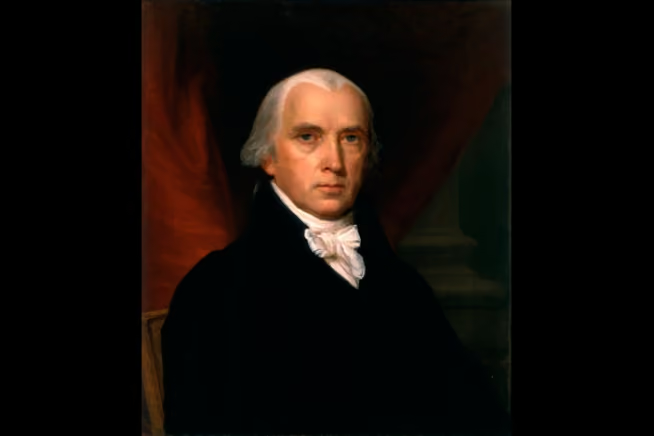
That distinction points directly to James Madison. Hamilton’s coauthor in The Federalist focused on faction, ambition, and the problem of controlling power. In Federalist 10, Madison defined faction as a group of citizens united by an interest or passion adverse to the rights of others or to the lasting interests of the community. Political conviction, economic interest, and even religious zeal could all become sources of faction. Appeals to faith, family, workers, or national renewal did not remove the danger that a coalition might use public power to advance its own interests.
Madison’s famous warning in Federalist 51 follows from the same insight: “If men were angels, no government would be necessary. If angels were to govern men, neither external nor internal controls on government would be necessary.” Government is needed because people are imperfect, yet it is run by imperfect people. Moral guardrails, Christian or otherwise, cannot substitute for institutional limits on those who wield public power. Madison therefore supplies the missing counterpart to Vance’s argument. If weakened churches, families, and communities make a more active government seem attractive, they also make checks on that government more important.
Milton Friedman’s contemporary, James M. Buchanan, brought Madison’s concerns into modern economics. Buchanan, who earned his Ph.D. at the University of Chicago while Friedman was beginning his long tenure there, later received the 1986 Nobel Memorial Prize and helped found public choice theory. Buchanan’s distinctive contribution was to analyze politics without assuming that public officials pursue the common good more faithfully than people pursue their own interests in markets. Firms seek subsidies and protection, politicians seek support, agencies seek larger budgets, and voters often pay little attention to costs spread thinly across the public.
That perspective is especially relevant to the right’s Hamiltonian turn. Tariffs, industrial policy, and subsidies tend to create concentrated benefits for firms and industries that have strong incentives to organize in their defense, while distributing their costs among consumers, taxpayers, and downstream producers. Policies introduced as temporary responses to national needs can therefore become durable privileges. Programs intended to support families, churches, or communities can also make those institutions dependent on the officials who set funding rules and eligibility requirements. Buchanan’s response was to shift attention from particular policies to the rules governing political choices. Rules chosen before winners and losers are known are less likely to be designed around the demands of favored groups. A conservative economic program should rely on general laws rather than negotiated favors, legislative authorization rather than broad administrative discretion, and limits established in advance rather than improvised for favored groups.
That approach should make conservatives especially wary of industrial policy that lets firms present private advantage as national necessity, tariffs that shift costs onto consumers and downstream producers, and programs that make families, churches, schools, or local associations more dependent on officials who control funding and eligibility. Citizens should be able to see who benefits, who pays, and when a policy will end or be reconsidered. Vance’s rhetoric evinces little concern for these well-known consequences and burdens, which, in many respects, could harm the very families and local institutions he wants to help.
Loftily stated goals do not remove the risks of concentrated benefits, dispersed costs, and political capture. If conservatives abandon Friedman’s suspicion of state power without replacing it with a serious theory of constraint, they may exchange one half-truth for another. They will have learned that markets can fail society, but forgotten that politics can fail it too. The alternative to Friedman cannot simply be Hamilton without Madison.
Carola Binder is an Associate Professor of Economics at the University of Texas at Austin in the School of Civic Leadership, and is a senior fellow at the Civitas Institute.

From Milton Friedman to Alexander Hamilton: Why J.D. Vance’s Economic Vision Needs James Madison
Loftily stated goals do not remove the risks of concentrated benefits, dispersed costs, and political capture.

On Debt: Two Honest Measures, Two Different Questions
A response to Thomas Savidge's '“Full Faith and Credit” Means a Claim on America.'

Adam Smith, Economist of the American Revolution
Clear-eyed economic thinking remains one of humanity’s most powerful instruments for understanding our problems and advancing our possibilities for improvement.




Get the Civitas Outlook daily digest, plus new research and events.
Get the Civitas Outlook daily digest, plus new research and events.