
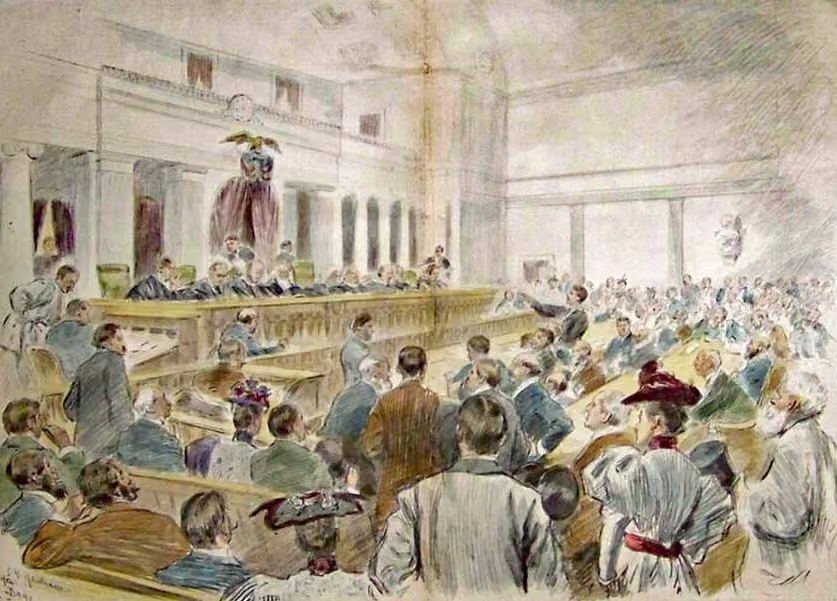
How to Shorten SCOTUS Oral Argument

The length of oral argument has exploded in ways that may hinder its functions.
I love oral argument, but many question whether it matters all that much at the U.S. Supreme Court. After all, the Justices spend hours upon hours thinking about cases in advance of argument and then spend a great deal of time after argument in back-and-forth communications with their colleagues and clerks. The Justices also receive lengthy written briefings from the parties and outside groups and usually benefit from well-crafted decisions by multiple lower court judges. After reading hundreds of pages of analysis and sometimes conducting massive amounts of independent legal research, it is unsurprising that oral argument usually does not make that much of a difference when the Justices decide cases. For example, Justice Clarence Thomas once was asked “[h]ow often does your mind change during an oral argument?” His answer: “Almost never. You can go whole terms without it ever changing.” Nor, by his account, is he alone. According to Thomas, oral argument changes his colleagues’ minds’ only “in 5 or 10 percent of the cases, maybe, and I’m being generous there.” Oral argument may be flashy, but it is easier to convey complex ideas in writing.
True, oral argument may matter in some cases, but even then, perhaps not in the bottom-line outcome of who wins or loses. Instead, “the Court writes an opinion in a particular way based on the argument.” This too should be unsurprising: “[C]ases don’t necessarily go up to the Court with an either/or component. There are many shades of gray, many different rules the Court could adopt, and many different doctrinal pathways it might follow.” Although Justices spend a lot of time preparing for each case, they may not have thought through all those second and third level complications. Oral advocacy may help navigate those complications.
In other words, even when oral argument matters at all, it rarely is the main event in the Court’s decision-making process. Rather, as Chief Justice John Roberts has explained, “oral argument is the tip of the iceberg—the most visible part of the process—but the briefs are more important.”
Yet although most of the work is done by the Justices in quiet offices away from the microphones, the public often focuses on oral argument. There are reasons for this, too. For one, even if oral argument is not the most important part of the process, it is the most visible to outsiders. For another, oral argument comes with pomp and ceremony. Walking into the Supreme Court can be an awesome experience. Oral argument thus serves, at least to some extent, a “legitimizing function.” It is an opportunity for the public to see the Justices at work and to experience (for want of a better word) the law. Reading the Court’s work product is the best way to understand what is going on and why, but for many people, pageantry and symbolism are important, too.
The relationship between these functions—oral argument helps the Court get the law right and offers the public a window into the Court’s operations—is complicated, especially when they are in tension. I share the apprehension, for example, that if oral argument were televised, it would not be as helpful for decision-making. As Justice Elana Kagan once said, “I think we would filter ourselves in ways that would be unfortunate.” Or as Justice Samuel Alito put it, “I think lawyers would find it irresistible to try to put in a little soundbite in the hope of being that evening on CNN or Fox or MSNBC or one of the broadcast networks and that would detract from the value of the arguments in the decision making process.” Put differently, the Court’s most important function is getting the law right.
In recent years, the length of oral argument has exploded in ways that may hinder both of its functions. During the tenure of Chief Justice Rehnquist, oral argument was essentially always an hour—and not a moment longer. Indeed, he “severely limited oral arguments to 30 minutes a side and was quite strict about it. He was once said to have cut off an advocate when the red light went on in the middle of the word ‘of.’” Now, however, oral arguments have stretched on average to almost twice as long. As Amy Howe from SCOTUSBlog reports, “the general rule that reporters in the press room have adopted to figure out how long an argument will actually last is to take the time allotted for the argument—normally one hour—and double it, especially if there are more than two lawyers arguing.” This increase in argument length may cause the Justices to be “less engaged.” It also makes it harder for the public to take in the entire experience.
There are at least a couple of overlapping explanations for this development. First, the Court hears oral argument in less than 60 cases a term; decades ago, the number was closer to 150. Although the Court now also spends a great deal of time resolving cases on “the emergency docket” (which often do not receive oral argument), the downtick in overall caseload means the Court can (and does) spend more time on each argued case. And second, the Court has introduced a seriatim round of questions. After the ordinary argument period, during which all the Justices can ask questions, each Justice is given time to question the advocates individually, without disruption from their colleagues. This seriatim round began during COVID, when oral argument was done over the phone, but continued afterward.
At least some of the Justices are unhappy with the length of oral argument. Last month, I interviewed Justice Alito during the Judicial Conference of the U.S. Court of Appeals for the Fifth Circuit, and (quoting Howe’s account), he lamented that oral arguments sometimes extend “past the point where they are contributing to the decision-making process.” Chief Justice Roberts, too, reportedly believes “the new oral argument format has ‘blown up’ and is ‘too long’ and the court might revisit it this summer.” And a few years ago, Justice Neil Gorsuch also expressed displeasure during oral argument itself about its length.
My sense is that these views are broadly shared by those who follow the Court: arguments take too long. But what should the format look like instead?
Unfortunately, any answer must be impressionistic—what makes for an effective oral argument process is not easily measured. It is also hard to create a bright-line rule because sometimes more time is helpful and sometimes it is not. It is hard to defend Rehnquist’s 60-minute hard limit; sometimes a case is especially complicated, and more questions are helpful. But it is also hard to defend the Court’s current approach. Unless checked, oral argument risks devolving into the worst kind of faculty meeting—one where everything has been said but the meeting does not end until everyone says it. What’s more, we are talking about a multi-member body. Different justices will disagree about whether a particular case warrants additional argument time and, if so, how much.
Here’s my proposal: Why not give the Justices an allotment of “extra” time to spend as they will across the term? For every case the Court hears, each Justice receives, say, two minutes. So, if the Court hears 60 cases a term, that would be 120 minutes of personal time per Justice. If a Justice thinks a case warrants additional questions, he or she can use more personal time on that case. But if a Justice thinks a question has already been asked by someone else or is not especially important, there is an incentive to save time for a future case. If necessary, the Court could also decide that no one can spend more than a certain number of minutes of personal time in any one case. The result should be greater care in asking questions. In fact, I suspect that the self-discipline of watching a clock would lead many Justices to use nowhere near all their personal time.
My suggestion is imperfect. Logistically, it should not be especially difficult, but it is a change—someone would have to keep the clock. It is also blunt; perhaps some questions should be asked even if time has run out. And maybe the public would misunderstand. For example, if a Justice does not use minutes in a particular case, some observers might infer that the case is unimportant rather than that additional questions would not help the decision-making process. Any solution here will have downsides. But letting each justice decide whether a case warrants additional questions should be an improvement, so long as good incentives are in place. For decades, the Court did just fine with 60 minutes arguments—not every case warrants an exception from that practice.
Of course, there is another option. The Court could grant review in a lot more cases. Parkinson’s law holds that “work expands so as to fill the time available for its completion.” So, if oral argument is dragging on too long, perhaps the answer is to decide more cases and see if the problem takes care of itself. Advocates, I suspect, would prefer this option. But if the Court is not going to solve the problem organically, why not try personal questioning time?
Aaron L. Nielson is a senior fellow at the Civitas Institute and holds the Charles I. Francis Professorship in Law at the University of Texas at Austin School of Law.

.jpg)
The Best Escape from the U.S. Attorney Mess
The process for appointing U.S. Attorneys is sputtering, but there is a way out of this mess.
Fighting Anti-Semitism from the Bench
Judge Roy Altman wrote "Israel on Trial" not as a judge, but as an American who loves this country.
Justice Gorsuch’s Warning
'Slaughter' may have rid us of the headless fourth branch of government, but it might end up leaving us with an all-powerful presidency.




Get the Civitas Outlook daily digest, plus new research and events.
Get the Civitas Outlook daily digest, plus new research and events.