A Permission Structure for Violence

Noah Rothman's book Blood and Progress is a gritty survey of political violence that prompts readers to consider the broader American story.
Political violence is on the rise. That in itself is a concern, but perhaps more worrisome is the reaction to that violence. Enter National Review’s Noah Rothman, who has been writing about left-wing political violence long before Luigi Mangione murdered insurance executive Brian Thompson, the 2025 assassination of Charlie Kirk, or the three assassination attempts against President Donald Trump.
In his new book, Blood and Progress, Rothman addresses both violence and the reactions to that violence. (Full disclosure: Rothman is a friend.) As the subtitle – “A Century of Left-Wing Violence in America” – suggests, Rothman is primarily focused on violence from the left. However, he is clearly cognizant that political violence arises from all quarters. Admirably, Rothman seeks to look at the root causes of left-wing violence – the permission structures that fail to sufficiently condemn violent acts and the deliberately restrained cues that seem to encourage it. Here, he feels – with some justification – that the left is indeed more guilty than the right.
Rothman, a veteran journalist, editor, and podcaster, notes that violence on the right gets plenty of attention: “The commanding heights of American culture, politics, and law do not need to be goaded into the noble work of containing right wing political violence. That’s the sort of threat to which they’re already tuned and for which they are forever scanning the horizon.” In contrast, and here is the main point of the whole book, it’s an “observable fact” that “the American left—too often, fringe and mainstream alike—either refuse to confront or are disconcertingly comfortable with a certain level of domestic political violence.”
To provide much needed balance in this debate, Rothman conducts a broad historical survey of political violence in America dating back to the early twentieth century. This effort includes close looks at the anarchist terror bombings in the 1910s. After Attorney General A. Mitchell Palmer was almost killed by one such bombing, he initiated a series of raids – known as the Palmer raids – in 36 different cities, arresting 6,000 people.
Fortunately, left-wing violence calmed down somewhat in the 1920s, but, as Rothman shows, political violence never recedes totally in the U.S. According to Rothman, “It would be wrong to call the decades that followed the anarchist terror a peaceful time in American history. Indeed, it would be hard to identify any time in American history that was bereft of civic friction and some accompanying level of political violence.”
But as we know all too well, some eras are worse than others. The shared national response to the Great Depression, World War II, and the beginning of the Cold War tempted many to conclude that political violence was a thing of the past. Unfortunately, the 1960s disabused everyone of that notion. This is where Rothman’s survey takes off, as he considers the intellectual and cultural climate that seemed to promote, or at least to forgive, political violence.
Rothman recounts a familiar list of shocking violence from the 1960s, but does the all-too-rare work of connecting many of them to what was then the American left. We had the assassination of John F. Kennedy (by an attempted defector to the Soviet Union) and Robert F. Kennedy (by a Palestinian terrorist, the first Palestinian terror attack in the United States). In addition, there were urban riots every summer during Lyndon Johnson’s presidency, and leftist terror groups like the Weathermen terrified Americans by bombing key institutions. Rothman quotes an FBI agent who lamented, “There was a sense that these guys might go on doing this, the bombings, literally forever.”
At the same time, dangerous justifications for violence were emerging as well. As Rothman explains the thinking from some on the left, “The race riots. The police violence. The attack at the Chicago convention. The war. The draft. All of it prosecuted by American law enforcement on orders from American elected officials and spectated by the utterly indifferent American people. To the radicals, it was a comprehensive indictment of the United States.” Using this logic, some elements of the leftist group Students for a Democratic Society adopted a new and terrifying approach: “The United States had declared war on them. It was time to fight back with equal ferocity.”
Radicals making these kinds of dangerous determinations were further enabled by other forces with their own interests in promoting or at least turning a blind eye to violence in America. Rothman shows how some of the radicalism infecting our lives today has its origins in the Soviet Union agitprop against the West. These deep roots poisoned the soil of anti-Western and anti-American feelings, including anti-Israel sentiments. As Rothman describes it,
“In Soviet academe, such as it was, ‘Zionology’ became the subject of study. Zionism was declared a ‘world threat’ typified by ‘militant, chauvinism, racism,’ and ‘anti-communism,’ Soviet researchers maintained. It was an ‘antihuman, reactionary movement’ and exporter of the evils of ‘colonialism and neo colonialism.’ The KGB took its new mandate and ran with it.”
Regrettably, this madness is felt today in open antisemitic statements and violence.
In addition to troublemaking from the Soviet Union, things got worse in 1979 after the mullahs took over in Iran. Rothman shows that “The Soviet Union and the Islamic Republic had a conflictual relationship from the start, but the new Iranian regime’s blending of elements of Marxist theory with Islamist characteristics proved useful to international socialism’s devotees.”
Of course, we had intellectuals hyping bad ideas on American college campuses as well. These included the German thinkers from the Frankfurt school, most notably Herbert Marcuse, the advocate of “repressive tolerance.” According to Rothman, Marcuse’s “philosophy prescribed ‘intolerance against movements from the right’ and ‘toleration of movements from the left.’” As Rothman notes, “You don’t get more explicit than that.” It was a theorized version of no enemies to the left.
Even after the 1960s storm abated, those who engaged in violent behavior were far too easily rehabilitated or, as Rothman puts it, “welcomed back into polite society.” Members of the violent terrorist group the Weather Underground, such as Bill Ayers, Mark Rudd, and others, were not only allowed to return but also received positions teaching the next generation, which seems unwise for a society to do. Underground co-founders Ayers even became a friend and sometime adviser to Barack Obama. After Obama biographer David Garrow interviewed a former Weathermen terrorist – presumably Ayers -- he recalled that, “I am taken aback by just how easy it is to pal around with terrorists.”
Foreign actors, leftist intellectuals, and rehabilitated terrorists found additional partners in cultural icons who celebrated violent actors on the left. Cop killer Mumia al-Jamal has gotten support from “leading cultural lights” such as Martin Sheen, Susan Sarandon, and Bonnie Raitt. The celebrity supporters of Leonard Peltier, who murdered an FBI agent, included Nelson Mandela, Steve Van Zandt, and Louise Ehrdrich. Perhaps worst of all is the succession of Democratic presidents, including Jimmy Carter, Bill Clinton, Barack Obama, and Joe Biden, who have pardoned or commuted the sentences of those engaged in left-wing violence.
All these efforts have created a tragic permission structure that too often justifies and excuses violent behavior from the left. These fellow travelers are united by a dangerous belief: that left-wing political violence is a form of speech, whereas right-wing speech itself is a form of violence. We saw this belief illuminated by the raging infernos of 2020, which cost $1-2$ billion in property damage and more than two dozen deaths. Rothman calls that annus horribilis a “demonic year,” while left-wing leaders, including the then mayor of Seattle, called it a “summer of love.”
While Rothman convincingly demonstrates with over a century of examples that the left has a greater permission structure for violence, to his credit, he doesn’t let the right off the hook. He rightly criticizes the January 6 riot at the Capitol. Political violence is unacceptable, and the only way we can hope to eliminate it is to have people on both sides of the aisle condemn it, regardless of who engages in it.
Blood and Progress is a gritty survey of political violence that prompts readers to consider the broader American story. The brilliance of the system the Founders created is that it provides a multitude of ways to divide power, limit government, and resolve serious doctrinal and policy differences via deliberation and the ballot box. Unfortunately, those who resort to violence don’t see it that way. They want to circumvent our processes to advance their political goals or exact political revenge. They also fundamentally lack gratitude, which makes them all too eager to tear down any society that does not conform to their ideology, even, or especially, if it happens to be their own. The purveyors of violence on the left lack gratitude for Western civilization, rights, or the cost of freedoms. It is that lack of gratitude, coupled with the Rousseauian belief in the perfectibility of man and the corruption of institutions, that opens the door to violence. Rothman’s important mission is to undercut the ideological arguments of those who would justify such an approach.
In his conclusion, Rothman tells us that it’s not enough to personally eschew violence. As a society, we must condemn and punish it as well, wherever it comes. His final words must be taken to heart if we want to avoid another flare-up like the 1960s or the “demonic year” of 2020: “Until we summon the courage to respond to political violence with consistency, the cycle will continue, and violent street action will become a feature of American public life. We should expect it.”
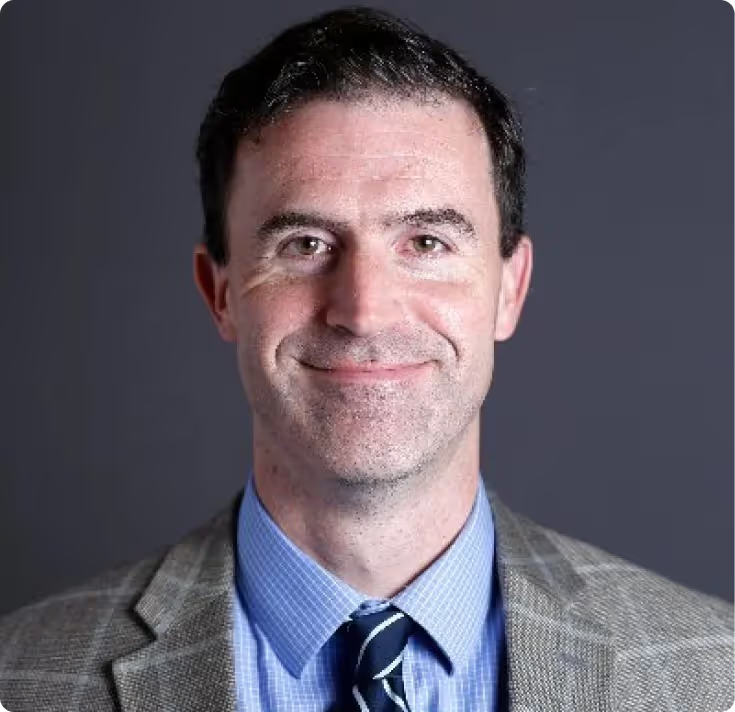
Tevi Troy is a senior fellow at the Ronald Reagan Institute and a senior scholar at Yeshiva University’s Straus Center. He is the author of five books on the presidency, including, most recently, “The Power and the Money: The Epic Clashes Between Commanders in Chief and Titans of Industry.”

Introducing 'The Civitas Collection 250'
We hope that you, the reader, will deepen your understanding of the Declaration and develop greater devotion to this remarkable country we have been called to uphold and cherish.

Adding Friction to Rushed Federal AI Governance
We don’t want federal policy regarding AI made in Sport Mode.
“Birthright Citizenship” an Invented Tradition?
To truly reopen debate on this issue, it is important to recognize that neither “birthright citizenship” nor “jus soli” was part of the legal world that gave rise to the Fourteenth Amendment.


Get the Civitas Outlook daily digest, plus new research and events.
Get the Civitas Outlook daily digest, plus new research and events.