The Common Law and Citizenship in the Constitution: A Response to Linda Denno

Those who support Trump’s anti-birthright executive order have failed to produce definitive historical evidence from the founding, the antebellum period, and the ratification history of the Fourteenth Amendment to overturn the long understanding of citizenship as based on birthright.
Professor Linda Denno urges the Supreme Court to grant a rehearing in Trump v. Barbara to correct its allegedly manifest errors of constitutional interpretation. The chances of that are less than the chances that the New York Mets will win the World Series this year; or that Joe Biden will return as the 2028 Democratic presidential candidate; or – you get the idea.
The reason why the Court will not be reversing itself is not just because the Court almost never grants petitions for rehearing. It is because the majority made no mistakes that demand a rehearing of the case. Instead, the majority and dissent differ on the best method to answer a constitutional question on which the text is not clear. Professor Denno would fill this constitutional ambiguity with a political philosophy that does not govern legal interpretation. The majority instead used standard approaches to answer the question whether the Fourteenth Amendment changed the standard for recognizing birthright citizenship.
To begin, I assume that Professor Denno agrees that policy concerns should not dictate the answer to the question of constitutional interpretation. For example, the argument that “the Court’s expansive definition of birthright citizenship incentivizes illegal immigration and “anchor baby” strategies, undermining the nation-state,” may or may not be true, but it does not change the proper interpretation of the Constitution. If the Founders adopted a constitutional provision with a clear meaning, even if it advances a policy that does more harm than good, we must still follow the original understanding.
I believe Professor Denno further agrees that the original understanding of the Constitution, not external considerations, such as economic, social, or political theory, should govern interpretation. If the Constitution adopts a provision that is immoral under her preferred political philosophy, we must still follow the original understanding. The constitutional text permits the government to impose the death penalty. Even if we personally disagree with the morality of the state putting a convicted felon to death, we cannot interpret the Constitution to prohibit capital punishment. Or, to put it more controversially, the original Constitution allowed states to permit slavery. Although it violated the most fundamental of individual rights, even Abraham Lincoln had to promise that, as President, he would not interfere with slavery in the states where it already existed.
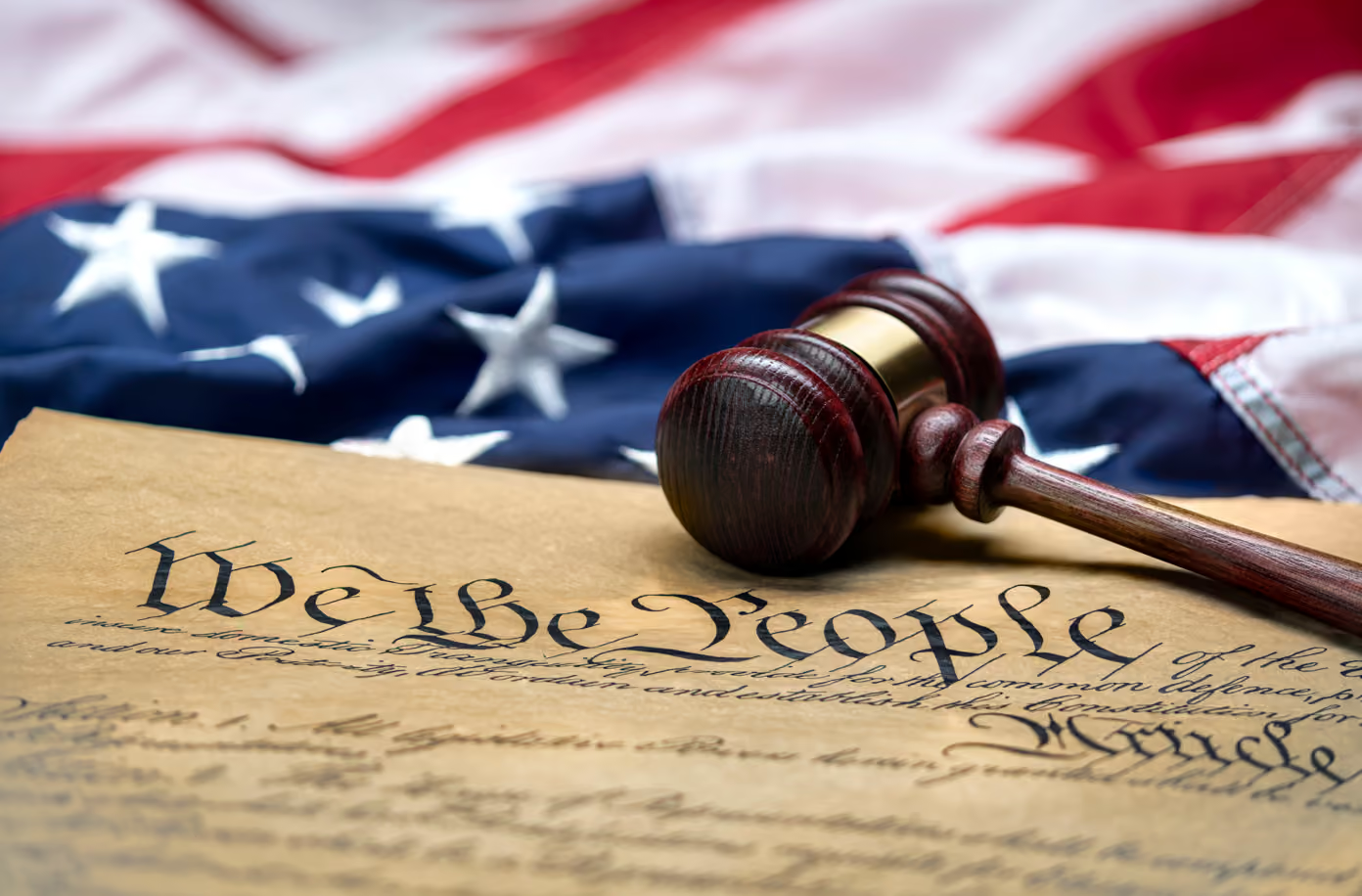
Thus, the answer to whether the Fourteenth Amendment makes any baby born on American territory a citizen, regardless of whether the parents are in the country legally, depends solely on the best reading of the constitutional text. The Fourteenth Amendment simply declares: “All persons born or naturalized in the United States, and subject to the jurisdiction thereof, are citizens of the United States and of the State wherein they reside.” The case for birthright citizenship is straightforward. The text of the Fourteenth Amendment, the historical record of its drafting and ratification, the common-law tradition it incorporated, and 127 years of Supreme Court precedent all support birthright citizenship. The Fourteenth Amendment text sought to codify the traditional American and British rule that the place of birth determined citizenship on the one hand, and to remove the great stain on that principle: the prohibition of slaves from citizenship. No Congress, no President, and no Supreme Court appear to have ever denied American citizenship to a baby born on American territory, except for the case of Indians – who are specifically excluded by the constitutional text.
I believe the fatal flaw in Professor Denno’s argument is that she would elevate political philosophy above the original understanding of the constitutional text. She argues, in brief, that our nation is built on a social compact formed by the consent of individuals with inherent natural rights. She claims that Americans rejected the British theory of the relationship between the sovereign and the subject, which Professor Denno dubs “perpetual feudal allegiance” created by simple birth on the sovereign’s territory. She writes:
Where the Court is badly and profoundly mistaken is in its ahistorical and wholly inaccurate assertion that such subjectship was the basis for citizenship once the United States declared their independence from Great Britain. The former colonists stated unequivocally that their ‘separate and equal station’ entitled to them by ‘the laws of nature and nature’s God’ absolved them ‘from all Allegiance to the British Crown.'
Denno believes that the Declaration of Independence’s citation of natural rights and natural law means that citizenship must be consistent with natural rights theory. She does not clearly explain whether this natural rights theory is that of the philosophers of that time (Thomas Hobbes and John Locke) or of today (John Finnis, Harry Jaffa), or even whether there is any disagreement between the two. It appears that she believes natural rights theory demands that citizenship must arise from the consent of both the state and the wanna-be citizen. She writes, “[c]itizenship derived from choice, deliberation, and social compact—not accident of birth.” She appears to conclude, therefore, that the child of illegal aliens cannot be a citizen because of the parents’ violation of immigration law – this appears to be tantamount to society refusing its consent to the child joining the American polity.
Even if this were the governing theory, it seems to beg the question. If the Fourteenth Amendment recognizes that birthright citizenship is the governing rule, that would qualify as the consent of society. But Professor Denno has not yet proven that natural rights must govern where the Constitution is silent. Both Professor Denno and I agree that there is no positive law in the original Constitution that dictates a rule of citizenship–that would not come until the Fourteenth Amendment. The constitutional structure generally requires that, where the text does not grant a power to the federal government, the states should govern. That leads me to agree with the Barbara majority that the determination of citizenship during the antebellum period was for the states to decide. Professor Denno believes that political philosophy, not the states, sets the rule because that political philosophy gave rise to the Declaration of Independence.
I do not think it is so easy to quote the famous passage about the right to “Life, Liberty, and the Pursuit of Happiness” and then claim that natural rights theory must supply the answer to every question left open by the constitutional text. But it is not clear what those natural rights are, why and when they may override constitutional structures – such as federalism and the separation of powers – and whether there must be agreement in society to adopt natural rights as governing philosophy. Suppose the Framers did not share a consensus that natural rights, whatever their content, should act as a governing philosophy that would automatically fill in the gaps left by the constitutional text. Professors Gordon Wood and Bernard Bailyn, the leading historians of the American Revolution of the last half-century, have shown that the colonists rebelled not out of an attachment to abstract natural rights, but because of an almost paranoid belief that the British were imposing tyranny. Even if Professor Denno were to deny the weight of these historians’ work on the ideological origins of the Revolution and the Constitution, she has not shown that the Framers would have agreed that the content of natural law should prevail over the separation of powers and federalism limits on the powers of the national government in general, and of the judiciary in particular.
If Professor Denno’s interpretive maneuver were applied, it would override the Constitution’s location of the primary policymaking authority in the states. She would instead transfer power from our decentralized state-based system to federal judges. A similar exercise would find that the Supreme Court erred in the recent BPJ case, which found that states retained the authority to ban transexual men from participating in women’s sports. Instead, the Court should have made clear that the Constitution does not recognize transgender rights at all, since natural law would not permit the existence of anything other than biological sex as determined at birth. The Court not only should have rejected the idea that the Constitution required gay marriage, but it should have prohibited states from recognizing the practice, since gay marriage violates natural rights. Dobbs was a mistake too, because it overruled Roe v. Wade but allowed states to permit abortion; natural law would seem to require that the Court interpret the Constitution to ban abortion nationwide.
But instead of imposing such a national rule, the Constitution, as it does in these areas, left citizenship originally up to the states. This is why the majority is correct to conclude that citizenship was determined by the common law rule of birthplace. This is not because, as Professor Denno appears to believe, the Court erred in imposing the mysterious, feudal ideology of the common law upon the true natural rights system of the Framers. Instead, the states were free to adopt their own approaches to determining citizenship – and they all used this discretion to adopt the common law rule of birthright. This is not all that remarkable: upon independence, the states enacted laws that incorporated the British common law. After all, the common law had been the law of the colonies before independence, and without continuing it in existence, the states either would have had to pass law after law to adopt the common law rules one by one or invite legal chaos. If we must reject birthright citizenship because the common law somehow conveys a feudal system of belief at odds with natural rights and the Declaration, we must also reject all the other bodies of common law, such as the laws governing contracts, torts, property, and criminal justice. But we don’t reject them; in fact, much of this allegedly feudal law continues to govern the everyday conduct of every American to this day. The common law was not a political ideology, as Professor Denno would have it; rather, it was the foundation of the Anglo-American legal system.
The radicalism of Professor Denno’s argument is not even accepted by the dissenters in Barbara. Writing for the dissent, Justice Thomas does not advance a broad argument based on the revolution in political theory that she theorizes. He does not argue that the United States, upon independence, rejected the birthright rule of the common law because it conflicted with natural rights and the idea of a social contract. Instead, Justice Thomas accepts that the states adopted the rule of citizenship and, like the majority, sees the Fourteenth Amendment as codifying that rule to overrule Dred Scott. The dissent’s argument is that the majority has erred in its definition of the common law rule. Justice Thomas claims that the common law rule was one of birthplace plus domicile – domicile refers to the intention to remain as a resident in a state. But the federal structure of our Constitution still reserved to the states, not an omnipresent, mandatory, natural law, the authority to set the rule of citizenship.
Because of this acceptance of the common law and federalism, Justice Thomas’s narrower dissent finds potential common ground where Professor Denno sees only chasms. Justice Thomas argues that the birthright-plus-domicile rule rules out the children of temporary visitors from citizenship. But he does not argue that his rule would ban the children of illegal aliens who do in fact reside in the United States. In a critical footnote, he says: “Because this case presents a facial challenge and no one disputes that lawful temporary visitors and some illegal aliens are not domiciled here, I would reserve for another day the question whether the children of illegal aliens can be domiciled here.” If Professor Denno’s view held sway, this footnote would be entirely unnecessary. In fact, the footnote would be contradictory, because it admits the possibility that an alien could be here illegally – which, in Professor Denno’s view, signifies the refusal of the community to consent to the addition of a new member – and yet still give birth to a citizen by a) giving birth on U.S. territory, and b) continuing to remain on U.S. territory long enough to become a resident (which would seem to make the illegality worse). Professor Denno’s alleged reconceptualization of citizenship, wrought sub silentio by a theory of natural rights, as articulated in the Declaration of Independence, is too radical even for the most originalist Justices on the U.S. Supreme Court.
Once we have cleared away Professor Denno’s claim that a moral theory of natural rights allows the government to reject birthright citizenship, we can identify the actual difference between the majority and the dissent. Both the Court majority and the dissent agree on the basic sequence of events. First, at the time of the Founding, the states had the authority under our federal system of government to set the rule on citizenship. That rule, drawn from the common law, rooted citizenship in birth on U.S. territory. Second, Dred Scott v. Sanford overturned that rule by finding that blacks – whether free or slave – could never become citizens, even though they were born on U.S. territory. Third, the Fourteenth Amendment sought to overturn Dred Scott and codify the antebellum common law rule.
The main difference is whether the common law rule required “domicile” in addition to birthplace. Chief Justice Roberts follows the traditional reading and concludes that neither the common law nor post-Fourteenth Amendment practice required anything more than birthplace. Justice Thomas’s dissent finds that it did, and that the phrase “subject to the jurisdiction thereof” in the Fourteenth Amendment’s text incorporated the “domicile” requirement. Both Wong Kim Ark and the Barbara Court reply that “subject to the jurisdiction thereof” instead incorporates the international public law rule that the children of ambassadors and of occupying forces were beyond domestic law and hence were not citizens at birth.
The definitive piece of evidence needed to decide the case still rests undiscovered in the historical record. Both the Chief Justice and Justice Thomas rely upon a few scattered judicial decisions and commentaries in the first half of the nineteenth century to divine the common law rule on citizenship. But the authorities are actually few and far between. Neither the Chief Justice nor the dissent provides much evidence on states' practice in granting citizenship. When someone appeared for jury service, filed a lawsuit, tried to vote, or entered the country from abroad, a court or the executive branch would have had to determine whether the juror, litigant, voter, or traveler was a citizen. Immigration historians report that birthright is the general rule, but they do not address whether domicile was also required.
To complicate matters, it is fair to say that the drafters of the Fourteenth Amendment were not thinking about immigration. Throughout the antebellum period, the nation did not pursue an exclusionary immigration policy. The states instead sought to attract foreign immigration. Congress would not enact a federal immigration law until the Chinese Exclusion Act of 1882, with perhaps the sole exception of the very different law ending the slave trade. The drafters and ratifiers of the Fourteenth Amendment were focused, as Justice Thomas correctly observes, on reversing Dred Scott.
Barbara asks instead how a constitutional amendment, adopted by the nation to address one problem, would apply to the very different, unanticipated phenomenon of illegal immigration. And not just immigration, but immigration in violation of federal laws enacted pursuant to a federal power whose existence the Court would not recognize for another two decades. I believe that those who support Trump’s anti-birthright executive order have failed to produce definitive historical evidence from the founding, the antebellum period, and the ratification history of the Fourteenth Amendment to overturn the long understanding of citizenship as based on birthright.
John Yoo is a senior research fellow at the Civitas Institute, and a distinguished visiting professor at the School of Civic Leadership at the University of Texas at Austin.

The Common Law and Citizenship in the Constitution: A Response to Linda Denno
The fatal flaw in Professor Denno’s argument is that she would elevate political philosophy above the original understanding of the constitutional text.

The End of Independent Agencies
"We have tolerated adventurous theories long enough. It is time to return, all the way, to the Constitution."
The Constitution, Birthright Citizenship, and a Self-Governing Republic
The American people, as a distinct political community, must consent to the admission of new members through naturalization or other lawful means.


Get the Civitas Outlook daily digest, plus new research and events.
Get the Civitas Outlook daily digest, plus new research and events.