
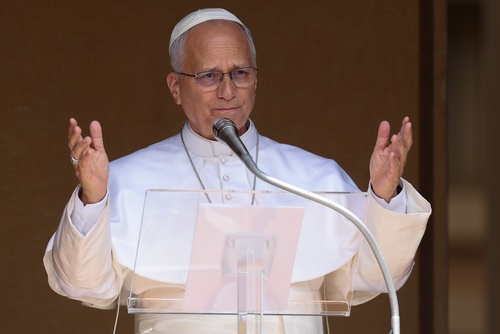
The Pope’s AI Politics

Pope Leo’s focus on the politics of AI offers an arresting account of the significance of machine learning.
Saint Augustine’s political analysis of the city of man and the city of God structures Pope Leo’s XIV’s first encyclical letter, Magnificia Humanitas. Surveying the times, On Safeguarding the Human Person in the Time of Artificial Intelligence sees personal liberty threatened by currents in geopolitics. “Our world is filled with attempts to seize control of markets and spheres of influence, often shrouded in reassuring rhetoric and seductive ideologies.” This context shapes Leo’s negative assessment of AI. He recognizes its world-building potential. “The construction of a world in a state of perpetual conflict is an evil and must be named for what it is. This way of portraying our current situation may seem bleak or pessimistic, yet I consider it necessary to do so.”
Released in May, the encyclical received rave reviews on social media. This is curious given the document’s bleakness. It would be comforting to both enjoy the technology and side with the pope on the politics. However, Leo argues that the technology is as problematic as the politics. He cautions parents and educators “to protect our young people from the promise of the perfect machine.” He acknowledges AI's speed in providing summaries but warns, “as Plato wrote, the deepest and most important things are learned only after much time and effort.” He worries that the technological marvel urges angelism upon us, so the pope recommends we “cherish places and times where physical presence remains crucial;” for no matter that “machines excel in efficiency, a human face that asks to be gazed upon remains the center of our history.” Without legal and moral oversight, Leo is sure machine learning is not a continuation of Western humanism.
The encyclical surprises because it is less about what kind of intelligence AI is and more about the circumstances and motives of its designers. The text’s central effort is to pull back the curtain on the genesis of AI. “In practice, however, technology is never neutral, because it takes on the characteristics of those who devise, finance, regulate, and use it.” Specifically, Leo hammers away at the question, “Why now?” His assessment is bleak because there is a “crisis of the multilateral system,” which means AI construction is pursued by the powerful in a “paradigm of war.”
Leo is blunt. Given AI’s geopolitical genesis, he presents machine learning as the latest iteration of Augustine’s city of man characterized by the lust of domination. Speaking for the city of God, Leo counters that “the living God descends into our history in order to free us from all forms of slavery.” Magnificia Humanitas offers the thesis that since technology is not neutral, the security of human dignity hinges on who owns AI and how it is configured.
Augustine’s City of God characterizes Nimrod as “a giant hunter against the Lord,” a vainglorious ruler who erects the Tower of Babel. Contrasting the city of man with the city of God, Leo recalls Nehemiah, a faithful Jew in the service of the Persian King Artaxerxes (who figures in Thucydides). With the king’s permission, Nehemiah sets about rebuilding the walls of Jerusalem. This work contrasts with Nimrod’s vanity project because “men, women, priests, artisans, heads of households, and young people all play a part… Thus ancient Jerusalem rediscovers a common language that is not one of uniformity, but one of communion – namely, the harmony that arises when all persons assume their own role and recognize that their strength comes from the Lord.”
At least since Aquinas, Catholic political thought holds the state responsible for the common good. Leo thus supports state regulation of AI, yet he also ably describes the decline of state power. This is a weakness in the document. No matter how nimble the arguments of Magnificia Humanitas, AI has the pope – and us – boxed in. On the one hand, “a just society requires a vigilant state and civil institutions that are capable of overcoming the singular mentality of efficiency.” On the other hand, Leo rightly observes that “global dynamics” today mean that “the highest level [of power] is not the state, but rather major economic and technological actors that exercise de facto power over the conditions of everyday life.”
The owners of AI are oligarchs, yet popular solidarity demands that “when it comes to decisions regarding economic flows and digital platforms, as well as the governance of data and algorithms, we cannot allow a handful of actors to dictate these processes on their own.” As AI diminishes state competence and strengthens oligarchy, how can popular sovereignty break free of AI’s subversive allure?
“In the past, it was largely up to the state to guide and direct innovation. Today, however, the main drivers of development are private… Technological power thus takes on an unprecedented, predominantly `private’ aspect, which makes it even more challenging to discern, govern, and direct such power toward the common good.”
Our Nimrods are not innocent, because power is not now merely brute coercion but a subtle structure of communication. “When every action – movements, purchases, relationships, and preferences – leaves a trace, a new form of power emerges – namely, the power to profile, predict, and influence behavior – often without individuals being fully aware of it.” Again, Leo is blunt: “the fight against new forms of slavery is a decisive test for the ethical discernment of AI and digital transformation.”
Complicating the legal management and ethical control of AI is that it feeds a new, highly attractive mythology. Nimrod built his Tower of Babel to be self-sufficient, but “when a city is built on pride and the claim to self-sufficiency, communication breaks down,” and solidarity erodes. Transhumanism drives this erosion. A form of angelism, transhumanism is “the ideological background present in some centers of technological power” which thrill to “a futuristic vision” of a “human-machine hybrid.” This animating mythology of AI “threatens to normalize an antihuman vision.”
To be moral, Leo argues that AI must conform to humanism. Technically, he explains, “current AI systems are more `cultivated’ than `built,’ for developers do not directly design every detail, but instead create a framework within which the intelligence `grows,’” and critically, AI does not “grow over time through choices, mistakes, forgiveness, and fidelity. Rather, it is a form of statistical adaptation.” AI has no “order of the heart” (Pascal), and this is why, for example, Leo insists that weapons systems must never be fully automated.
Adopting Pascal, Leo proposes that Christianity is a “covenant between glory and fragility.” The heart is the fulcrum of the two. Without the sentiments of the heart, we “lose track of history and our own past, since our real personal history is built with the heart.” The perfectionist mythology of transhumanism replaces the suffering of human life but, cautions Leo, this can only be malforming: “Those who love and desire cannot avoid passing through trial and suffering; and over the years, we carry within us lessons that leave their mark like scars, the memories of a journey.”
Angelism threatens this painful journey and, with it, human liberty. First, AI assaults our “interior freedom.” “The subtler forms of addiction linked to the `digital attention economy’ should not be underestimated, since platforms and services are often designed to capture users’ time and attention, exploiting their vulnerabilities and weakening their inner freedom.” In addition to encouraging persons to cultivate “digital sobriety,” Leo must welcome the news that 40 U.S. states are pursuing the largest lawsuit in history, claiming that Meta purposely designed attention traps that have damaged childhood development.
Secondly, AI designers have built an “architecture of visibility,” with the consequence that “what is amplified or rendered invisible, what is rewarded or penalized, ultimately shapes opinions and choices, fostering confirmation and self-censorship.” Human beings can be controlled as adroitly by communication nudges as by formal prohibitions, warns the pope.
Lastly, Leo turns to physical domination. He reminds readers that “nothing in the world of AI is immaterial or magical. Every seemingly immediate and flawless response is the result of a long chain of mediation, involving vast networks of natural resources, energy infrastructure, and, above all, people.” The pope argues that without solidarity, “the digital age will not be postcolonial, but colonial in another form” built on “a new mindset of extraction.” Therefore, legislation is urgently required. Some nations agree. For example, the Danish have a copyright proposal that aligns with Leo’s demand that making knowledge a common good “requires restoring to individuals not only the data that describes them, but also the ability to decide how it is used, by whom and for whose benefit.”
Leo’s focus on the politics of AI offers an arresting account of the significance of machine learning. He draws back the curtain on the threat AI’s oligarchic ownership poses to personal liberty and popular sovereignty. For my part, I could not find his proposed solution for wresting digital property from the oligarchs, but by citing Plato, Augustine, and Pascal, he hints that the solution will come from our mining the long tradition of Christian humanism. This is the hope at the heart of his otherwise cautionary analysis.
Graham McAleer is a lay member of the Judicial Ethics Committee of the State of Maryland and author most recently of Tolkien, Philosopher of War (CUA Press, 2024)


Rebuilding Venezuela
The hardest work is only beginning: rebuilding the institutions that will transform a false State into a real one.
The Pope’s AI Politics
Complicating the legal management and ethical control of AI is that it feeds a new, highly attractive mythology.

Data Centers Are a National Issue
America needs to resolve its data center debate with a national framework.
.jpg)


Get the Civitas Outlook daily digest, plus new research and events.
Get the Civitas Outlook daily digest, plus new research and events.