
The Green New Dependency: How China Captured Western Climate Agendas

By influencing the Net Zero mandates of major Western economies, China has effectively written itself a guaranteed order book.
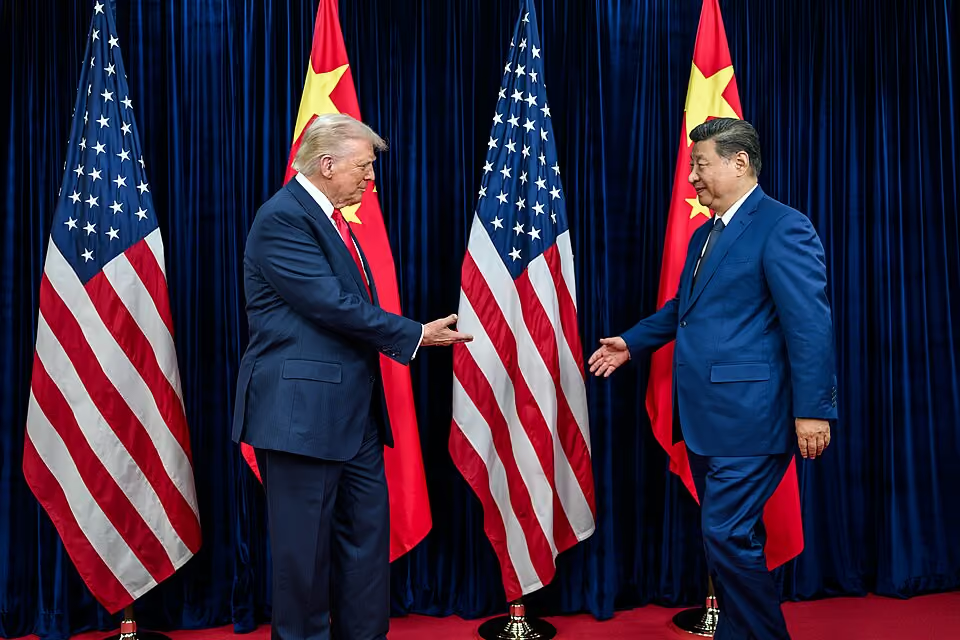
When EU leaders convene in Brussels today to discuss how to reduce the flood of Chinese imports into European markets, they will be confronting a problem of their own making and financing. Western universities are partnering with Tsinghua University in Beijing to increase purchases of Chinese-made green technology.
Both in California and in Europe, China has influenced the Net Zero mandates of major Western economies, ensuring that those mandates specify electric vehicles, solar panels, and wind turbines rather than gas-fired generation or nuclear power, effectively writing itself a guaranteed order book.
California
US partnerships were documented in a new report published last month by the National Association of Scholars, which reveals how Tsinghua University, one of Beijing’s most prestigious and state-connected institutions, partnered with the University of California to shape American climate regulations in ways that benefited Chinese manufacturers. This was accomplished through joint academic institutes, publicly funded research, and formal legislative entrenchment.
In 2021, Assembly Bill 39 gave statutory recognition to the California-China Climate Institute, a partnership between UC Berkeley and Tsinghua’s Institute of Climate Change and Sustainable Development. That institute then became the conduit for a bilateral agreement between China’s Ministry of Ecology and Environment and the State of California, helping to write zero-emission vehicle mandates that Chinese carmakers were uniquely positioned to fulfill.
The report’s author, Ian Oxnevad, calls this regulatory capture through academic partnership. It’s a foreign government operating through a nominally academic body, helping design the rules for a major economy’s green transition. With 17 states signed up to follow California’s rules, the universities delivered U.S. market access to China on a silver platter.
Europe
Similar partnerships are happening in Europe.
The Tsinghua Institute, at the center of the California story, is the co-founder and co-chair of the Global Alliance of Universities on Climate (GAUC). Europe’s co-chair, seated opposite Tsinghua at the head of the table, is the London School of Economics. GAUC’s membership includes London’s Imperial College, the Universities of Cambridge and Oxford, and Sciences Po in Paris.
LSE’s participation is led by its Grantham Research Institute, which aspires to shape UK and EU climate legislation. When the Grantham Institute co-chairs a global alliance with a Chinese Communist Party-linked university, few ask questions, and reasonable people might ask whether the policy outputs have been shaped accordingly.
LSE and Tsinghua University have also established the LSE-Tsinghua University Sustainability Research Fund, which generates policy-relevant research to support environmental causes. Launched in 2025, research topics include a “just and feasible energy transition,” frameworks for green methanol development, and decarbonization of the power sector. Professor Susana Mourato, LSE’s Vice-President, describes the fund as “connecting world-leading social science with global partners to address pressing environmental challenges.”
The University of Surrey signed a memorandum of understanding with Tsinghua on carbon neutrality and energy systems transformation, including joint research facilities and graduate training programs. Max Lu, the university’s President and Vice-Chancellor when the agreement was signed, was born and educated in China before moving to Australia to pursue a doctorate in engineering. His research papers include green hydrogen and biofuels.
Calling the climate crisis the most important of our time, President Lu said, “The collaboration between Tsinghua University and the University of Surrey will further leverage our long-standing partnerships with universities, research institutions, and enterprises in the UK and across Europe in climate change research and beyond.”
A conference held in Beijing in March brought together the EU Ambassador to China, Jorge Toledo, and Professor Hu Bin of Tsinghua’s ICCSD to discuss the future of EU-China climate governance, covering clean energy transition and policy coordination. Net Zero is an industrial procurement program of historic scale, and China has cornered the market.
China now manufactures 92 percent of the world’s solar modules and 82 percent of global wind turbines, as well as 60 percent to 65 percent of electric vehicles and 75 percent to 80 percent of batteries. Chinese propaganda results in lower economic output in the West and higher output in China. EU industry chief Stéphane Séjourné warned that 29 million European jobs are at serious risk. China’s clean energy dominance was built through decades of state subsidies, vertical integration across entire supply chains, and cultivation of academic partnerships that helped write the regulatory demand for the very products China was subsidizing into existence.
China Exempts Itself from EU Regulations
The EU’s Carbon Border Adjustment Mechanism, its instrument for taxing selected imports containing certain greenhouse gases, depends on obtaining accurate supply chain emissions data from foreign companies. On April 13, 2026, China’s State Council issued a sweeping new regulation that makes compliance with such requirements effectively illegal for Chinese firms.
The regulation creates an identification mechanism to designate foreign regulatory requirements as improper, and then prohibits Chinese companies from complying with them. Penalties for non-compliance include restrictions on government procurement, import-export restrictions, asset freezes, and personal fines against corporate executives. The regulation also authorizes a “Malicious Entity List” that can target foreign companies, think tanks, and lobbyists who promote carbon taxes.
Chinese manufacturers, who dominate the global supply of products required by the European Net Zero policy, are now legally barred from providing the supply chain transparency that EU carbon accounting demands. Europe has designed a carbon accounting system, and China has passed a law making it impossible to account for Chinese carbon. The EU summit should be asking how that happened.
The problems do not stop at regulation. A Bloomberg investigation published on May 24 has found that companies in at least nine European countries purchased carbon credits for Chinese projects that either did not exist or were verified by auditors who were simultaneously employed as project developers, treating the two roles as a revolving door.
The investigation found that sites registered as emissions-reduction projects in the Changqing oilfield in central China and the Shengli oilfield in Shandong province showed no evidence of the equipment needed to capture gas emissions. In one case, the registered company address in Beijing turned out to be a residential apartment.
The European Commission is now proposing to allow international carbon credits to cover up to 5 percent of the EU’s 2040 climate target. If the integrity of the existing system was so thoroughly compromised, the prospect of vastly expanding that system should give Brussels serious pause.
Tsinghua-affiliated researchers have argued against EU tariffs on Chinese electric vehicles, just as EU policymakers were debating that question. This is advocacy research, state-funded by Beijing, circulated through the prestige of Western academic publication, timed to influence a live European policy debate.
Repairing the Damage to Western Economies
The European Commission has finally begun to recognize what California has not. It declared last week that the current EU-China trade relationship is “not sustainable.” Possible measures on the table this week include forcing EU firms to diversify supply chains and introducing new trade defense mechanisms for chemicals, metals, and clean technology.
These are welcome steps. But they address the symptom without the cause.
If universities, funded substantially by taxpayers, are jointly producing “policy-relevant research” with an institution that serves as a key conduit for Chinese industrial strategy, then the very policy environment these universities are helping to create will continue to favor Chinese producers.
If the carbon credit system that underpins European climate compliance has been systematically defrauded by Chinese ghost projects, while a new Chinese law prevents the supply chain transparency the carbon border tax requires, the Net Zero architecture breaks down.
All universities should be required to disclose partnerships, funding sources, policy outputs, and the government affiliations of all related institutions, especially those that explicitly aim to “shape climate policy.”
For instance, the California Air Resources Board should disclose input from Tsinghua University. The GAUC partnership between LSE and Tsinghua’s ICCSD should be disclosed in every policy briefing the Grantham Institute submits to the UK or EU government. The bilateral LSE-Tsinghua research fund should publish the full list of funders, including any contributions from the Chinese government or state enterprises.
EU leaders meeting this week will speak about supply chain diversification and trade defense instruments. They should also speak about the academic partnerships that helped build the dependency they are now scrambling to undo, the carbon market defrauded on their watch, and the new Chinese law that renders their flagship border tax unenforceable. With the help of universities, Net Zero’s rules were quietly written to save China’s export model—with the West as the customer.
Diana Furchtgott-Roth, former Deputy Assistant Secretary for Research and Technology at the U.S. Department of Transportation, is a Distinguished Fellow at the Energy Policy Research Foundation and an adjunct professor at George Washington University.

From Milton Friedman to Alexander Hamilton: Why J.D. Vance’s Economic Vision Needs James Madison
Loftily stated goals do not remove the risks of concentrated benefits, dispersed costs, and political capture.

On Debt: Two Honest Measures, Two Different Questions
A response to Thomas Savidge's '“Full Faith and Credit” Means a Claim on America.'


.jpg)


.png)
Get the Civitas Outlook daily digest, plus new research and events.
Get the Civitas Outlook daily digest, plus new research and events.