
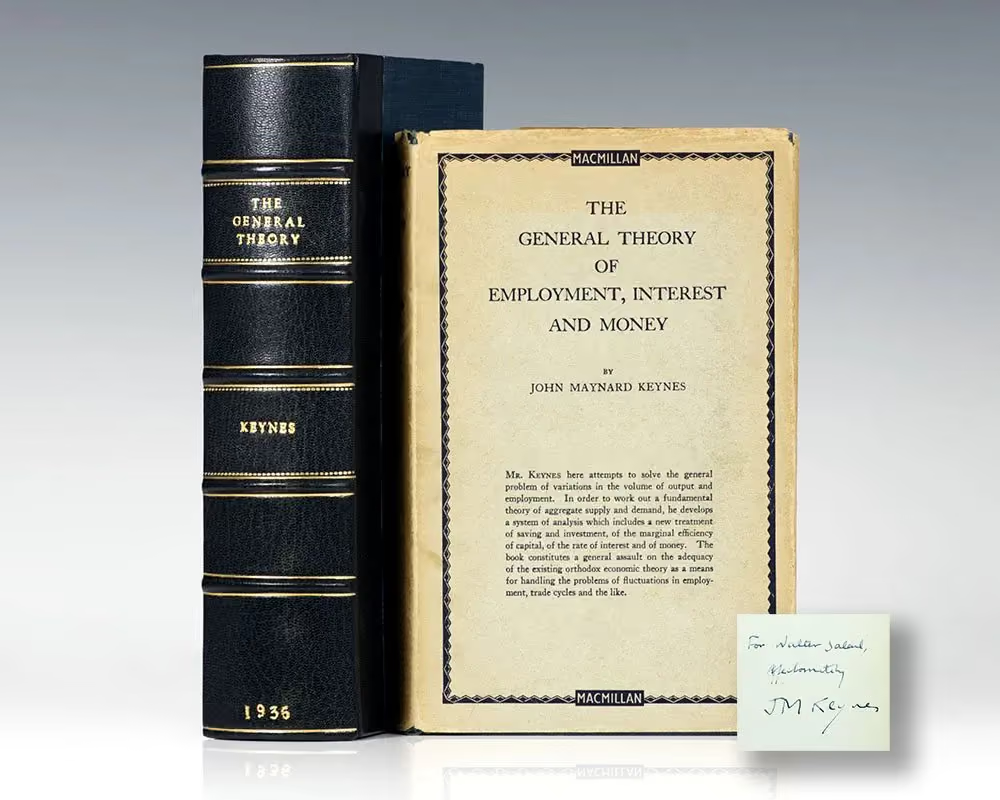
Keynes Was Not a Keynesian

The flaws in what is now called the “Keynesian” model can’t be blamed on Keynes.
In the fall of 1980, I entered graduate school at Washington University at St. Louis, intent on learning Keynesian macroeconomics. Things started with a bang: a seminar taught by Dr. Hyman P. Minsky, a student of Harvard’s Joseph Schumpeter and Wassily Leontief.
On the first day, Minsky outlined the semester: stability without equilibrium, sluggish price adjustments, financial contagion, “animal spirits,” and “in the long run, we are all dead.” Markets cannot self-correct, so government must act. I had arrived!
By the second day of class, I was eager to dive into the foundations of this marvelous model. But Minsky simply reprised his opening lecture, with a few digressions and historical examples.
After a month, I realized that was it: Minsky had no model of Keynes, just an account of the flaws and problems in investment and business cycles in a capitalist economy.
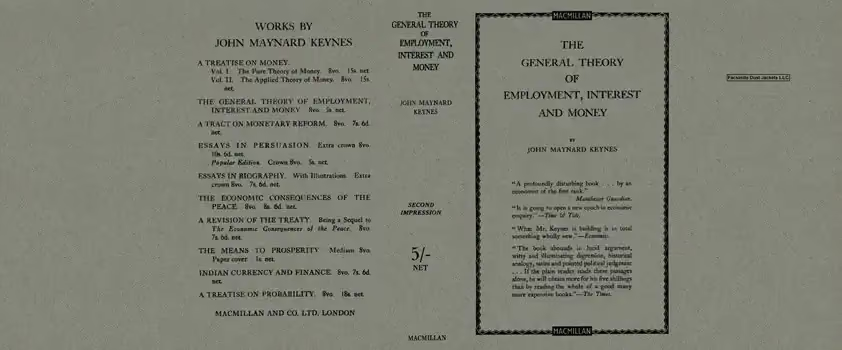
It took me years to realize that the failing was not in Minsky but in my expectations. The General Theory is never a model; it was a response to a particular economic crisis. And the flaws in what is now called the “Keynesian” model can’t be blamed on Keynes.
The Particular Theory
After the First World War, British unemployment remained stubbornly elevated. By the early 1930s, the global depression had undermined every orthodox prescription (although, as Amity Shlaes and George Selgin show, orthodox prescriptions had not been tried!).
The essential Keynesian diagnosis of the business cycle centers on fluctuations in aggregate demand (AD). When AD is strong, economies prosper and grow. But when there is a “shortfall” (compared to the productive capacity of the society), then economies shrink and wither. Market economies had no automatic self-correcting mechanism, at least within practically relevant time spans. That meant that resources (especially labor) could be unemployed indefinitely.
The essential Keynesian prescription was massive government spending, financed by borrowing, to create new jobs. When new wages were spent, “multiplier” effects would increase AD several times over for each government dollar paid out. This was genuinely revolutionary — but for Keynes it was a targeted, conditional prescription for a specific crisis in the mid-1930s, not a permanent license for expansionary policy.
Keynes understood the contingent nature of the claims. His 1937 Times articles, written just one year after the General Theory, reveal a thinker who had already pivoted sharply. With unemployment still around 12 percent, he argued that Britain had reached or was approaching “the point where there is not much advantage in applying a further general stimulus at the centre.” The economic structure was, in his words, “unfortunately rigid,” and he insisted the country was “in more need today of a rightly distributed demand than of a greater aggregate demand.”
Keynes advocated prudence and pumping the brakes in multiple articles and letters throughout 1937 and 1938. He had two concerns: first, excessive stimulus would artificially overheat the turnaround. Second, deficits in downturns had to be offset by surpluses during booms over the course of the business cycle.
This is quite explicit: Keynes said that, just as it had been advisable for the government to incur debt during the slump, “so for the same reasons it is now advisable that they should incline to the opposite policy.” Local authorities that had pressed on with capital expenditure during the slump should now “postpone whatever new enterprises can reasonably be held back.” The boom, he famously declared, was “the right time for austerity at the Treasury” (my emphasis).
But the “Keynesians” pushed for ambitious employment targets, scoffed at price stability, and treated any reduction in spending as a betrayal of “Keynesian principles” regardless of cyclical conditions. Harrod actually demanded a zero unemployment target; Robinson declared any unemployment rate above 2 percent “cold-blooded.” Keynes, by contrast, had regarded 3 percent as overly optimistic and, in 1937, urged restraint at 12 percent.
Perhaps most important, Keynes seems to have understood what we would now call the “public choice objections”: naïve optimism about the information and incentives possessed by elected governments. Throughout his career, he oscillated between scathing dismissals of politicians and the confident belief that governments would act rationally under enlightened intellectual guidance.
Yet Keynes clearly saw that elected governments would find it easy to justify deficits and nearly impossible to sustain the surpluses that symmetrical fiscal management required — which is why he favored a presumption in favor of “laissez-faire,” a presumption rejected by the Keynesians. As T.W. Hutchison noted, in his Keynes vs. the Keynesians (Institute for Economic Affairs, 1977):
Certainly it is very easy to understand, from the passages we have quoted from Keynes's last article, the complaint of Joan Robinson that some ‘Keynesians’ ‘sometimes had some trouble in getting Maynard to see what the point of his revolution really was’…According to Robinson: 'The bastard Keynesians turned the argument back into being a defence of laissez-faire provided that just one blemish of excessive saving was going to be removed.’ Given Joan Robinson’s meaning of laissez-faire, this ‘bastard Keynesian’ argument seems to be a succint [sic] but reasonably accurate summary of the “Concluding Notes” of The General Theory. (emphasis added, p. 23)
Keynes naively believed he could control politics through the force of his personality, and his impending death frightened him: his last major publication was a posthumous 1946 jeremiad in the Economic Journal. Keynes invoked “the wisdom of Adam Smith” and warned against rejecting “the classical medicine from our systems altogether.”
Minsky, then, had things right all along. The General Theory has always been worth reading as a conceptual corrective to excessive reliance on a naïve version of the classical model. But the subsequent intellectual indignities of the “Keynesians” are not in the same tradition. Keynes was not a Keynesian.
Michael Munger is Professor of Political Science and Economics at Duke University. His research focuses on the relations between political and commercial institutions.
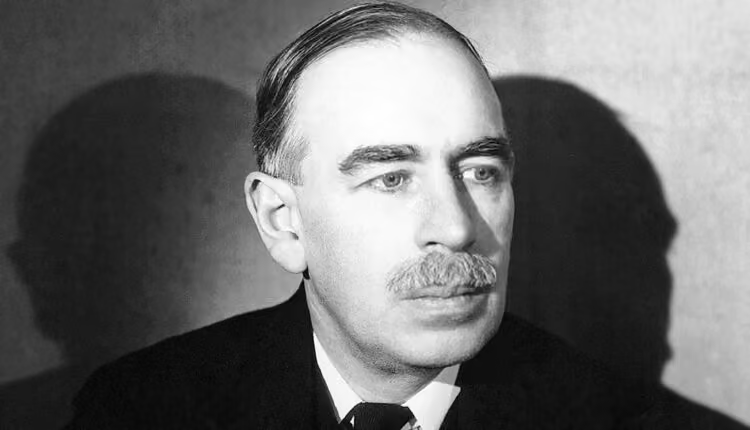
On Keynes, Coase, and Posner
The differences between Keynes, a pioneer of government spending and intervention, and Ronald Coase, a pioneer of maximizing growth by minimizing transaction costs, are as far as can be.

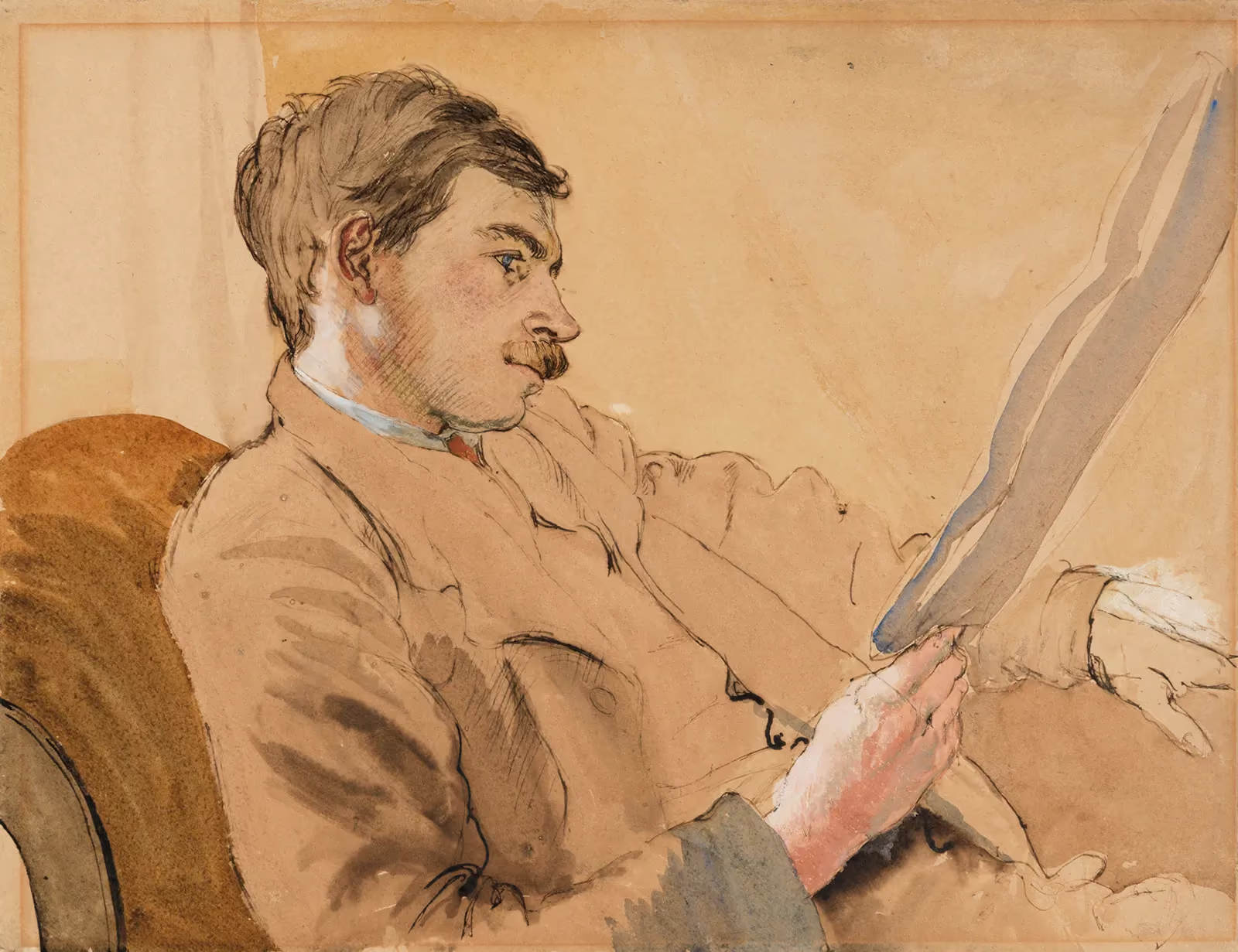
What We’ve Learned About Fiscal Policy Since Keynes
Modern evidence suggests that reality is more restrained than Keynes thought: people’s propensity to consume, as well as fiscal multipliers, are generally much lower than previously thought.

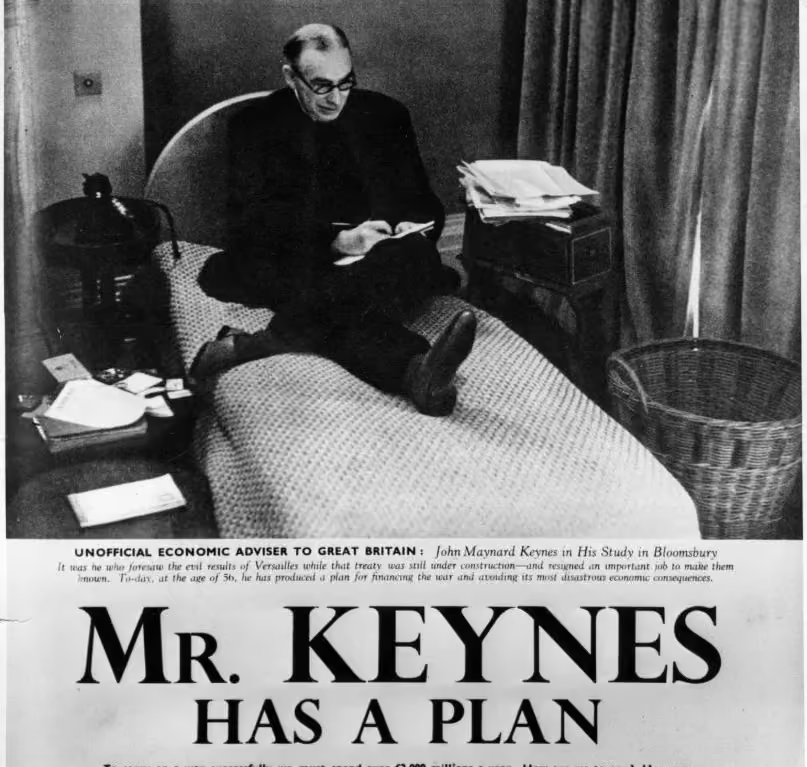
Keynes’s 'General Theory' as an Emergency Brief
The 'General Theory' was born from a specific historical emergency: the failure of postwar governments to deal with a depression rooted in the unimaginable destruction of wealth and the corresponding monetary disequilibrium.

.avif)
.jpg)
.png)