
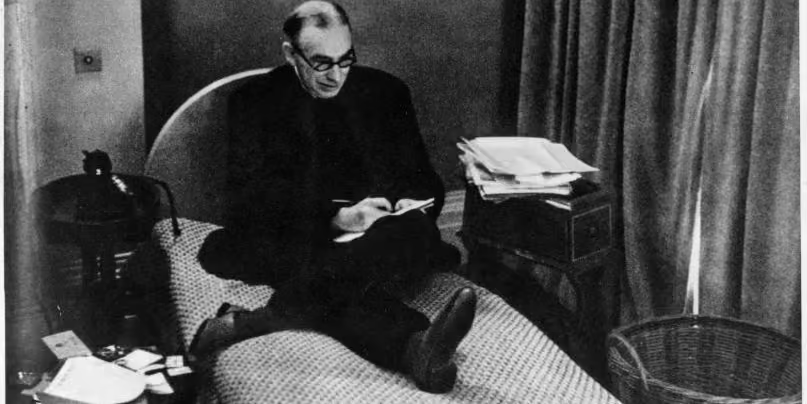
Keynes’s 'General Theory' as an Emergency Brief

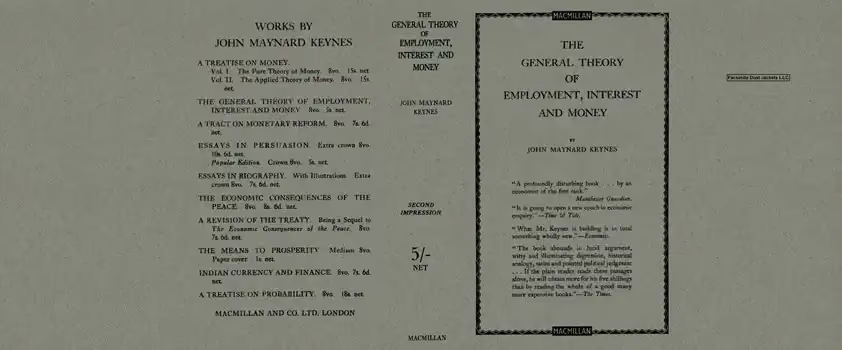
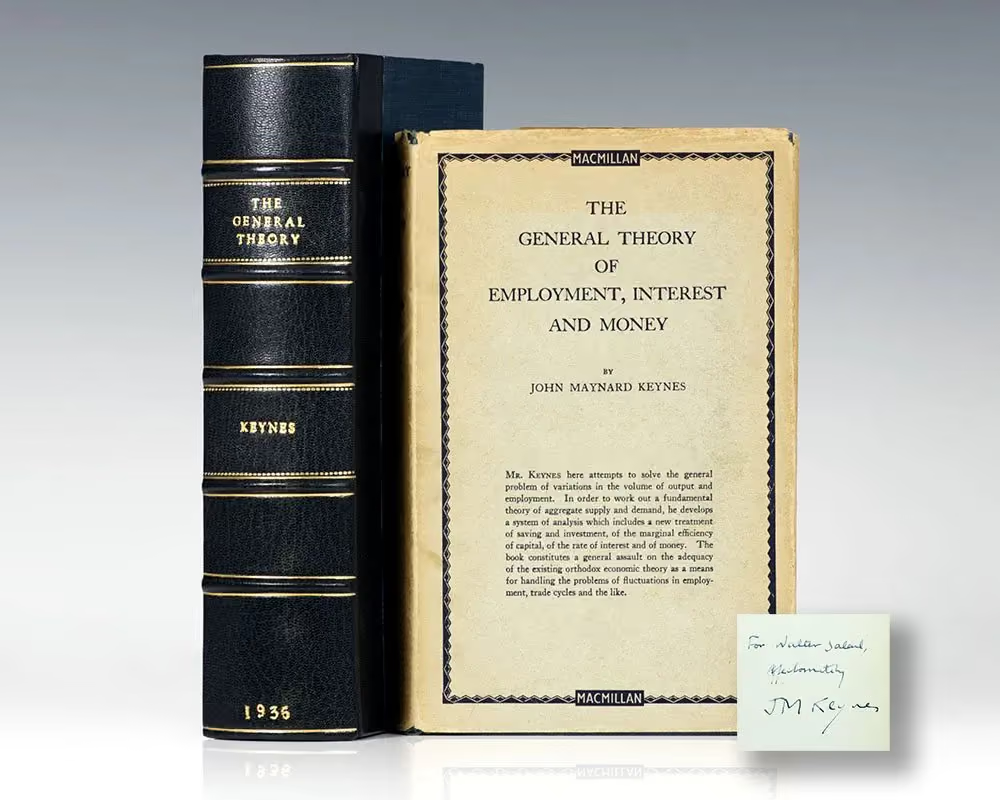
Keynes's 'General Theory of Employment, Interest and Money' was less a “general theory” than a brilliantly effective brief for exceptional times.
Whether change is driven more by culture or by institutions, ideas trigger change. Ninety years after its publication, John Maynard Keynes’s General Theory of Employment, Interest and Money is usually treated as the founding text of modern macroeconomics. But that reading risks missing its Raison d'être. The book was less a “general theory” in the timeless sense than a persuasive brief written for an emergency. Its purpose was to convince politicians and opinion-makers that, in the face of mass unemployment, they had to abandon inherited orthodoxies and act.
The historical setting matters. The Great Depression did not simply fall from the sky, nor was it merely the inevitable consequence of the gold standard as such. Arguably, a more persuasive account is that the disaster arose from the monetary disequilibrium created during and after the Great War. Wartime inflation had altered relative prices and the purchasing power of money. Yet Britain, and in important respects also the United States, sought to restore convertibility at prewar parities that no longer reflected economic reality. In effect, governments fixed the price of gold at an artificially low level. The result was not equilibrium, but a prolonged struggle to force domestic prices and costs down to a parity that had become unrealistic.
That is crucial for understanding Keynes. He watched Britain endure painful deflation starting in 1919 to prepare for the return to gold at the old parity in 1925. Unemployment remained stubbornly high, industry lost competitiveness, and policymakers proved unwilling to abandon the moral and political prestige of “sound money.” When a government maintains an overvalued parity, it tends to defend it through tight money and high interest rates, thereby producing recessionary and deflationary pressures until the arrangement finally breaks down. Incidentally, a comparison with Argentina’s later convertibility crisis is illuminating, as it shows that the interwar crisis can be understood as a kind of global currency crisis.
From Keynes’s perspective, this experience had two implications. The first was economic: under those circumstances, conventional monetary policy seemed ineffective, as he came increasingly convinced. If the whole system was organized around defending a disequilibrium in the value of money, cheaper credit alone could not reliably restore employment. The second was political: in an example of his powerful rhetoric, in the book Keynes states that “Pyramid-building, earthquakes, even wars may serve to increase wealth, if the education of our statesmen on the principles of the classical economics stands in the way of anything better” (Keynes, 1936: 129). In Keynes’s view, in the 1930s, many statesmen would hesitate to take extraordinary measures as society collapsed around them.
What was needed, then, was not merely a policy proposal but an intellectual justification strong enough to overcome these scruples. That is what The General Theory supplied. By arguing that market economies could settle into an underemployment equilibrium, Keynes undermined the older confidence that recovery would come automatically through wage and price adjustment. By shifting attention to aggregate demand, he legitimized deficit spending, public works, and monetary expansion as remedies for mass unemployment. The point was to make the intervention intellectually respectable.
Seen this way, The General Theory was a rhetorical achievement as much as an analytical one. Keynes was constructing a framework within which politicians could “do something” without appearing reckless. He was giving them permission to act against depression, even if that meant violating older liberal taboos about public finance and money.
Yet this should not lead us to mistake Keynes for an enemy of liberalism. Like Mises, he was fundamentally a liberal, though one driven by crisis to conclusions that earlier liberals would have rejected. Mises captured the transformation of the postwar world in a passage I will paraphrase: “Before the Great War, even a socialist like Knapp was in favor of fixed exchange rates; after the war, even a liberal like Keynes was against.”. The monetary and political dislocations of the interwar period had changed the horizon of what a liberal could plausibly defend, or so was Keynes’ conviction.
That is why Keynes’s book should be read less as a detached science of the macroeconomy than as an emergency intervention in a world distorted by wartime inflation, misguided parity restoration, and the social trauma of deflation in the UK and the US and inflation elsewhere. If the Great Depression was intensified by governments’ determination to preserve an unsustainable monetary order, then Keynes’s response was to create a new language in which abandoning that order could be defended.
Its influence was immense because it succeeded both politically and intellectually. It changed the terms of the argument. But precisely for that reason, we should hesitate before treating it as universally applicable. The General Theory was born from a specific historical emergency: the failure of postwar governments to deal with a depression rooted in the unimaginable destruction of wealth caused by the Great War and the corresponding monetary disequilibrium, prolonged by their own attachment to an economic orthodoxy that was proposed to make sense of a free society without those dislocations. As such, it was less a “general theory” than a brilliantly effective brief for exceptional times. To read into it more than that is as much a mistake as to deny its importance.
Leonidas Zelmanovitz is a Liberty Fund Senior Fellow and a part-time instructor at Hillsdale College.
On Keynes, Coase, and Posner
The differences between Keynes, a pioneer of government spending and intervention, and Ronald Coase, a pioneer of maximizing growth by minimizing transaction costs, are as far as can be.

What We’ve Learned About Fiscal Policy Since Keynes
Modern evidence suggests that reality is more restrained than Keynes thought: people’s propensity to consume, as well as fiscal multipliers, are generally much lower than previously thought.

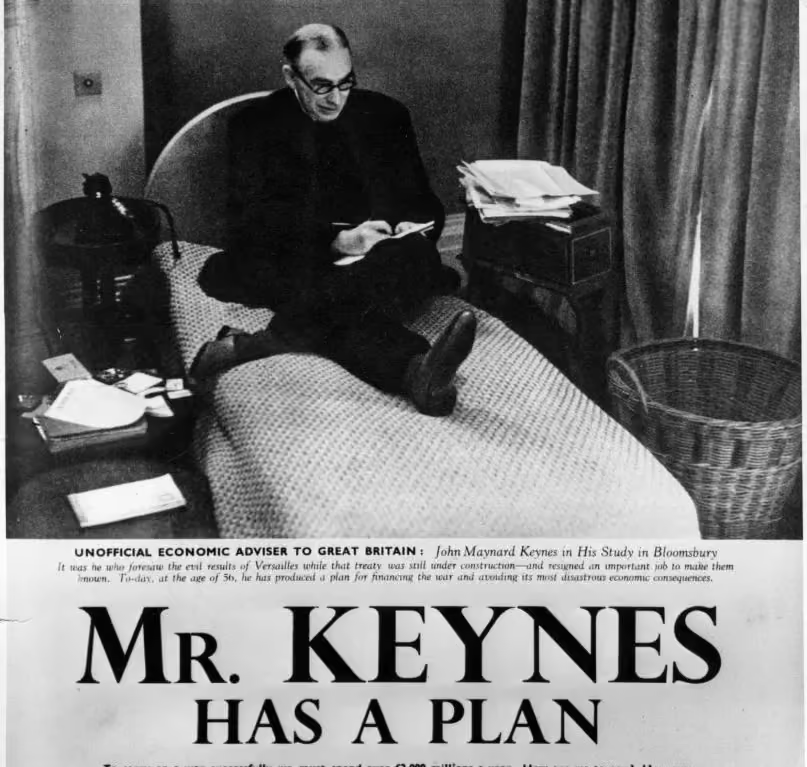
Keynes’s 'General Theory' as an Emergency Brief
The 'General Theory' was born from a specific historical emergency: the failure of postwar governments to deal with a depression rooted in the unimaginable destruction of wealth and the corresponding monetary disequilibrium.
.avif)

.jpg)
.png)