
Justice Thomas’s House Divided Speech
Justice Clarence Thomas may stand right now as our most Preeminent Public Man.
Associate Justice Clarence Thomas’s address marks the critical challenge posed by Progressivism in our own time, with its deepening threat to dissolve the regime built upon the anchoring truths of the Declaration of Independence. This address is one of the most moving speeches I have ever read—and something that should stand now in the Archives of Great American Speeches. What made the speech compelling—and moved it to a new plane—was the remarkable biographical account Thomas provided, combined with the deep teachings he had absorbed about human dignity and the moral ground of the Constitution built by the American Founders. He absorbed it through the teachings of his Grandfather and Grandmother, and through the Catholic education they were determined to provide for him. But this was the riveting part: he could come to love Georgia and America even as he lived in Georgia under an entirely corrupt system of law, one that nearly denied the human—and legal—standing of him and his family.
But surely the most moving and telling point was that Thomas came to know with a deep surety that the positive law that enveloped them was based on a deep lie: running deeper than the Declaration was the surety, as Lincoln said, that “nothing stamped with the Divine image and likeness was sent into the world to be trodden on, and degraded, and imbruted by its fellows.” We don’t get that from a syllogism, and not exactly from Greek philosophy. But it is surely the anchoring point that underlay the Declaration, and it explains more than anything else why we treat that man in the gutter, who has broken his own life, as a rights-bearing being with a dignity—even latent and muted—that simply has to be respected.
This is the story of a young man stamped with a lower racial caste, and yet buoyed up, confirmed by the surety that there is a deep law, a moral and natural law, that should impart confidence—and hope. Can we ever find a more heartfelt and compelling account of the natural law and the American constitutional regime?
But apart from everything else, Clarence Thomas’s speech also confirms one of the deepest truths I’ve known about Thomas since the time I came to know him, when he was on the DC Circuit—a truth was deepened after the assault and abrasions of the battle over his confirmation: Beyond everything, and the proving test that always matters most decisively—Courage. I’ve heard this earnestly from him, in one way or another, for years, and that has been one of his own grounding truths. And so, as he says, people “can write essays and talk at conferences about the Declaration with the best of them. All too often, however, this was but lip service camouflaged by grand theories in the tall grass of big words and eloquent phrases.” And what a telling line that one knows Thomas feels with the sting of truth: People will “water down their message, negotiate against themselves, vote against their principles, and hide in the tall grass.”
And on the rest of it, Clarence rolls it out as we’ve so plainly seen it: judges “growing” as they drift over to the liberal side, with visions of writers doing the book, “Mr. Justice X: A Life in the Law.” Clarence maps it out:
[These people] become controlled by criticism, so fearful of negative attention that they find ways to avoid doing the right thing. Or, they fall prey to the enchanting siren songs of flattery, and become so bewitched by praise that they will desperately seek to conform accordingly. They are enticed by access to things that were previously unavailable to them. They get so swept up in the euphoria of acclamation and acceptance that they put aside their convictions.
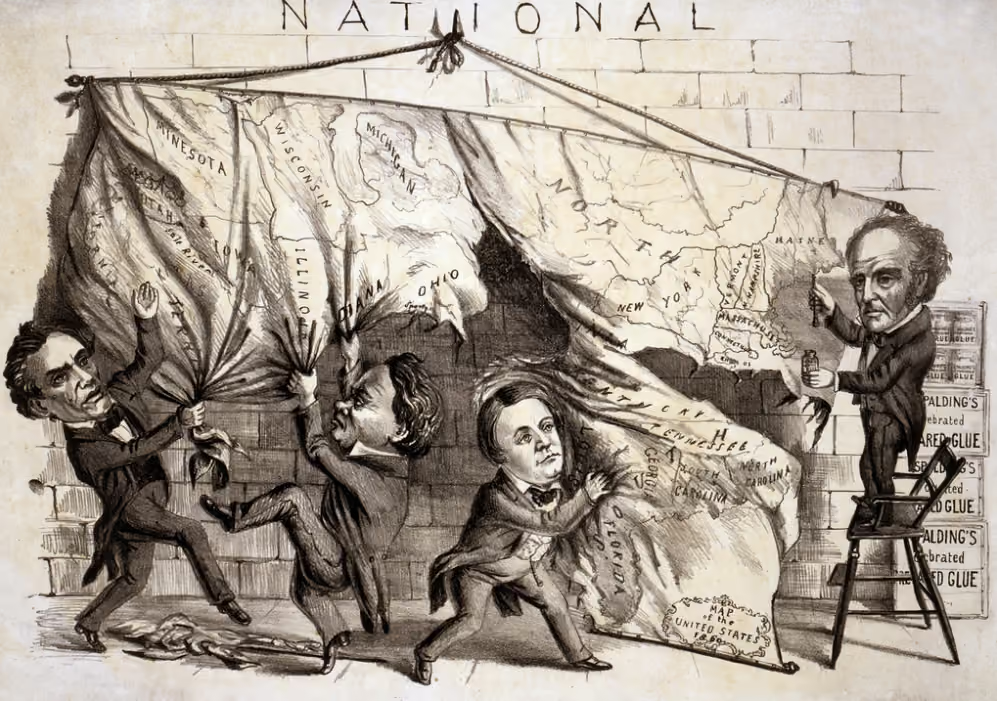
But one final thing that marks this talk as one of the Great American Speeches: Thomas has given us the new, comparably urgent version of the House Divided Speech. He recognizes that nothing since the Antebellum period and the Civil War has given us a mainstream movement in our politics as radical in its denial of the moral premises of the Founding as the Progressivism that is becoming more and more dominant in the Democratic party. After some deadly apt passages from Woodrow Wilson and John Dewey, deriding the notion of natural rights and moral truths lasting past one historic epoch after another, Thomas puts the matter sharply:
Progressivism seeks to replace the basic premises of the Declaration of Independence, and hence our form of government. It holds that our rights and our dignities come not from God, but from the Government. It requires of the people a subservience and weakness incompatible with a Constitution premised on the transcendent origin of our rights.
Lincoln said that, in the division of his time, the dynamic must move one way or the other. The same could be said in our own time, and when we consider the cultural conditions that have been building for relativism, which opens the soul to totalitarian tendencies, over the past hundred years, the future, frankly, looks dim. Thomas’ speech must be one of those calls that help to bring forth another Grand Awakening.
In what he has suffered, what he has learned from it, and what he has come to teach so forcefully, Justice Clarence Thomas may stand right now as our most Preeminent Public Man.
Hadley Arkes is Founder and Director of the James Wilson Institute, and the Edward N. Ney Professor in American Institutions (Emeritus) at Amherst College.
Read Justice Clarence Thomas’s full remarks here.

.jpg)
The Best Escape from the U.S. Attorney Mess
The process for appointing U.S. Attorneys is sputtering, but there is a way out of this mess.
Fighting Anti-Semitism from the Bench
Judge Roy Altman wrote "Israel on Trial" not as a judge, but as an American who loves this country.
Justice Gorsuch’s Warning
'Slaughter' may have rid us of the headless fourth branch of government, but it might end up leaving us with an all-powerful presidency.





Get the Civitas Outlook daily digest, plus new research and events.
Get the Civitas Outlook daily digest, plus new research and events.