
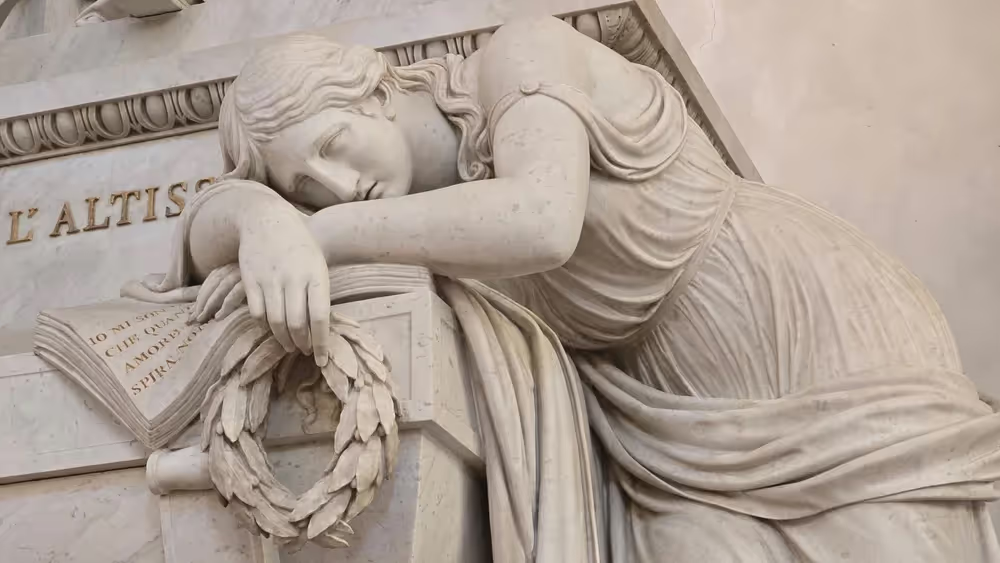
Liberal Education as Civic Renewal

Eva Brann's book, Paradoxes of Education in a Republic, proves relevant decades after its original publication.
In her sixty years as a beloved tutor at St. John’s College, Annapolis, Eva T. H. Brann, who died in 2024 at the age of 95, came to exemplify the distinctive spirit not only of that venerable institution, but of liberal education as such: wakeful inquisitiveness; delight in learning; playful, even mischievous seriousness; unstinting attentiveness to all things. Winner of the National Humanities Medal in 2005 and author of roughly twenty books and countless articles on a wide range of subjects, she showed that slow reading, deep reflection, and broad learning, undertaken in wonder, nourish an exuberant humanity.
Brann’s reflections on higher education are acutely intelligent and richly stimulating. This is especially true of Paradoxes of Education in a Republic, first published by the University of Chicago Press in 1979. More than a demonstration of liberal learning as “an acquisition and, more important, as a process,” the book is a timely reflection on its essential significance in the United States, for which Brann, a Jew whose family escaped Germany at the impossibly late date of 1941, felt lifelong affection and gratitude. She cites with approval Montesquieu’s observation that “the whole power of education” is required in a republic. The paradoxes she unearths arise from the new spirit of Enlightenment that gave the American experiment in ordered liberty its secular and scientific bent, its emphasis on useful knowledge, and its Cartesian understanding of reason. That spirit, she argues, fueled a distinctively American entrepreneurial energy, but has proved insufficient for the maintenance of a healthy polity — a fact that has much to do with the crises currently roiling American higher education and the American republic. The happy coincidence of the Semiquincentennial with the ongoing establishment of schools and centers of civic thought (of which there are now seventeen in twelve states) makes this an especially opportune moment to revisit Brann’s seminal book.
The “very reason for being” of a republic (from the Latin res publica, “the public thing”), Brann observes, is “the public good.” While the word democracy is purely descriptive, denoting a situation in which the common people (demos, in Greek) hold power (kratos), the name republic conveys an aspiration to secure and steward the good of all citizens, whatever their station in life. The citizens of a republic are therefore obliged to engage in ceaselessly renewed inquiry into, and debate over, the common good. As Aristotle notes, this public sharing and refinement through speech of our perceptions of what is advantageous and harmful, good and bad, just and unjust, is the political activity, one as educational as it is deliberative. Politics, in this fundamental sense, does not come naturally but must be learned. At a minimum, it requires moderate habits of civil discourse and argumentation, a capacity politely — if often spiritedly — to articulate and exchange reasons for one’s views. At its best, it requires a prudent understanding of ends as well as instruments: intelligence informed by sustained reflection on the best that has been thought and said about what it means to be a human being and a citizen.
The education that could adequately prepare Americans for politics in its original and primary sense is all too scarce today. Part of the understanding of education in America was stamped by the Enlightenment. Among the Founders, it was Jefferson, by nature a constructive thinker and a builder, who gave most thought to citizen education. He considered Bacon, Locke, and Newton, in that order, to be “the three greatest men that have ever lived, without any exception.” A general idea of what this means may be gleaned from the fact that Bacon, in an act of what Brann calls “breezy vandalism,” opined that “it is useless enough to those who live at present to know whether a man called Aristotle ever lived.” (But Jefferson was a man of parts. After signing the Declaration of Independence, he and Franklin—both religiously unobservant men—argued over which scene from the book of Exodus should adorn the great seal of the new nation. In the end, neither did.) Seeing that American higher education consisted solely of classical colleges, whose modest aim was to transmit knowledge to successive generations, Jefferson proposed to establish universities dedicated instead to its scientific advancement and diffusion. His vision, finally realized in the late nineteenth and early twentieth centuries, created big, well-funded research universities on the German model: institutions whose size and preeminence produced gravitational distortions in the pedagogy of higher education.
Brann’s paradoxes of education are institutionally embodied in the substantially different missions of home-grown American colleges and German-style universities. In her 1987 review of The Closing of the American Mind, Brann implicitly conceded Allan Bloom’s concern about the collapse of liberal education in universities. But she insisted that, in thousands of American colleges, “students are still capable of grand longings, books are read with receptive naiveté, and religion is not debased to the frisson of ‘the sacred.’” Perhaps. But that claim is less true today than ever, just as her description of American undergraduates in Paradoxes as “gullible in sophistication,” “thin of speech,” “stuffed with theory,” and “emptied of reflection” is more true.
To be clear, Brann celebrates the institutional diversity of American higher education, appreciates that the paradoxes she observes have been — and can again be — a source of educational vitality, and has zero interest in simply dissolving them. Yet she is adamant that it is both personally and politically desirable for Americans to be liberally educated, whatever their aspirations may be. Her book identifies and explores three sets of paradoxes under the rubrics of utility, tradition, and rationality. The main ones are these: utilitarian education treats learning as a means, although it is naturally an end in itself; secular and scientific education eclipses classical learning and neglects the tradition, without which neither modernity nor the American Founding can be adequately understood; and what she calls “rationality” relativizes truth and subordinates reason to sentiment, narrowing and flattening our intellectual and spiritual horizons.
Paradoxes’ reflections on utility encompass problems that have only become more acute in the half-century since Brann’s book was published. “To be a means,” she cautions, “is precisely to be discounted in favor of an end. When that end is improperly established — false or forgotten — the mode of usefulness acquires a pathology.” And as “our public realm is primarily one of means,” inquiry into ends “ought always to have been crucial.” But because it has not always been, the means — the technical capability to effect something — have come to justify the ends. Just as bad, fantastic notions of what ought to be have increasingly crippled our capacities to see and say what actually is. These problems have, in recent years, been exacerbated by an undue emphasis, often starting in primary schools, on social utility, which is now reckoned at least as much in political terms as economic ones. In his 1947 lectures “Leisure the Basis of Culture” and “The Philosophical Act,” the philosopher Josef Pieper decried the “total claim of the world of work” in modern life and education. Thirty years later, Brann perceived that the problem extended far beyond premature vocationalism: universities increasingly understood their primary educational mission to be preparing students for urgent social and political change. Her discouragement of curricula that are preoccupied with impending catastrophe, encourage self-flagellation, and confound “the preparation for affairs with the mature transaction of them,” and her resistance to calls for universities to intervene directly in the public realm, have never been more timely.
The paradoxes of usefulness are inseparable from those of tradition. In American higher education, the transmission or tradition of knowledge — trader means “to hand down” — eventually yielded to its advancement and diffusion. Communities of learning gave way to Baconian “agencies of research,” and already modest understanding of the past to a narrow presentism or “just-nowness” — the modo in modernity. An overwhelming flood of information swamped pedagogical efforts at thoughtful formation, a problem that is orders of magnitude larger and more random in the current digital age. “[M]assiveness, muchness, manyness” —quantity rather than quality — “became a determinant of learning.” Analytical methods used to construct abstract theories, often with applications in public policy, replaced naïve inquiry and produced an illusion of newness, “reinforced by the eclipse of the old.” It’s not that there is nothing new under the sun. Rather, as Brann observes, the only real novelty of which we are capable is the renovation of the tradition, which is, after all, “the mode most essential to its [the tradition’s] life.” As is by now painfully obvious, our age condemns itself to cultural sterility insofar as it refuses to work the rich soil of the past.
Brann reserves some of her most trenchant criticism for rationality, perhaps because that “unreasoned use of reason” manifests the collective neglect of ends and the forgetfulness of tradition. A sentiment of self-sufficiency in thought and judgment (however unschooled these may be) and a “self-assertive resistance to authority,” rationality is characteristic of our democratic republic. Its immediate political consequence is that conflicting opinions cancel one another out, making truth—particularly where so-called “values” are concerned—effectively a private, inarguable possession. One solution to this problem, pushed hard in recent years, is to defer to the knowledge of “experts.” But as we learned to our sorrow during the Covid pandemic, imputed expertise is entirely compatible with incompetence, illiberalism, and a basic lack of self-knowledge. The determination of truth cannot be offloaded to specialists, much less to machines; citizens must jealously guard their right and obligation to judge the character and competence of experts.
The shrinking and hardening of thought within the mode of rationality have other harmful consequences. Chief among these is the pervasive preference for form over content, process over substance, in matters that call for practical reason. The quantity of aggregated opinion has come to outweigh the quality of thought when assessing what is just or choiceworthy. Possibility eclipses actuality as a primary object of attention. Students are to be prepared for “tomorrow’s world,” whose “mere futurity” makes it the most formal aspect of existence. The relentless pursuit of equality, no more than a condition for the possibility of a good life, displaces inquiry into the good itself. And people in positions of authority outsource their judgment to bureaucratic proceduralism to avoid individual responsibility for contested decisions.
Brann’s “resolutions” of the paradoxes preserve the productive energy of the inherent dilemmas of American education. She argues for what she calls inquiry, “a direct, unpretentious, common pursuit of meaning” that integrates the multiple ends of higher education into a wholesome unity of basic practices and understandings. Inquiry proceeds essentially through “readings of original texts of poetry, science, and philosophy,” for “the course of education is the course of learning to read, and to have an education is to know how to read” (her italics). To read, she explains, is “to un-riddle” or interpret — the primary discursive activity of the human mind. Her broad conception of reading includes books of musical notes and mathematical symbols, and could certainly be extended to artistic productions of all sorts. But only “books of letters” can turn the initially unconscious activity of learning into a “directed desire of the intellect.”
These books of letters must be “tried texts,” preserved by consensus and regarded as possible sources of wisdom: original writings — not textbooks — to which one is entitled to bring a “trusting expectation of inexhaustible meaning.” Nor does it matter precisely which books are included in the curriculum, provided they are great ones; the main thing is the act of reading. (Lincoln, Brann claims, was the best-read president, not because he read most widely — he did not — but because he read well.) These books must be taught in seminars led by instructors skilled in using basic questions to get students speaking and giving reasons for their views. They must above all be approached naïvely, without the interposition of preexisting frameworks of interpretation. For inquiry is intent on “thinking things anew,” and it stands at the furthest remove from the ideological “interrogation” that teachers and professors use to torture great books today.
The liberal education through inquiry that Brann describes is neither impractical nor incompatible with life in a republic. On the contrary, a true community of learning “is a small republic of the intellect within a political community,” one united by the common purpose of a life of learning. It instantiates “the chief characteristic of the larger republic: that the more each person does in his own behalf, the richer is the public realm.” Because it concerns itself with common and communicable things, it “form[s] the kind of friendship that comes from dwelling in an essentially public realm.” It thereby prepares students for the eminently practical knowledge of an elevated and dignified life that is good in itself: “life in a real republic, not so much as it is, but … as it ought to be.”
Brann’s exhilarating book is a must-read for anyone concerned with repairing American higher education and renewing the promise of our republic. The new schools of civic thought have already begun this essential work, as have classical K-12 academies, but there is much more to be done. Parents and students, particularly those with experience of public education, have proved more receptive to these initiatives than faculty and administrators at existing universities. How to persuade skeptics that these schools are neither politically partisan nor elitist remains a serious problem. Perhaps the best approach is to provide them with multiple opportunities to see things for themselves, such as reading groups, classroom visits, and lectures where students are present. Seminars are labor-intensive and costly, and ensuring an adequate supply of competent professors and teachers in schools of civic thought is an urgent problem. Schools of civic thought should establish undergraduate programs to prepare educational entrepreneurs and teachers to found and staff classical academies. And if these schools are to meet the demand for liberally educated faculty, they will need to work with their universities to reform and expand existing Ph.D. programs.
Patriotic philanthropists, state legislatures, and governing boards of universities and colleges, take note: all of this will be expensive. But it would be hard to think of a better investment in the American republic, or a more propitious moment to make that investment. As Brann notes, the right to pursue happiness that is enshrined in the Declaration of Independence implies “a chance at a good life.” This year’s Semiquincentennial offers a perfect opportunity to restore the education on which that chance depends. If not now, when?
Jacob Howland served as Provost and Dean of the Intellectual Foundations Program at the University of Austin from 2022 to 2025, and before that, as McFarlin Professor of Philosophy at the University of Tulsa. The author of five books on Plato, Kierkegaard, and the Talmud, he will be a Distinguished Visiting Professor in the School of Civic Leadership at the University of Texas in AY 2026-27.

The Great Books and Great Books: An Education for Liberty
Let us come together around these books and join the great conversation that has been unfolding across the centuries.
The Constitution of Academic Freedom
“If the university no longer seeks the production and dissemination of knowledge, it loses the primary justification for its academic freedom.”
.avif)
Trump's Overreach Against Harvard
A close look at the allegations in the second complaint provides further evidence that Harvard should not be forced to relitigate old issues in a new forum.




.png)
Get the Civitas Outlook daily digest, plus new research and events.
Get the Civitas Outlook daily digest, plus new research and events.