The Fragility of International Law
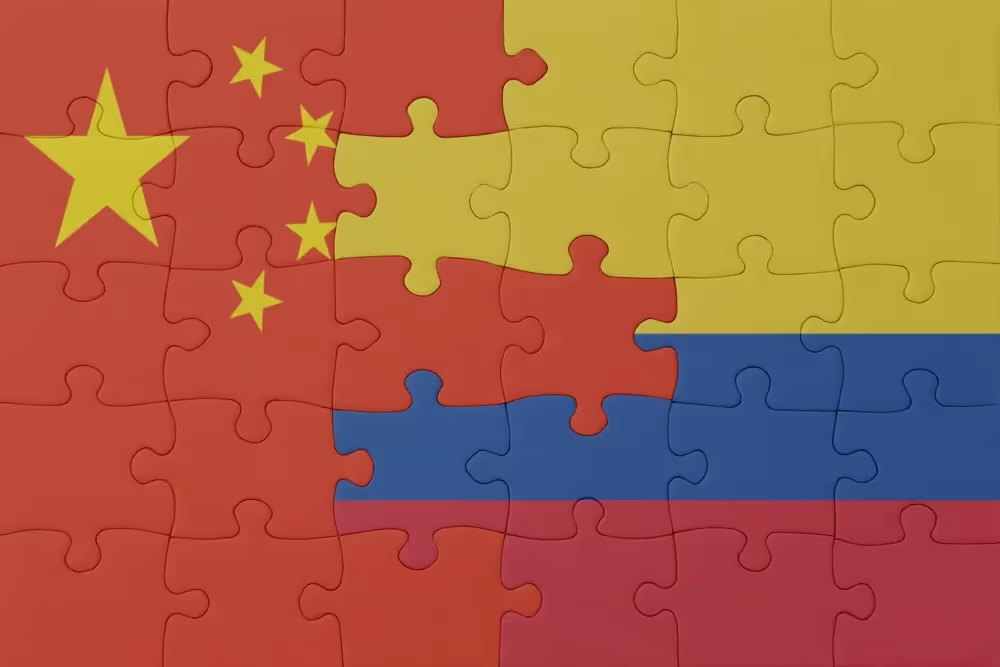
In the months and years to come, the US should expand its reach in Latin America to counter Russian and, especially, Chinese influence.
Editor's Note: This essay is part of our Venezuela Symposium.
Now that Maduro was captured, a lot of socialists or “liberals” are arguing that the US has violated international law. This is supposed to establish a pernicious precedent for other states to follow. Finally, it will have internal and external consequences, from Venezuela’s remaining regime and from Russia or, especially, China.
In one sense, the US has probably violated international law. But the real question is whether international law was owed compliance. In this case, complying with international law meant bringing the issue to the UN Security Council, where a vote would decide whether to authorize a military intervention in Venezuela. Russia and China had veto power in that council, so it was impossible for the US to obtain a favorable ruling.
At the same time, China, Russia, Iran, and Cuba had economic and military ties and were heavily infiltrated in Venezuela. Who authorized this intervention? Dictatorships with no legal or even de facto legitimacy. We must remember that the air defenses of Venezuela were Russian and Chinese, and the personal guard of Maduro was a contingent of hundreds of Cuban militias.
Not only that, the Russian, Chinese, Iranian, and Cuban presence in Latin America was part of a broader game, in which these countries try to destabilize the region, with a special focus on the US. They want countries to align with them commercially through infrastructure investment, trade, and a military presence, including espionage activities, in addition to other softer ways to intervene and manipulate societies. Also, they used certain geographic points in Latin America -especially in Venezuela and Mexico- to weaponize migration, utilize agents of criminal organizations like “Tren de Aragua” to sell drugs in the US, engage in money laundering, and so on.
What does international law say about this? International law is primarily formal. Maduro was the president of Venezuela, despite fraudulent elections, authoritarian control of all the branches of government, and the commission of criminal activities with state means, including systematic violations of human rights. , Maduro’s authorizing foreign governments — enemies of the US — to operate in Venezuela's territory and even conduct military activities within it naturally caught the attention of America. But this also made China and Russia incumbent parties and judges at the same time (because of their UN veto prerogatives), something prohibited in any other area of law, but apparently has no meaning in international law. China and Russia cannot profit from their incursions in Venezuela and then prohibit American redress from their UN perch.
In another sense, international law is also relatively indifferent to violations that are less noisily done. If an unknown drone had struck Maduro and Delcy Rodriguez was unilaterally calling for US help, all the “international law” arguments would be in vain. International law is cynical in the sense that it knows that the US cannot follow its rules to obtain a better result (stopping state undercover attacks on American territory or human rights violations) and it is amenable to rules being violated under the table (like the intrusion of China, Russia, Iran, and Cuba in Venezuela or US operations in foreign countries, like the capture of Osama Bin Laden).
US intrusion into Venezuela is not a new phenomenon; it is just more emphatic. All the powers are attempting to gain more influence and to take or divert resources from their adversaries: Russia in Ukraine; China in Taiwan; in Iran and Latin America, and so on. The US is just protecting its interests in a more aggressive, tactical manner.
Retrieving Latin America from China and Russia was the intelligent move, and the US is now pressing on this front. In that sense, American action presupposes a bigger game in which China, Russia, and other countries are also playing their hands to diminish or control US power.
The control of petroleum assets in Venezuela is a motivating factor of US behavior, but not for the reasons people are saying. The US has an interest in Venezuelan oil because of global oil prices and because it is an important asset for China and Russia. Also, America has an interest in Venezuela that goes beyond oil: it’s a key location for supervising or controlling the rest of the region. Other military alliances will likely also be pursued by the US with countries like Peru (the US recently expressed its interest in Peru as a non-NATO military ally).
In the months and years to come, the US should expand its reach in Latin America to counter the influence of Russia and, especially, China. In return, we can expect China to pursue various legal options, along with intensifying conflicts nearer to their territory: the Asia Pacific and the Middle East.
Oscar Sumar is a deputy vice-chancellor for academic affairs at Universidad Científica del Sur and a fellow to the Public Law & Policy Program at Berkeley Law. He is also a founding director of BeLatin.
The Fragility of International Law
In one sense, the US has probably violated international law. But the real question is whether international law was owed compliance.
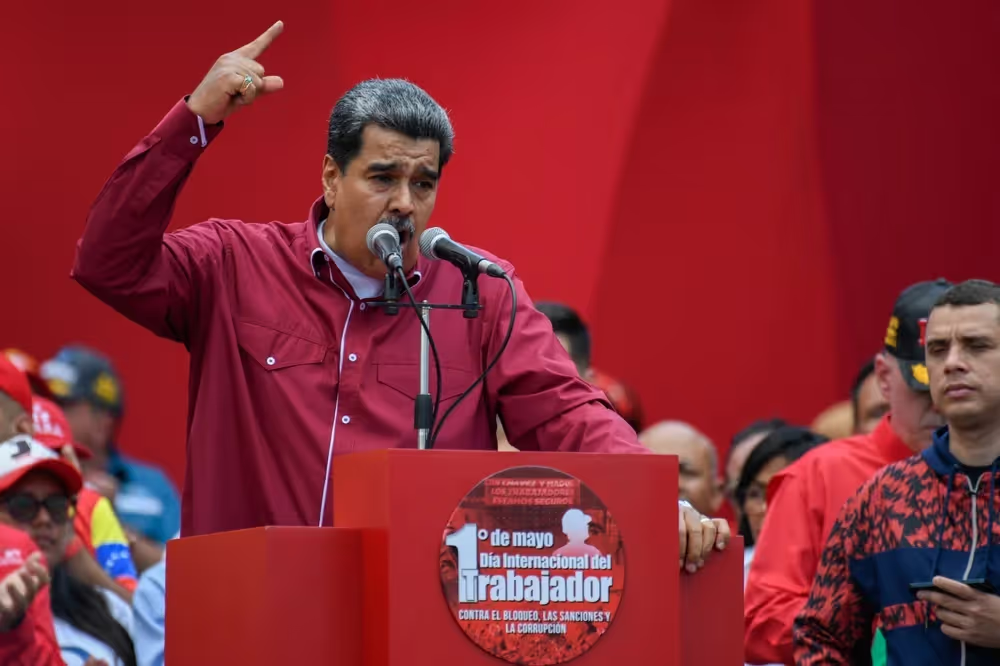
Nicolás’ Last Dance
Despite mounting international pressure, Maduro continued to attract the support of left-leaning parties and organizations worldwide — often deflecting criticism with another dance, another performance.

Can Venezuela be Lifted from Its Trap?
The challenge for Venezuela's economic recovery is complex, long-term, and urgent, given that its society and state will transition from a broken foundation.


.jpg)
.png)