

A Deadly New York Parable
.png)
Tax them so they leave—then tax them again if they want to return.
On July 1, 2026, New York City put into place its tax on second homes—the so-called pied-à-terre tax on high-value homes, condos, and co-ops within the city. That tax was applied retroactively from January 1, 2026, but its retroactive application is only one of the many problems with a tax whose two major supporters are New York State Governor Kathy Hochul and Mayor Zohran Mamdani. On the day of its publication, the lead editorial of the New York Times dismissed an anticipated fuss over the new tax as though it were no big deal, billing it as a corrective against out-of-staters who freeloaded on New York’s vast cultural and social resources. The Director of Finance in the City, Richard Lee, announced that the City is “committed to implementing the new nonprimary residence property surcharge fairly and efficiently.” But the public mood sharply changed when the Mamdani administration took one large and foolish step when it published a list containing some 960,000 units that could be subject to the tax, including, as the New York Post notes, such celebrities as Woody Allen, Anna Wintour and Cynthia Nixon. The mayor thinks that he can clear $500 million per year, while the Democratic City Controller puts that number to between $340 and $380 million—which, given the pace of events, could also be too high. But the bad news is out of the bag: the tax roll already “far exceeds early estimates.”
The story already looks like a colossal policy misadventure. So as the events continue to play out, it is useful to conduct a post-mortem to explain how the legal situation came to this place. The driving force behind the campaign is a proud boast: TAX THE RICH. Mamdani makes no bones about it. As he stated on Tax Day, “I promised that we would tax the rich, and with our new pied-à-terre tax, that is exactly what we have done . . . to fund our parks, schools, and libraries.” At the same time, Governor Hochul pleads with the rich ex-New Yorkers to return home, knowing full well that their exodus was driven by an oppressive mix of high taxes and repressive regulations. A pied-à-terre tax is not a way to lure them home.
So now the acid test for the new pied-à-terre tax is this: what does it do to help the situation especially when it doesn’t only tax the rich? To see how counterproductive the new pied-à-terre tax system is, look at the full table put out by the Department of Finance that covers all classes of non-primary residents, even though there can be only one primary residence, even for full-time New Yorkers with two or more homes in the city.
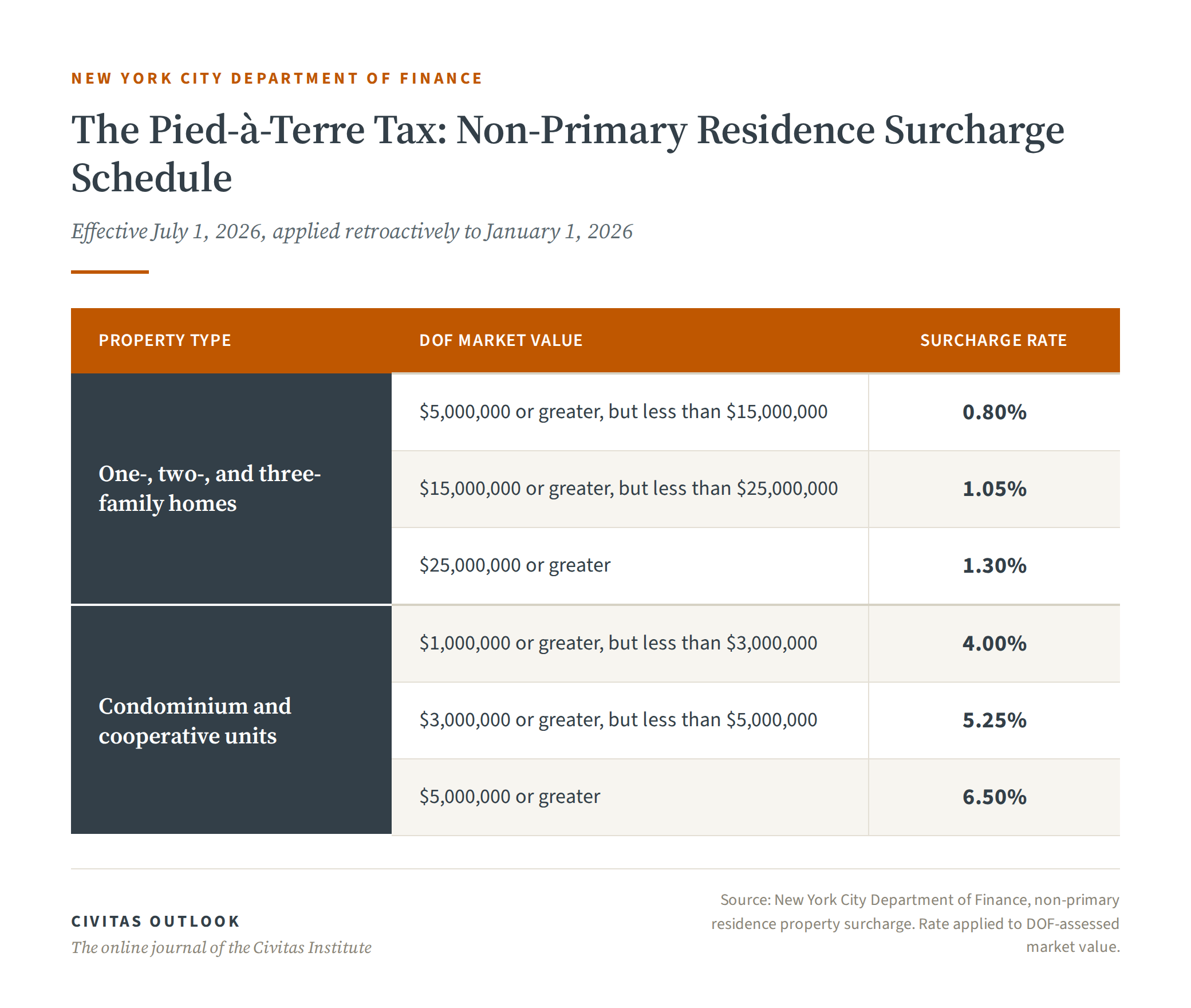
A week ago, the Times and others wrote as if this tax were targeted on the rich by concentrating exclusively on single-family homes. But the real shocker is how regressive this new tax is relative to its stated purpose. As a first approximation, if the out-of-state rich persons—or in-staters with two or more homes—are scourges, it should not matter whether their second home is a house on the one hand, or a co-op or condo on the other. But the city’s tables differentiating between houses and condos read very differently. For co-ops and condos, the burden starts at $1 million, a number that does not place its owner in luxury, but buys a small studio or a one-bedroom condo. However, that tax rate for co-ops and condos is five times the 0.8 rate that homeowners pay on houses worth $5 million. That ratio is not a bug but a feature of the system, because Ken Griffin’s $239 million house (may he enjoy it in peace) is taxed at a rate only 20 percent of the tax on a $5 million apartment.
The tax figures on the houses may be sustainable for billionaires, but few owners of so-called non-primary homes could or would pay $40,000 to $120,000 per year in addition to their regular taxes and fees for the privilege of getting a foot into the second-home market. Include the condos and co-ops in the base, and it was never fair to say that the “pied-à-terre tax is both modest in size and narrowly targeted.” Instead, individuals who live in condos and co-ops are far more likely to sell to buyers who are permanent residents in the city. However, even here there are complications for many of these families who may split their time between New York City and some other location, at which point they will have to fight their way out of the web by proving that their city residence is their primary one. And lest anyone think they can sit tight before making a move, the applicable regulations state that these homeowners have to apply for the needed exemption, which means the statute will embroil everyone on that huge list of names to some extent. This will increase, probably exponentially, the number of disputes between owners and the city authorities as to the status of the property, meaning the administrative costs to both the city and to all the homeowners will eat up a fair portion of the putative gains so that it is quite likely that, in the long run, the measure will raise little, if any, revenue at all once the tumult settles down if it ever does. And if the retroactive application holds, the minimum tax already incurred is for the cheapest units over $20,000 and rising daily. The possibilities for constitutional challenges are sure to be raised, and soon.
Well, why take this destructive route? The Times is never at a loss for bad reasons. The individuals who live in the city for less than 184 days—a status craved by those whose other residence is in some state without an income tax, like Florida—are now said to obtain key services like “garbage collection, snow plowing, public transportation, policing and so on—without paying their fair share.” More pure politics. All these individuals pay their regular real estate taxes, and for full-time residents, these taxes are thought to cover their expenses. The part-timers in the city use those public services only part of the time while also not taking advantage of the school system or the vast array of social services provided by the city. So, in fact, it looks as though they are paying for more than their fair share, which is exactly what the mayor and governor intend their “tax the rich” program to avoid—even for those full-time New Yorkers with two homes.
The mayor and the governor understand this one measure they call “progress” will make only a dent in the housing shortage, if indeed it does anything at all. They happily speak of reducing regulations and speeding up the permitting process, but those are the places that they should have started first because they offer the combination of lower administrative costs and more rapid construction. Such changes can be made without a pied-à-terre tax. It is a sign of the warped socialist mentality that high public figures always start at the wrong end of the problem by preferring tricky redistribution schemes over simple pro-market reforms. But for this shift in priorities there is a sinister explanation: Pick that reform that keeps the mayor and governor in the thick of things because they never want to prudently step to one side.
The impending fiasco with the pied-à-terre tax is yet another illustration of the ongoing debate over whether these additional taxes will increase local revenues or just drive those rich folks away. Pro-market forces have long stressed the incentives that high taxes create for people to move. Progressive forces claim, as in an outdated argument made recently by the New York Times Editorial Board, that these rich people “have more money than they can easily spend” and will stay put and pay that tax. As a general matter, the supposed assumption of rigidity does not explain the significant migration between states over the last decade or so, as the National Taxpayers Union Foundation insists. In the short run, that position could be true of any given tax at any given time, but it is not sustainable over a longer period. Thus, New York City has the same number of billionaires today that it had in 2013. Yet that number is a smaller percentage of the nation’s total billionaires, down from 12% in 2013 to 8.7% in 2022, and likely to have fallen further since then. The revenue losses from this exodus are about $12 billion per year, which dwarfs Mayor Eric Adams’s modest deficit of $380 million for 2025, a deficit that is scheduled to rise to some unknown figure over ten times that amount for fiscal 2026 and beyond.
Nonetheless, in the face of rising deficits, Mamdani, Hochul, and, of course, other defenders of a (misguided) general wealth tax point to the massive inequalities of wealth in New York City and elsewhere, where these billionaires can see their wealth increase by millions of dollars per day as ordinary people barely get by. Yet, what is the connection between the two? New York has in place a whole host of laws that retard the formation of capital, the construction of new homes in select locations, and the sale of cheap energy. It overlooks the simple point that only trivial administrative costs are needed to remove or lower these barriers and fees. A more open economy creates opportunities at the bottom of the ladder to provide services, among others, to the rich who are more than able to pay for them. Although the folks at the New York Times acknowledge this possibility, they are not keen to act on it, so the exodus from the state takes place at all levels of the income system.
It is no answer to this objection to remind folks that the Gini coefficient—a well-known measure of inequality designed in 1912 by Corrado Gini—gives the right answer to the wrong question. That measure goes from 0 to 1, where 0 represents perfect equality of wealth, and 1 puts all wealth in the hands of one person. The steep inequality in Manhattan runs between 0.55 and 0.60, which exceeds that in third-world countries. But the hard question is how to reduce that inequality. That can be done in principle by making the rich poorer, the poor richer, or some combination of the two. It is a lot easier to tax the rich than to help the poor. So, is it good to reduce that index to 0.5 by reducing the wealth of the rich by 10 percent and the wealth of the poor by 5 percent? Or is it good for the poor to see their incomes double because those of the upper 0.1 percent have tripled? The social task is to figure out how to raise both groups through tax reduction, deregulation, and trade, so that when poorer people compare their position today with their previous position, they can answer yes to the latter—which they cannot do with ease today.
Richard A. Epstein is a senior research fellow at the Civitas Institute. He is also the inaugural Laurence A. Tisch Professor of Law at NYU School of Law.

A Deadly New York Parable
The public mood in New York City sharply changed when the Mamdani administration took one large and foolish step.

Rebuilding Venezuela
The hardest work is only beginning: rebuilding the institutions that will transform a false State into a real one.
The Pope’s AI Politics
Complicating the legal management and ethical control of AI is that it feeds a new, highly attractive mythology.

.jpg)


Get the Civitas Outlook daily digest, plus new research and events.
Get the Civitas Outlook daily digest, plus new research and events.