
Adding Friction to Rushed Federal AI Governance


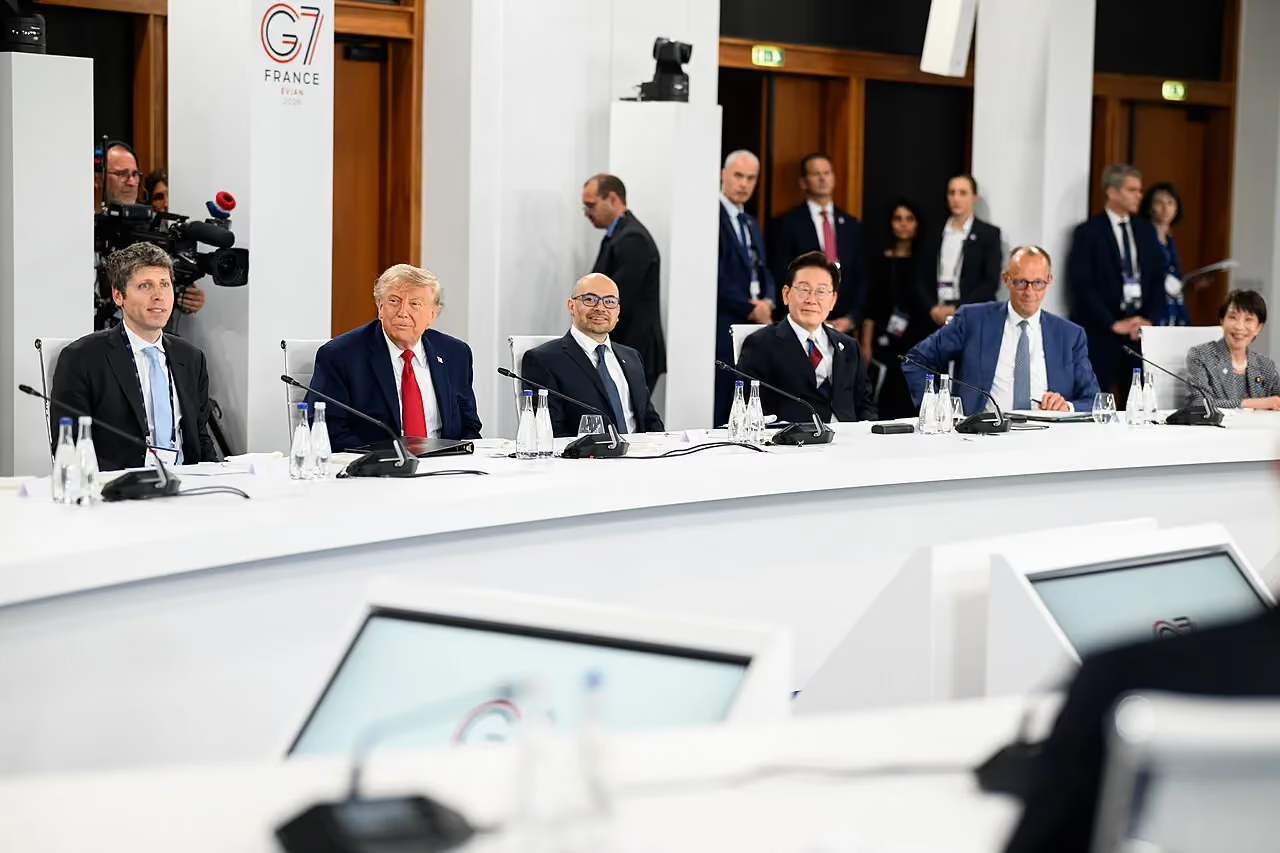
It’s unclear what processes, if any, the Trump Administration is using to guide its AI regulatory approach.
Good government is slow by design. The Constitution’s drafters built friction into lawmaking, enforcement, and adjudication so that consequential decisions would be reached only after thorough deliberation and adherence to specific processes. Artificial Intelligence (AI) is straining that design. Faced with rapid advances in AI capabilities, federal officials have begun acting at the first sign of a problem, bypassing established checks and forgoing a more inclusive, albeit slower, process. To borrow a term from new cars, the government has shifted into Sport Mode.
Absent the creation of new checks and balances in AI policymaking, AI threatens to lock the federal government into this setting. When operating in Sport Mode, officials rush to respond at the first sign of an emerging issue, bypass existing checks and balances, and ignore deliberative input from interested parties and from civil society more generally.
This is not how the federal government is supposed to work. Yet, it’s how the Trump Administration has been operating in response to the national security concerns posed by rapid and substantial advances in AI.
Three Days in Sport Mode
The Administration decided to effectively ban access to Anthropic’s Claude Mythos 5 and Fable 5 models via a process that — from what little public evidence is available — seems to have been conducted in Sport Mode.
On June 9, Anthropic released its Fable 5 model, a version of Mythos 5 that includes safeguards to protect against dangerous requests. At some point thereafter, Amazon researchers identified ways to circumvent Fable 5’s safeguards (that is, ways to “jailbreak” the model) that it regarded as particularly concerning. Amazon CEO Andrew Jassy speedily relayed that information to a handful of White House officials. The White House then reportedly contacted Anthropic, asking it to either update the model or withdraw it from use. Anthropic appears to have pushed back on the request. The frontier AI company later noted that the flagged jailbreak was of minor consequence considering the myriad safeguards it developed; notably, dozens of independent cybersecurity experts reported this same conclusion in a letter they published on June 14. The Department of Commerce, purportedly acting on its authority under the Export Control Reform Act (ECRA), directed Anthropic on June 12 to prevent foreign nationals from accessing Mythos 5 and Fable 5 until Anthropic secured a license to do so. Unable to verify which users were foreign nationals, Anthropic opted to foreclose anyone from tapping into the two highly capable models.
That all transpired in three days. As of this writing, America’s leading AI models — models that may play a pivotal role in helping entities defend against cyberattacks — remain inaccessible worldwide (including to foreign nationals employed by Anthropic). It’s unclear what’s stopping the Administration from sending similar letters to other AI labs that offer tools with similar capabilities and vulnerabilities. It’s also unclear what processes, if any, the Administration plans to put in place to make its future decisions about AI developments more transparent, predictable, and reasoned.
This vague, undefined policy posture was employed most recently to block the general release of OpenAI’s latest model, ChatGPT 5.6. The lab has agreed to the White House’s request that it make the model available only to a small group of entities approved by the Administration. No specific authority has been cited by the White House to justify its tacit ban.
Related AI governance episodes do not provide promising evidence that the other branches will return the whole of government to “deliberation mode,” as the Constitution’s drafters intended. Congress has so far failed to pass any legislation that would alter how the executive branch responds to sudden shifts in AI capabilities – by U.S. companies or foreign ones. Few members seem inclined to exercise their oversight powers as another means to ensure a more methodical approach to AI governance. While a small group of bipartisan legislators asked the Department of Commerce to provide more information on its Fable 5 process, legal authorities, technical evaluations, and criteria for renewing access to the models, to date, the government has not yet responded. The courts, although working through cases adjudicating the merits of prior AI decisions made in “Sport Mode,” such as the Department of Defense’s decision to label Anthropic a “supply chain risk,” may not produce timely, clear, and broadly applicable guidance on how the government ought to respond to similar decisions. (This is arguably as it should be. Courts act only when a plaintiff with standing brings a ripe dispute and issue rulings no broader than what’s required to resolve the instant dispute. They cannot prospectively set general rules for AI governance.)
What Frictionless Government Costs
The result of these dynamics is something close to what one of us labeled “frictionless government” in a law review article co-authored with Kristen Eichensehr. The government is especially susceptible to flawed decision-making under certain conditions—specifically, when it faces pressing decisions with national security or foreign relations ramifications and when both political parties and both chambers of Congress are aligned with (or at least not opposed to) the executive branch. Some of the nation’s gravest policy mistakes took place when these conditions were satisfied, including but not limited to the internment of Japanese-Americans, the conduct of the Vietnam War, and some aspects of the nation’s response to 9/11. Although the Fable 5 situation does not rise to the level of overwhelming policy consensus that the article identified as the paradigm of frictionlessness, there certainly are aspects that echo the perils that frictionless creates. Officials operating under such conditions, which generally include secret deliberations, are especially likely to fall prey to certain cognitive biases as they determine how to proceed
Optimism bias leads officials to overestimate the likelihood that their policy will work as intended and to underestimate, ignore, or otherwise fail to consider its downsides. Those who made the recent Fable 5 decision appear to have been influenced by this bias. Presumably, they believed that limiting access to Fable 5 would have a net positive effect on the nation’s cybersecurity posture. Their decision would not make much sense if they expected otherwise. Yet cybersecurity experts warned that this “action has taken the best models away from defenders, created market uncertainty, and risked America’s AI leadership without any real risk to justify it.”
Overconfidence bias manifests when decision-makers unrealistically value their own abilities and inflate them relative to those of their adversaries. Again, this bias seems to have played a role in the Administration’s Fable 5 process. The Administration has repeatedly and vehemently stressed the significance of ensuring that the United States stays well ahead of China in developing frontier AI tools. Yet, just days into the current suspension of Mythos 5 and Fable 5, Chinese AI developers announced an open-source model, GLM-5.2, that nears the capability of Anthropic’s models. As AI researcher Nathan Lambert observed, the result of the Administration’s regulatory posture is to put wind behind China’s sails while sending U.S. AI labs into the doldrums: “GLM-5.2 is being given time to carve out the economic underbelly of the [U.S.] frontier labs.”
Finally, the secrecy heuristic “leads people to perceive secret information as more valuable and accurate, regardless of actual differences in the quality of that information.” This cognitive miscalculation may explain why Jassy’s report on Fable 5’s jailbreaks, which has not been made public, carried so much weight with the Administration, even though many cybersecurity experts reached the opposite conclusion.
This is just a fraction of the known cognitive biases that can occur when there is too little friction between the government’s recognition of a problem and its response. We have both studied and written about the related perils of groupthink, which causes individuals to prioritize group harmony over the quality of the group’s decisions. Individuals who would have otherwise contested the group’s decision will either opt not to share their perspective or find themselves locked out of the proverbial room where it happens. Without a reliable cadre of individuals to push back against group tendencies, the group’s insular proclivities may worsen to the point that beating other groups becomes the overriding objective. “Stereotyped views of enemy leaders as too evil to warrant genuine attempts to negotiate, or as too weak and stupid to counter whatever risky attempts are made to defeat their purposes” may come to characterize policy decisions dominated by groupthink, according to scholar Irving Janis.
It’s hard not to read such thinking into some of the Administration’s recent AI decisions. In the immediate aftermath of the Department of Commerce’s decision to clamp down on Mythos 5 and Fable 5, Secretary of Defense Pete Hegseth tweeted,
Three months ago, @DeptofWar kicked @AnthropicAI out of our building—forever. Every passing day proves why that was the right move.
The White House claimed it was told that Dario Amodei, CEO of Anthropic, was generally unavailable to negotiate the deemed export control decision because he was at a wellness retreat. An Anthropic spokesperson vehemently denied the claim as “absolutely false.” This sort of “he said, she said” does nothing to inspire confidence that the decision rested on careful deliberation rather than on a White House posture toward Anthropic that had already hardened.
One could interpret these same facts differently. Perhaps the decision reflects not group dynamics but the idiosyncratic judgment of a few principals who lack a deep technical understanding of frontier AI systems. From the outside, the two are hard to distinguish, and we need not choose between them. Groupthink, personal animus, and ordinary cognitive bias all lead to worse decisions for a related reason: nothing in the process provided the friction needed for decision-makers to confront well-reasoned, contrary views before acting.
The Role of Friction in AI Governance
Friction can arise from constraints imposed by Congress or self-imposed by the executive branch, as well as from external sources, such as pressure from allied governments, lobbying by interested stakeholders, or resistance from organizations the government must rely on to implement policies enacted in a frictionless setting, such as corporations. Some readers are likely familiar with the checks the Executive can impose on itself. These include red-teaming exercises that have long helped national security officials pinpoint weaknesses in their plans by tasking certain staff members with stress-testing proposals. These checks are valuable and obvious. However, there’s reason to believe that this Administration may shy away from such practices, given serial reports of oppositional staffers being unceremoniously dismissed.
Congress can impose similar checks on the Executive. It has previously mandated that the Executive branch disclose its reasons for certain decisions before taking especially significant policy steps. This disclosure requirement increases lawmakers’ and, to the extent the Executive’s reasons are publicly available, the general public’s ability to challenge an agency’s plans and demand a new path. One starting point may be to amend the ECRA to require that the “Is Informed” letter process that Commerce used to stop foreign nationals from accessing Mythos 5 and Fable 5 include a more comprehensive and detailed analysis of the facts and findings underlying the government’s decision. Congressional appetite for this kind of legislation appears quite low today. However, as Congress increasingly recognizes the unique policy challenges posed by the speed of AI development, stakeholders concerned about errors that may result from decisions in a frictionless setting should advocate that Congress include procedural speed bumps in any broad AI package.
A more likely source of short-run friction will emerge from third parties. Affected AI labs, for instance, may pursue legal avenues to slow or reverse government actions. Additionally, scholars and researchers, such as cybersecurity experts who contested the Administration’s response to Jassy’s concerns, may publicly provide information that erodes the legitimacy of rushed government responses. Such actors can rapidly analyze emerging trends and produce authoritative findings.
If produced in a timely fashion, the resulting information will force the executive branch to evaluate its policy proposals or risk public questioning by journalists, members of Congress, and perhaps by users themselves. In the Fable 5 context, this information arguably arrived too late; neither the Administration nor the public had reason to anticipate its publication, leaving the Administration unconstrained in proceeding on the basis of a limited set of information about the Fable 5 jailbreak concerns. If, however, there were an established, transparent, and routine process by which a broad set of experts and organizations agreed to scrutinize models for different capabilities and risks and publish their findings, pressure might mount on the Executive to delay any official response until after this external process was completed.
Consider, for example, a scenario in which those cyber experts, a similar set of biosecurity researchers, and a group of political scientists focused on the extent to which AI models may facilitate democratic backsliding all agreed to publish their findings on any new model release within a finite period (say, ten business days) via a single platform. If they detect findings that raise particularly sensitive concerns (say, matters that raise significant national security questions), the platform could include a mechanism to securely relay that information to Congress and the Executive. The select members of Congress and designated Executive Branch authorities could then confirm receipt of such information.
Overall, this repository of expert analysis could serve as a bulwark against hasty government action in response to secret information. Of course, existing stakeholders, such as the US Center for AI Standards and Innovation, the UK AI Security Institute, and third-party organizations like METR, could agree to a similar deadline and direct their findings through the same publication avenue. The resulting one-stop shop for nuanced assessments of a model would provide a speed bump, slowing down drastic, hurried policy.
There’s a case to be made that Congress should formalize and subsidize a process like this, but there’s no reason experts could not stand it up sooner on a voluntary basis. So long as participating stakeholders produce findings in a reliable, transparent, and objective manner, such formalization may be unnecessary. In some ways, this is a call for a more rapid, granular, and participatory Doomsday Clock. Operated by the Bulletin of the Atomic Scientists, the Clock serves as a highly legible symbol, set after extensive deliberation by the Clock Setters, a body comprising experts in climate studies, biodefense, nuclear weapons, existential risk, and military studies. The AI equivalent would immediately convey whether a new model marks a meaningful change in capabilities, risks, and related metrics.
To sustain participation in this rapid analysis platform, a financial prize modeled on a bug bounty should reward the experts who produce the most rigorous assessment of a new model. Critically, this model would reward both the identification of harms and the confirmation of a model’s safeguards’ adequacy. A traditional bug bounty pays those who find a flaw in software. This prize should go further. It should reward the most credible account of a flagged capability or risk, whether that account confirms the danger or shows it to be overstated.
The Fable 5 episode shows why that distinction matters. The cybersecurity experts who contested the jailbreak concern performed a public service, yet a prize that paid only for risks the experts confirmed would have left their work unrewarded and, over time, tilted the platform toward alarm. A prize indifferent to the direction of the finding keeps the incentive fixed on accuracy and comprehensiveness. Who would fund the program? One or more of the many philanthropies intent on guarding against worst-case AI outcomes should. Congress and other government actors can and should assist, so long as they do so in a manner that preserves the independence and quality of the underlying research.
Conclusion
None of this is an argument against the government acting quickly in response to the novel and significant harm posed by AI models. Emergencies are real, and the constitutional system was built to meet them. The government’s response to Russia’s further invasion of Ukraine illustrates a justified, rapid mobilization. What we resist is something narrower: a response that is fast because it is insulated, the product of a process controlled by a small circle acting in secret and susceptible to cognitive biases. Speed of that kind is not a mark of resolve. It is a sign that those in charge skipped deliberative and informative checks. We don’t want federal policy regarding AI made in Sport Mode.
Ashley Deeks serves as vice dean of the University of Virginia School of Law. She is a member of the State Department’s Advisory Committee on International Law and the American Law Institute, and she serves as a faculty senior fellow at the Miller Center.
Kevin Frazier leads the AI Innovation and Law Program at the University of Texas School of Law and is a Senior Fellow at the Abundance Institute.


The Uses and Abuses of the Pardon Power
The recent flood of pardon controversies shows no signs of abating.
.jpeg)
The Fall of Fauci
The greater the scope of authority granted to a single individual, by circumstance or deliberate action, the more important scrutiny and accountability become.


.png)
.png)
Get the Civitas Outlook daily digest, plus new research and events.
Get the Civitas Outlook daily digest, plus new research and events.