The Castle, the Cathedral, and the College

By refusing to assume burdens it cannot bear, and by persisting in its proper work, the university shores up enough of civilization to make renewal possible.
“These fragments I have shored against my ruins.”
— T. S. Eliot, The Waste Land
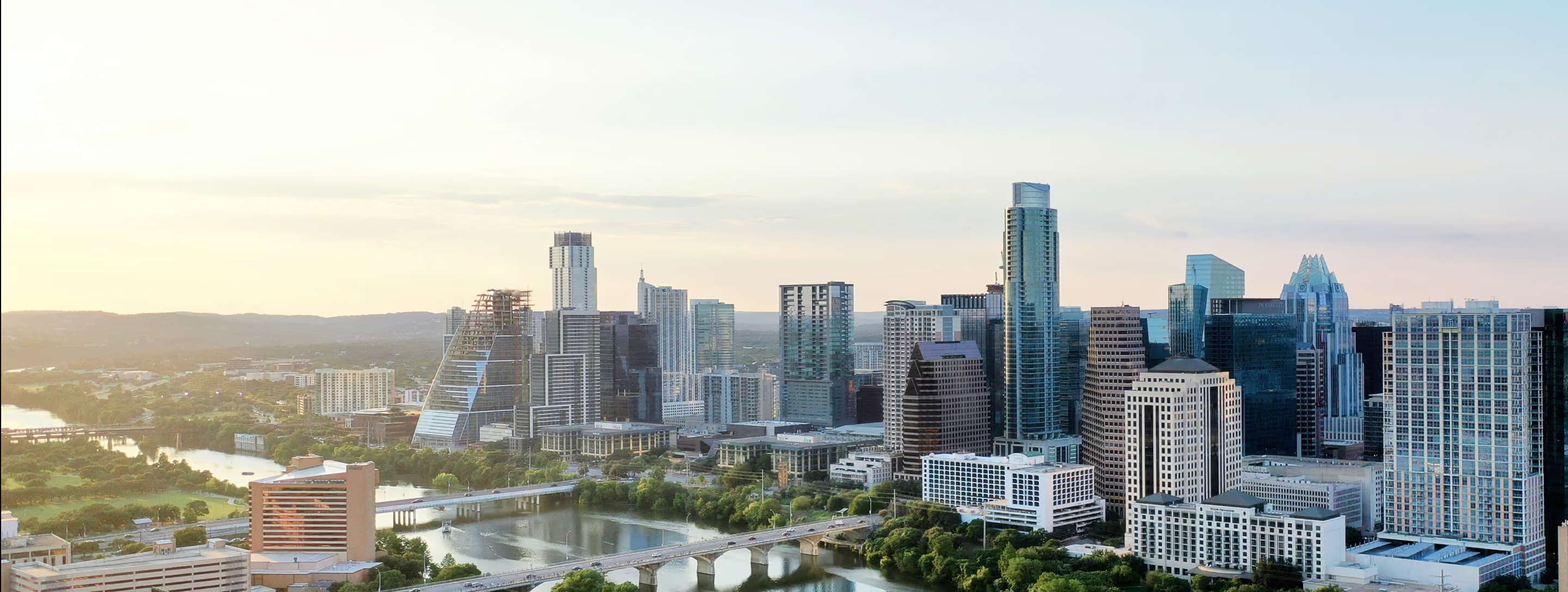
Recently, I found myself walking through Edinburgh on a slate-gray afternoon. It is a city thick with memory. Stone presses in. History announces itself at every turn — not as something settled, but as something still looming, unresolved. Edinburgh is a place of fragments carefully preserved, shored against what has been lost.
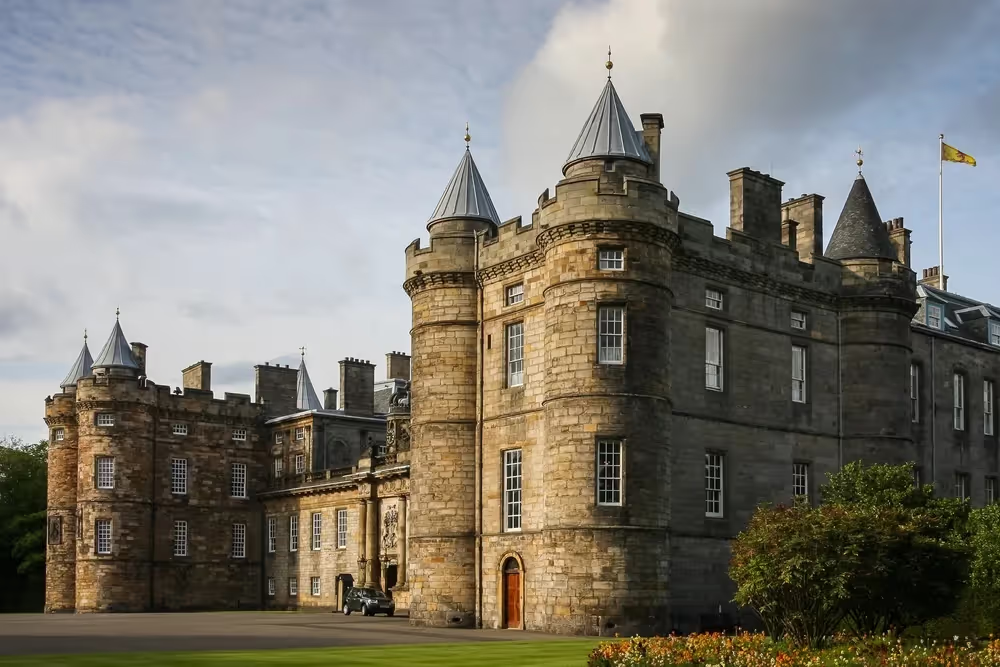
Edinburgh Castle rises above the city on a volcanic outcrop, its sandstone walls still suggesting permanence and command. Yet walking its grounds feels strangely hollow. The castle today is a managed tourist site: queues, placards, curated narratives, gift shops, a café offering scones and clotted cream. It gestures toward power it no longer possesses. The ambiance remains; the authority does not.
This scene repeats itself across Europe. Castles still dominate landscapes from the Loire to the Danube, from the Bavarian Alps to the Spanish meseta. They endure as monuments to sovereignty, even as sovereignty itself has migrated elsewhere.
As Max Weber understood, modernity is a process of rationalization in which authority moves from the concrete to the abstract. Power does not vanish; it becomes procedural, bureaucratic, and impersonal. Judgment gives way to rule-following. Legitimacy yields to compliance. The “iron cage” is not overtly tyrannical, but represents domination emptied of meaning.
The castle once situated power within a divine order. Kings ruled by grace as well as by force; even tyrants felt compelled to appeal to higher principles. Authority was visible and embodied yet constrained by standards beyond itself. Modern power, by contrast, is diffuse and opaque. It governs through systems rather than persons. The castle still stands, but sovereignty dissolves into administrative process — Kafka’s Castle, ruling through nameless intermediaries and inscrutable procedures.
From Castle Rock, I descended the Royal Mile toward St. Giles’ Cathedral, tossing a coin to a melancholy bagpiper along the way. Cathedrals remain among the most ambitious architectural achievements in human history. They were built to remind human beings of eternity, judgment, finitude, and grace. Their vertical reach trained the soul toward what exceeded it.
Inside St. Giles’, however, the experience was dispiriting. A small choral group performed treacly, inoffensive hymns while tourists milled about, filming on their phones. The vast nave functioned as a backdrop rather than a sanctuary. Quiet, awe, and inwardness — the conditions of transcendent encounter — were absent. The sacred had been domesticated and made consumable.
Charles Taylor describes modern Western life as structured by what he calls the immanent frame: a social imaginary in which meaning is assumed to arise entirely from within the natural world. Transcendence is no longer taken for granted as part of human experience. It becomes optional, and in most cases, suspect.
In such a world, cathedrals may survive as cultural artifacts, but they struggle to function as sites of the sacred. The language they once spoke — sin, redemption, sacrifice, grace — has grown faint, and for many, unintelligible.
This is not merely the culmination of secularization. It is a deeper unmooring. Our civilization struggles to explain why anything should command allegiance beyond preference or power. Obligation collapses into choice. Meaning becomes interpretive rather than given. The cathedral, like an abandoned conch shell, remains beautiful but hollow, echoing a grandeur now distant.
Passing through these evacuated symbols of power and transcendence, one might conclude that Western civilization has exhausted itself. And yet, turning down a quieter street in the gathering dusk, I came upon the neo-Gothic reading room of New College at the University of Edinburgh.
It did not announce itself. There were no crowds, no spectacle, no signage. But the lights were on. Through the arched windows, I saw students reading — actual books — engaged in sustained intellectual work. No one was filming. Nothing was being performed.
Here, unmistakably, was an institution still alive.
Historically, castles, cathedrals, and colleges formed a civilizational triad. The pursuit of power, salvation, and knowledge were the charges of distinct institutions, each with its own authority and limits. The castle governed. The cathedral oriented human life toward ultimate meaning. The college sought truth through disciplined inquiry. No single institution was asked to bear the full moral, political, and metaphysical weight of civilization.
That division of labor mattered. It allowed each institution to remain intelligible to itself. Political authority could be contested and restrained by moral and theological claims it did not itself generate. Religious authority could orient the soul without wielding coercive power. Intellectual life could seek truth without being required to legitimate sovereignty or supply a comprehensive moral vision for society.
Universities emerged within this ordered world, not in opposition to it. They presupposed a shared metaphysical horizon: that reality was intelligible, that truth was worth seeking, and that knowledge was ordered toward goods beyond power or utility. The college did not need to justify why truth mattered; that work was already being done elsewhere.
What we see today is the breakdown of this arrangement. The castle has lost sovereignty in any substantive sense. Political authority is no longer experienced as legitimate rule, but as administration: procedural, technocratic, and impersonal. Power persists, but without a shared account of why it should command loyalty beyond compliance.
The cathedral, meanwhile, has largely lost its capacity to orient society toward transcendence. Religious language has retreated into the private sphere or been translated into therapeutic or cultural terms. The claims it once made about sin, judgment, and ultimate ends are no longer publicly authoritative. Transcendence survives, if at all, as atmosphere or aesthetic.
As these two pillars weaken, their burdens do not disappear. They shift. Increasingly, they are placed upon higher education.
Universities are now expected to do what castles and cathedrals once did: legitimate authority, adjudicate moral conflict, and supply meaning. They are asked to form citizens, resolve political disputes, define justice, and articulate a vision of the good life — all while claiming neutrality about ultimate questions. This is an impossible task.
The result is the characteristic confusion of the modern university. It is expected to speak with moral authority while denying the sources of that authority. It is expected to resolve deep social conflicts through expertise alone. It is asked to provide coherence in a culture that has abandoned the very metaphysical commitments that once made coherence possible.
Under this pressure, the university oscillates between two unsustainable postures. On the one hand, it retreats into bureaucratic proceduralism, substituting rules, policies, and compliance for judgment. On the other hand, it erupts into moralized activism, enforcing norms it cannot fully explain or defend. Both responses reflect the same underlying problem: the college is being asked to carry more than it can bear.
This is not a failure of universities alone. It is a civilizational misalignment. The college cannot replace the castle or the cathedral without ceasing to be a college. When it tries, it loses its distinctive vocation: the patient, disciplined pursuit of truth.
What is needed, then, is not for universities to become more expansive in their ambitions, but more restrained. They must recover a sense of their own limits. Their task is neither to redeem society nor to serve as its highest moral court. It is to sustain serious inquiry across generations, to preserve the conditions under which truth can be sought, argued over, and transmitted.
T. S. Eliot understood that shoring fragments against ruins is not to imagine that what is ruined can be restored. It is an act of fidelity rather than ambition, holding fast to what still bears meaning when larger structures have failed. Shoring is not reconstruction. It is endurance.
This is the university's proper task. Its calling is not to repair politics or to re-enchant the world. Those are not the purview of the academy, and universities deform themselves when they have such aspirations. The task of the college is narrower and more demanding: the disciplined pursuit of truth through reasoned inquiry, sustained patiently across generations.
If universities remain faithful to their original purpose — truth-seeking governed by standards of argument, evidence, and judgment — they preserve something essential that neither politics nor religion can recover once it is lost. They do not supply authority or meaning, but preserve the conditions under which authority might again become legitimate, and meaning again intelligible.
In this sense, the college does not replace the castle or the cathedral. It buys time. By refusing to assume burdens it cannot bear, and by persisting in its proper work, the university shores up enough of civilization to make renewal possible.
Walking back through Edinburgh at dusk, I felt I had passed through an allegory of the modern West: power preserved as spectacle, transcendence reduced to an aesthetic, and scholarship quietly holding its ground. The lights are still on in the reading room. For now, that may be enough.
Pano Kanelos is a Senior Fellow at the Civitas Institute and Director of the Center for the Future of Higher Education.


The Great Books and Great Books: An Education for Liberty
Let us come together around these books and join the great conversation that has been unfolding across the centuries.
The Constitution of Academic Freedom
“If the university no longer seeks the production and dissemination of knowledge, it loses the primary justification for its academic freedom.”
.avif)
Trump's Overreach Against Harvard
A close look at the allegations in the second complaint provides further evidence that Harvard should not be forced to relitigate old issues in a new forum.



.png)
.png)
Get the Civitas Outlook daily digest, plus new research and events.
Get the Civitas Outlook daily digest, plus new research and events.