
The Courage of Justice Thomas

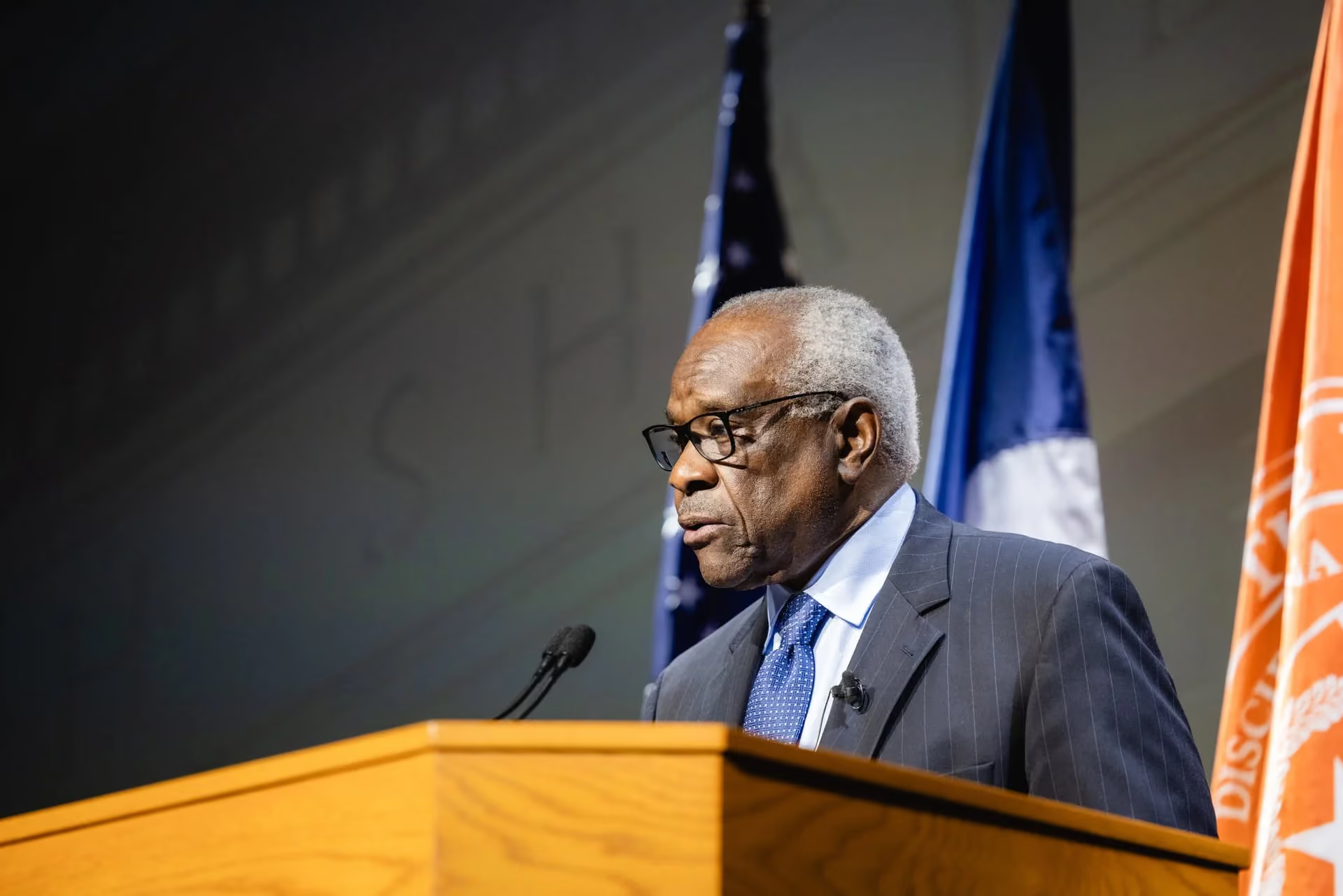
Courage was the theme of Justice Clarence Thomas’s recent, profound speech at the University of Texas.
Almost fifty years ago, Alexander Solzhenitsyn addressed the graduating class of Harvard University in a speech he entitled “A World Split Apart.” In 1978, the Cold War was growing hot, and the most obvious split in the world was between East and West, pitting the Soviet Union and the Warsaw Pact against the United States and its NATO allies. The speaker thought that the West was in danger of losing that war, not only militarily but (worse) by a preemptive philosophical and spiritual surrender. “A decline in courage,” Solzhenitsyn said memorably, “may be the most striking feature that an outside observer notices in the West today.”
Courage was the theme of Justice Clarence Thomas’s recent, profound speech at the University of Texas. Like all his Supreme Court opinions and his (rare, alas) public speeches, this one reverberated across the country and will be pondered for a long time to come. It was a meditation on truth—as well as on the obstacles and even resistance to truth that Thomas has confronted in his long life, particularly in his career as a distinguished jurist. Without courage, he argued, one cannot serve well either truth or the Constitution. Though the occasion of his remarks was the approaching 250th anniversary of the country, the speech had two distinct themes. The first was Thomas’s tribute to the Declaration of Independence, which began with comments on its famous asseveration “that all men are created equal, that they are endowed by their Creator with certain unalienable rights….” A familiar subject, but in Thomas’s hands, as always, given a distinctive and deeper treatment. For the Justice, these self-evident truths were not “academic playthings” but noble foundations of “a way of life.” Pausing only a moment to allude to the philosophical meaning of self-evidence, he accosted these truths as “articles of faith” so obvious as to require no “proof, argument, or explanation.” They were “the Holy Grail, the North Star, the rock—immovable and unquestioned” at least among the black Americans he grew up with and among the nuns, mostly Irish immigrants, who taught him in Catholic school.
“Somehow, without formal education, the older [black] people knew that these God-given or natural rights preceded and transcended governmental power or authority,” he recalled. “When you lived in a segregated world with palpable discrimination and the governments nearest to you enforced laws and customs that promoted unequal treatment, it was obvious that you did not get your rights or your dignity from those governments, but from God.”
How striking that the contours of his own life led Thomas to recognize that as central as the principle “all men are created equal” was to the Declaration’s epic greatness, the final sentence surpassed it in a way. “And for the support of this Declaration, with a firm reliance on the protection of Divine Providence, we mutually pledge to each other our lives, our fortunes, and our sacred Honor.” This pledge, which the signers made to each other, revealed an element of honorable inequality at the heart of the Declaration, as a kind of necessary complement to the great document’s thematic emphasis on human equality.
“Nothing in the Declaration of Independence, I now realize,” said Thomas, “matters without that final sentence. Without that final sentence,” the Declaration is mere words on parchment, “nice words” but just words. “What changed the world was not the words but the commitment and spirit” of those who were willing to “labor, sacrifice, and even give their lives…for the Declaration’s principles.” The name for that kind of willingness is courage. Without that virtue, that compelling excellence of character, America would not exist—and has little chance of continuing in existence.
With this argument, Thomas brought together the Declaration, Lincoln at Gettysburg (“the last full measure of devotion”), and Martin Luther King at the Lincoln Memorial. Such nobility in word and deed seems rarer these days, as Thomas noted when he turned from honoring the Declaration to criticizing Woodrow Wilson and the Progressive movement more generally. As if to confirm his expectations, it is this second part of his remarks that has drawn fire.
His decades of service in Washington, D.C., had exposed to him, argued the Justice, the reality of our downturn in civic cohesion and aspiration. At the root of the malady was growing uncertainty about what America’s convictions are, or ought to be. And the primary cause of that confusion was the “new set of first principles of government” injected into “the American mainstream” by the progressives and “most prominently,” by Woodrow Wilson, ventured Thomas.
Though this isn’t a new argument for Justice Thomas, nor for the conservative movement (Claremont scholars have been making it, or a version of it, for 40 years), Thomas gave it new prominence in his remarks commemorating the 250th. Immediately, the American Left counterattacked. “In his recent broadside against the 20th century,” commented Matt Ford, a staff writer at The New Republic, “the justice is as ill informed as he is mean-spirited.” Of course, the Left gave up its old enthusiasm for Woodrow Wilson some time ago; he was, after all, a notorious racist and anti-feminist, positions no longer as esteemed by the Democratic party as they once were.
Nevertheless, today’s progressives cannot abandon Wilson and the original Progressives, either. They cope mostly by shunning the close analysis of his and his coadjutors’ words and deeds, and by turning a blind eye to the intellectual and political connections between them and the larger, and later, progressive movements that culminated in the New Deal, Great Society, and the Obama-Biden manic-depression. There is, in fact, a very good book analyzing and refuting these stubborn historical denials, Bradley C.S. Watson’s Progressivism: The Strange History of a Radical Idea (Notre Dame).
These larger truths are what Justice Thomas appealed to in his speech. As to the contradictions he asserted between the moral and political assumptions of the Progressives like Wilson and John Dewey (who is also explicitly criticized in the speech) and the moral and political assumptions of the Founders as expressed in the Declaration and the Constitution, Thomas is basically correct. But it will take courage to admit it, and to face up to it; and he indicated as much. Progressivism, he concluded, “has coexisted uneasily with the principles of the Declaration. Because it is opposed to those principles, it is not possible for the two to coexist forever.”
Charles R. Kesler is the Dengler-Dykema Distinguished Professor of Government at Claremont McKenna College and editor of the Claremont Review of Books. His latest book is Crisis of the Two Constitutions (Encounter Books, 2026)
Symposium on Associate Justice Clarence Thomas’s Remarks on the Declaration of Independence
.avif)
Reclaiming Our American Inheritance
Thomas’s message is the same insight Abraham Lincoln invoked against Chief Justice Taney’s sophistry in the Dred Scott decision.
Three Generations of Living Constitutionalists Is Enough
Justice Thomas radiates a fundamental sense of decency, humility, and respect for the dignity of every human being—he lives the virtues of which he speaks.

.avif)
The Declaration’s Truths Heal a Multitude of Errors
Attacks on the Declaration from both the left and the right deny the universal character of its self-evident truths and their foundation in natural law.
.avif)



Get the Civitas Outlook daily digest, plus new research and events.
Get the Civitas Outlook daily digest, plus new research and events.