ISS and Glass Lewis Can’t Stop Texas

The Lone Star State may beat proxy advisors in yet another way—by making them irrelevant.
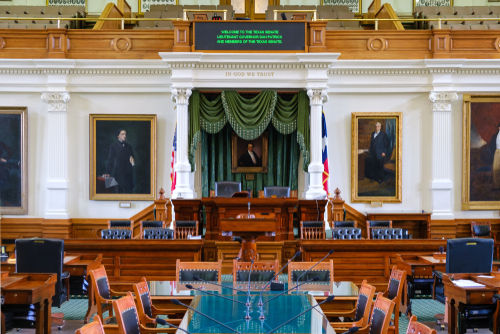
While billed as a discussion of the state’s proxy disclosure law (Senate Bill 2337), the Texas Senate hearing last week revealed far more about the broader vision underpinning the Lone Star State’s efforts to become the go-to venue for business.
Convened by state senator Bryan Hughes, whose 2022 hearing on “environmental, social, and governance” (ESG) investing is credited with prompting asset manager Vanguard to resign from a major “net zero” alliance focused on reducing carbon emissions, the session included Texas attorneys who have recently helped large cap companies reincorporate in the state and public policy experts who have tracked the emergence of progressive gatekeeper organizations, such as the proxy advisory firms, which seek to channel the deployment of private capital toward investments that check various social and environmental criteria.
The major proxy firms, Institutional Shareholder Services (ISS) and Glass Lewis, were invited to the hearing but declined to attend. The refrain from the lawmakers and policy experts who testified was that companies exist to generate financial returns for their shareholders, and that Texas corporate law must continue to uphold shareholder primacy to help them do it.
The big question, however, is what shareholders want. Texas is making a big bet that the answer is profits over social and environmental activism. So far, it’s paying off. According to Benjamin Edwards of the William S. Boyd School of Law at UNLV, Texas gained more reincorporations (15) than any other state, and those companies, including mega-cap ExxonMobil and Dell, accounted for more than 90 percent of the total value of all firms that redomiciled this year.
But support for corporate relocations has not been uniform. The lawmakers also discussed the defeat that shareholders dealt Texas Capital Bancshares’ effort to redomicile in the state, and the decision by e-commerce company Mercado Libre to drop its plans to do the same when it became clear that shareholders were against it.
The fight for shareholder approval is the backdrop to the state’s standoff with proxy giants ISS and Glass Lewis, which together control more than 90 percent of the shareholder advisory business. The advisors have recommended against all but one Texas reincorporation, even as the companies have selected different items from the new menu of corporate governance options now allowed under the Lone Star State’s recent business law reforms.
The impact of the proxy recommendations is what concerns Texas policymakers. Manhattan Institute senior fellow James Copeland, who testified at the hearing, has found that support for company proposals drops 15-30% when ISS and Glass Lewis oppose them.
The pull that proxy firms have on shareholders affects far more than public companies’ ability to reincorporate in Texas. Shareholders also vote on director elections, executive pay, and proposals on environmental and social topics, all of which can significantly impact the company’s profitability.
For example, ISS backed the election of three ExxonMobil directors nominated by the impact investment firm Engine No. 1, claiming that the company’s projections for future oil and gas demand were “overly optimistic” and new leadership was needed to bolster the board’s commitment to “energy transition.” Both major proxy firms also supported environmental, social, and governance (ESG) resolutions, such as the 2021 proposal requiring Chevron and ExxonMobil to pay more attention to scenarios in which global oil demand dropped by 75 percent.
The support from ISS and Glass Lewis for diversity targets, climate initiatives, and other policy issues has prompted a response from policymakers who fear that the proxy firms will sway shareholders into approving actions that will harm business. The Trump Administration and multiple states are pushing for greater oversight of the proxy firms. The principal motivation behind these efforts is to protect shareholder value and the efficient operations of public companies, not to lure businesses to move their legal charters to another state.
Since a Texas federal court blocked Senate Bill 2337, the fight over proxy advice has escalated into a multistate battle, with ISS and Glass Lewis filing lawsuits to enjoin Kansas’ and Indiana’s recently enacted disclosure laws. These measures aim to fill a legal hole, as Brad Hubbard from Gibson Dunn explained at the hearing. Before Texas’ first-of-its-kind law, the proxy firms were subject to no federal or state disclosure requirements. If the new state requirements survive the court challenges, the proxy firms will need to disclose when their advice considers factors other than shareholder value, provide an economic rationale for departing from management’s recommendation, and report when their advice differs materially across clients.
The impasse between the states and the proxy firms isn’t likely to resolve itself anytime soon. At least nine more states are considering proxy disclosure rules. The cross-country effort will invariably lead to court challenges that could take years to work through the appellate process.
In the meantime, there’s little indication that proxy firms will embrace voluntary disclosure. ISS and Glass Lewis didn’t tell shareholders that they are in litigation with Texas when recommending against virtually all the Lone Star State redomiciles. Investors are still in the dark about when proxy firms make recommendations on companies that are also their consulting clients.
The irony is that by pushing businesses to adopt more progressive policies, ISS and Glass Lewis are reinforcing a basic tenet of business: firms tend to act in their own best interests. In 2021, the German-based Deutsche Börse Group purchased ISS as part of its “ESG growth strategy” and as a “further demonstration of Deutsche Börse’s commitment to ESG,” according to a company press release. Peloton Capital Management, the Canadian private equity firm that owns Glass Lewis, describes ESG as a “key factor in investment decision-making.”
As Texas State Senator Charles Perry emphasized during the hearing, state laws are important, but corporate governance ultimately comes down to a market decision as to what comes first: company bottom lines or individual policy preferences. Fiduciaries are choosing Texas. Corporate boards are supporting redomicile plans. The size of the vote margins suggests that large asset managers are also viewing Texas business law as aligned with their shareholders’ best interests.
Management teams and investors should take note: without the required disclosures, it’s unclear how ISS and Glass Lewis weigh economic and noneconomic factors when advising on company policies. But Texas’s policy is clear: the state wants businesses to thrive as businesses. However the regulatory effort to shine a light on ISS and Glass Lewis turns out, the Lone Star State may beat the proxy advisors in another way—by making them irrelevant.
Michael Toth is director of research at the Civitas Institute at the University of Texas at Austin.

ISS and Glass Lewis Can’t Stop Texas
Texas’ policy is clear: the state wants businesses to thrive as businesses.

The Forgotten Greenspan Great Moderation Legacy
Alan Greenspan deserves to be remembered as one of the most consequential and successful central bankers in American history.

Can Socialist Fantasies Overtake the World?
Yes, if the unworldly philosophers at the Global Justice Project are allowed to have their way.






Get the Civitas Outlook daily digest, plus new research and events.
Get the Civitas Outlook daily digest, plus new research and events.