
Why Professor Mokyr's Nobel in Economics Matters

Three cheers for the recent award of the 2025 Nobel Prize in Economics to Professor Mokyr and his contributions to the field of economic history.
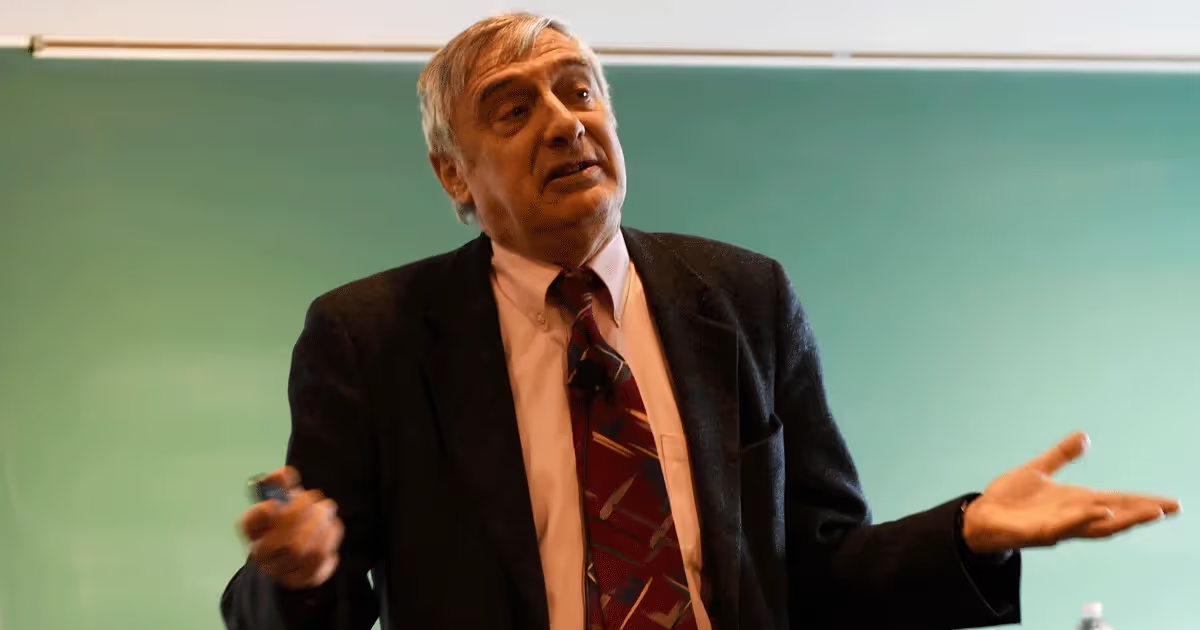
History is back in town, at least in the world of economics. The announcement of the 2025 Nobel Prize in Economics earlier this month revealed that the award was shared between three illustrious scholars: Joel Mokyr, an economic historian who studies the economic history of Europe, is the Robert H. Strotz Professor of Arts and Sciences at Northwestern University, where he teaches economic history. The other recipients are economists Phillipe Aghion from France, who teaches at the London School of Economics, and Peter Howitt, who is Brown University Professor Emeritus of Economics. Mokyr’s receipt of the top prize in the discipline has been met with a particular chorus of cheer, as well as surprise. In his own words, “I’m an economic historian. We don’t win Nobel Prizes”. For those voices arguing the relevance of history, this award provides tentative vindication in a decades-long battle for the soul of economics.
Despite Mokyr’s self-deprecating response, the significance of the moment cannot be overstated. For starters, Mokyr took fifty percent of the prize, whilst the other two recipients received 25 percent respectively — something that surely elicits a wry smile from other historians. But more significantly, when the award committee recognized Mokyr for “having identified the prerequisites for sustained [economic] growth through technological progress”, they explicitly singled out his use of historical sources in uncovering these gems.
This recognition confirms what economic historians have been arguing for decades with mixed success: history matters in economics. Whilst the mathematical logic of Aghion and Howitt sits comfortably with the norms of the top economics journals, Mokyr’s extensive scholarship is marked by a relative dearth of publications in the feted “top five” economics journals (The American Economic Review, Econometrica, the Journal of Political Economy, the Quarterly Journal of Economics, and the Review of Economic Studies). By contrast, here is a man whose corpus of knowledge can be found in hefty tomes and journals of history. A scholar whose illuminating insights are carefully crafted in the written verse, not the dense mathematical script that dominates the graduate training of most Ph.D. economists.
Why does any of this matter? The last time an economic historian in the mold of Joel Mokyr won a Nobel Prize in Economics was back in 1993, when the late Douglass North — then a faculty member at Washington University in St. Louis — took half the prize for his pathbreaking insights into how institutions, which are the humanly devised constraints that shape our interactions and incentives, such as laws, regulations, norms, and traditions, can be so decisive for long-term economic performance. Even then, despite North being extremely well-versed in the world of history, which was central to his academic contributions, the committee chose to emphasize his use of economic theory and quantitative methods in achieving this scholarly apex. Although there have been other historically interested economists who have taken the discipline’s top prize in recent decades, their modus-operandi remains firmly rooted in the world of economics, with the craft of the traditional historian ranking far down the pecking order.
Nevertheless, qualitative research methods, which gather and analyze sources such as texts, images, audio, and other non-numerical information, remain an important instrument in the economist’s toolkit for explaining fundamental economic concepts such as institutions and culture. And whilst there’s no doubt that quantitative data can help shine a light on what happened in the past, qualitative methods remain central to understanding the “why” part. History is seldom determined by inexorable forces beyond human control, but rather by decisions taken by individuals at key moments. Here we see the value of “thick” historical descriptions, which unpack the beliefs and actions of the main actors. Words can help extend our understanding beyond narrow factual accounts by teasing out the wider context in which the big decisions were taken, and how they contributed to the making of history as it is, rather than other possible outcomes.
In a world where such a high price is placed on the economist’s repertoire of technical skills and methodological finesse, Mokyr stands as a breath of fresh air and a beacon of reason. Particularly noteworthy is his sustained engagement with the history of ideas: that melting pot of human ingenuity — and at times stupidity — that has ultimately propelled humanity’s transformation from the swamp to the skyscraper. The history of economic thought and ideas has regrettably been driven out of economics departments over the last four decades, unable to satisfy an insatiable desire for yet more quantitative rigor. It has been similarly disowned by history departments, who perceived it with an air of mistrust, instead favoring allegedly more relevant sub-fields in social and cultural history. Mokyr’s award goes a long way in exposing how regrettable these decisions were.
Let this moment be a hopeful one for the economics discipline going forward. It is easy to indulge false binaries and to pit disparate methodological approaches into needless competition with one another. In the spirit of scholarly collaboration, Mokyr and Aghion had been working on a book before the announcement of their Nobel Prize. Therefore, let us recognize the immense contributions of both qualitative historical methods and quantitative economics, and renew our alliance to unravel the secrets of long-term prosperity. Mokyr has reminded the world that by weaving history into our study of the economy, we not only observe the process of economic growth, we give it meaning.
Joshua Banerjee is an assistant professor of intellectual history and economics at the School of Civic Leadership, and a Civitas Fellow, both at the University of Texas at Austin.


From Milton Friedman to Alexander Hamilton: Why J.D. Vance’s Economic Vision Needs James Madison
Loftily stated goals do not remove the risks of concentrated benefits, dispersed costs, and political capture.

On Debt: Two Honest Measures, Two Different Questions
A response to Thomas Savidge's '“Full Faith and Credit” Means a Claim on America.'



Get the Civitas Outlook daily digest, plus new research and events.
Get the Civitas Outlook daily digest, plus new research and events.