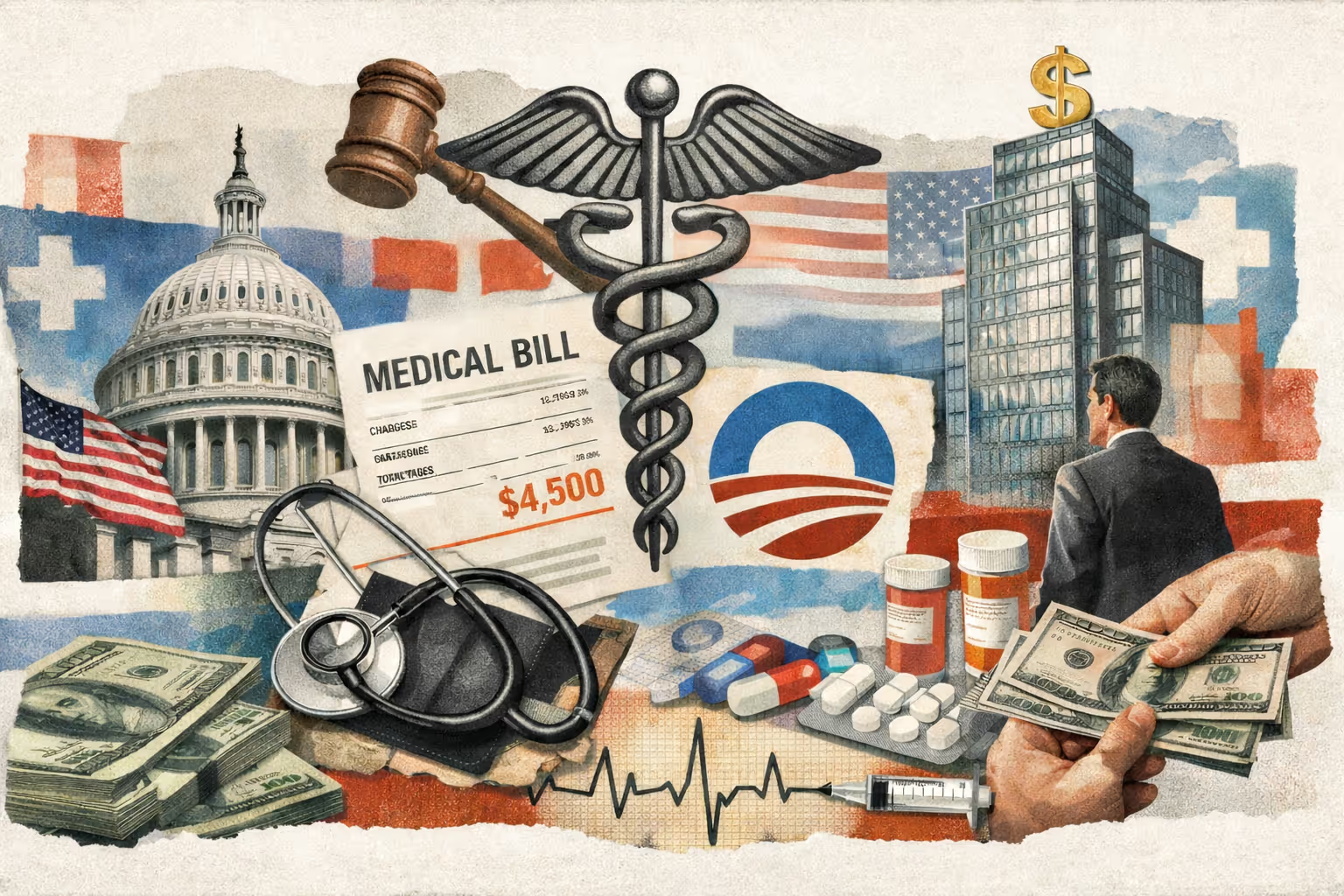
Stop Subsidizing Insurers, Start Empowering Patients

Washington's health-care debate has long focused on affordability, and understandably so. Individual market insurance premiums have tripled since 2013. Millions of Americans are feeling those premium hikes even more sharply now that the pandemic-era enhanced subsidies have expired.
But spending billions upon billions of taxpayer dollars on premium subsidies only obscures the fundamental problems that have made insurance unaffordable. Instead, policymakers need to shift power away from third-party payers and back to patients. Doing so would give consumers more control over their healthcare dollars and force providers to compete for their business.
The result would be a healthcare system that is more responsive to patients' needs, more transparent, and ultimately more affordable.
Today's affordability crisis has been more than a decade in the making. Obamacare, signed into law in March 2010, required insurers to cover ten essential health benefits and forbade them from pricing coverage based on health status or history. Those mandates increased the cost of coverage for many Americans.
Rather than addressing those cost drivers, Obamacare tried to mask them with subsidies. The Biden administration's pandemic-era enhanced subsidies were an extension of that approach, adding more federal dollars to stabilize an expensive system rather than reforms that would make coverage cheaper in the first place.
Subsidizing demand does not make health insurance cost less. It mainly changes who pays— shifting the bill from patients to taxpayers — while leaving the underlying incentives intact.
What the system needs instead is a dose of consumerism with reforms that allow patients to shop, save, and choose, and that unleash competition for healthcare dollars.
A natural place to start is by expanding access to health savings accounts. HSAs are triple tax advantaged. Contributions are untaxed, interest and earnings accrue tax-free, and withdrawals are not subject to tax when used for qualified medical expenses.
When patients pay out of pocket rather than have their insurer pay, they behave differently. They're more likely to ask what services cost, compare options across providers, and avoid low-value care. Providers, in turn, must compete for patients' business. Such competition can put downward pressure on prices and reward higher-quality care.
HSAs also expand patient choice. Individuals need not settle for providers in their insurer's network. They can visit any clinic and may even receive a cash discount for sparing providers the burden of dealing with insurance. Patients can pay for care they value instead of being limited to what an insurer covers.
Unfortunately, federal rules limit the usefulness of HSAs. To contribute, individuals must have a high-deductible health plan, defined as a plan with a deductible of at least $1,700 for an individual or $3,400 for a family. Contributions are capped this year at $4,400 for an individual and $8,750 for families. Medicare beneficiaries cannot contribute. And HSA funds generally cannot be used to pay insurance premiums.
Congress should relax these constraints. Anyone should be able to contribute to an HSA. Contribution limits should be higher. Account holders should have more flexibility in how they can use their savings.
These changes would align with President Trump's stated desire in his Great Healthcare Plan to give individuals control over their healthcare dollars, rather than insurance companies.
The same consumer-driven logic supports broader adoption of Individual Coverage Health Reimbursement Arrangements. ICHRAs allow employers to reimburse employees on a tax-free basis for purchasing insurance in the individual market. As such, they're an alternative to the conventional employer-sponsored health plan.
ICHRAs give patients the ability to purchase coverage that meets their needs, rather than settling for what their employer might select. As more consumers enter the individual market, more insurers are likely to meet them and compete more aggressively for their business. The result will be more choices and better value.
ICHRAs also enable consumers to own their health policies and take them from job to job. That portability reduces job lock and promotes a more efficient labor market, as workers are freer to choose positions that best match their skills rather than those with the most generous benefits.
Expanding access to short-term health plans can further improve affordability. Because they're exempt from Obamacare's mandates, they’re often far less expensive than exchange coverage.
Short-term plans can vary premiums based on a person's health status or history and can deny coverage. Consequently, they tend to be best for people who are young, between jobs, or need a bridge, say, between a health plan of their own and a spouse's.
The Biden administration curtailed the appeal of short-term plans by limiting them to three months, with an option for a single one-month extension. Many states have imposed additional restrictions.
During his first term, President Trump enacted rules allowing short-term plans to last up to one year and be renewed for up to three years. Congress should consider codifying that framework to make short-term plans a credible, affordable alternative to exchange coverage.
In the longer term, policymakers should explore health plan designs that empower individuals rather than insurers.
Consider the potential for guaranteed renewable health insurance.
This model addresses the central challenge of health insurance: protecting people against becoming sick without destroying the risk-based pricing that allows insurance markets to function.
Obamacare's mandates protect people with pre-existing conditions, but at the cost of higher premiums for everyone else and ever-larger subsidies to keep the system afloat.
Guaranteed renewable coverage offers a different path. It encourages people to buy coverage before they are sick and submit to medical underwriting once. In exchange, they are guaranteed the right to renew their policy even if their health deteriorates. Premiums can still change with age and general medical inflation, but not because someone develops a serious condition, so long as they maintain continuous coverage.
This model aligns incentives. Consumers are encouraged to buy insurance early, when they are low risk, and are rewarded for maintaining continuous coverage. Those who delay face higher premiums, which is a transparent price signal rather than a government mandate.
Insurers, meanwhile, have strong incentives to invest in prevention and disease management, since they benefit when their beneficiaries remain healthy and do not need expensive care.
Taken together, these reforms would move the U.S. healthcare system away from an insurer-centric, subsidy-dependent model and toward a consumer-driven one, where patients control more of their healthcare spending and providers compete to serve them.
Sally C. Pipes is President, CEO, and Thomas W. Smith Fellow in Health Care Policy at the Pacific Research Institute. Her latest book is The World's Medicine Chest: How America Achieved Pharmaceutical Supremacy — and How to Keep It (Encounter 2025). Follow her on X @sallypipes.




Get the Civitas Outlook daily digest, plus new research and events.
Get the Civitas Outlook daily digest, plus new research and events.