
The Original Sin of U.S. Health Care

The United States cannot simply erase decades of distortion overnight.
If we want a patient-centered health care system, the simplest and best way to achieve it is to put patients in charge of the money that funds their care.
That principle sounds obvious, almost banal. In nearly every other sector of the economy, consumers decide how their money is spent, and suppliers compete accordingly—on price, quality, service, and innovation. Health care is different not because it must be, but because we have constructed a system in which patients are systematically insulated from the economic consequences of their decisions. The largest and most consequential reason for this insulation is a mid-twentieth-century tax policy accident: the exclusion from taxation of employer-sponsored health insurance.
The exclusion of employer-sponsored insurance from income and payroll taxes is often described as a subsidy, but that framing understates its effects. It is better understood as the original sin of U.S. health care: the policy choice that pushed American health care onto a path of cost escalation, opacity, and misaligned incentives from which we have never fully recovered. Nearly every dysfunction in U.S. health care that reformers complain about today can be traced, directly or indirectly, to this single decision.
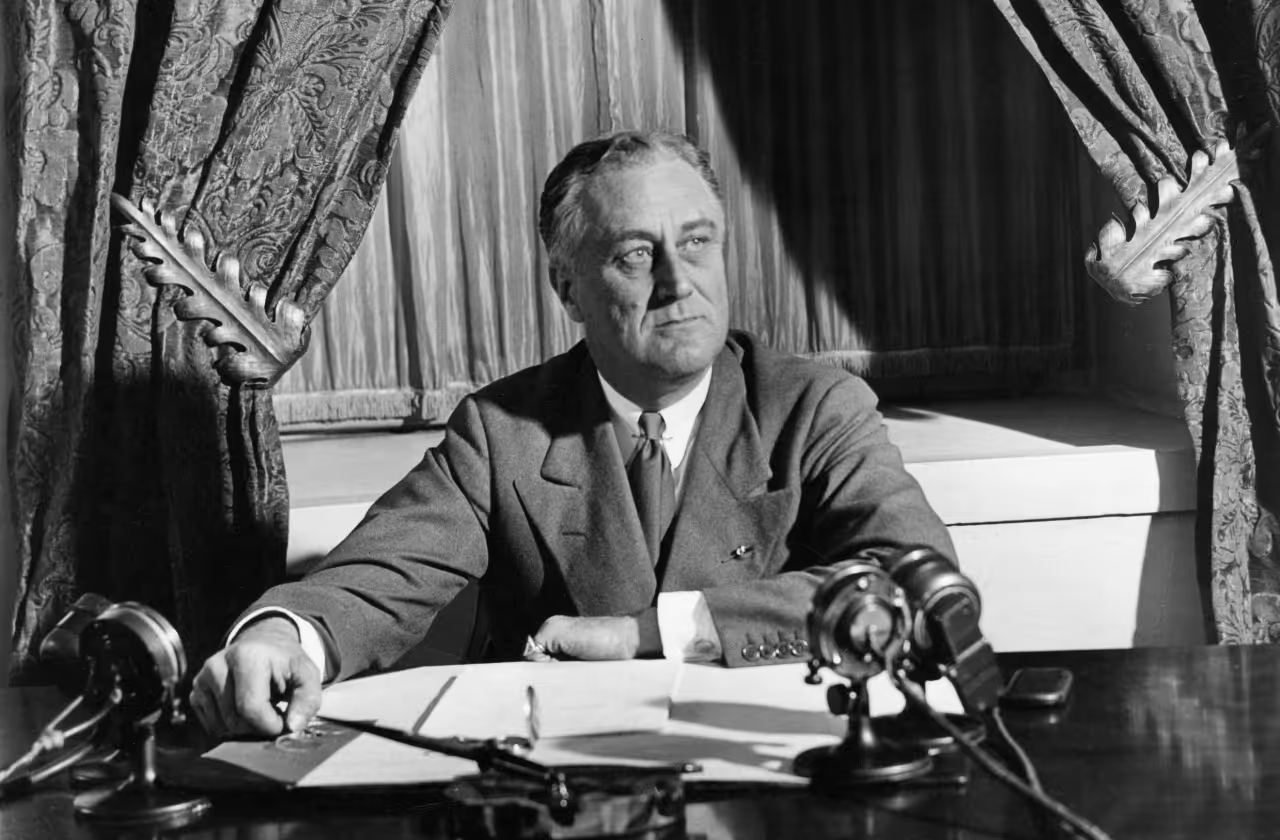
In 1942, President Franklin Delano Roosevelt signed the Stabilization Act of 1942, which required employers to adhere strictly to a federally controlled schedule of salaries and wages for U.S. workers. Congress and the President were concerned that, with young American men off to war, employers would raise wages to compete for increasingly scarce workers, leading to a wage-price spiral and an inflation crisis. Employers quickly found a workaround. The wage control system did not account for fringe benefits, such as health insurance. Employers began offering health insurance to compete for scarce workers. In 1943, the Internal Revenue Service ruled that these benefits were exempt from taxation. As more Americans became subject to the federal income tax, employer-sponsored health insurance became increasingly popular. By 1945, 32 million Americans had employer-sponsored coverage — 30 percent of the population — compared to 1.3 million in 1940.
The World War II-era loophole limited the value of the health insurance benefit to 5 percent of a worker’s salary. But in 1954, within an overhaul of the Internal Revenue Code, Congress excluded the value of employer-sponsored health insurance from all taxation, including federal, state, and local income taxes, as well as Medicare and Social Security payroll taxes.
The exclusion of employer-sponsored insurance from taxation effectively forced workers to become dependent on their employers for health insurance. Imagine a worker in the 22 percent federal tax bracket, paying a 4 percent state income tax and 7.65 percent in FICA, for a total of 33.65 percent. That worker keeps 66.35 cents after tax for every additional dollar received in wages. But that same dollar, if spent on employer-sponsored health insurance, is worth 100 cents: a 51% premium.
The consequences were profound. By making health insurance tax-advantaged only when purchased through one’s employer, federal policy effectively forced workers to obtain coverage through their jobs rather than on their own. Compensation that might otherwise have been treated as wages was instead funneled into ever more expensive health plans. Employees lost visibility into what their coverage actually cost, because premiums were deducted pre-tax and often paid largely by employers. Health insurance ceased to feel like something individuals purchased, evaluated, or could reasonably replace.
This distortion created at least four cascading effects that still define American health care today.
First, it destroyed price sensitivity. When consumers do not perceive themselves as paying for a product, they predictably consume more of it and care less about its cost. In health care, this manifests not primarily as overuse of services — Americans use fewer services than patients in many other rich countries — but as indifference to prices. Patients rarely ask what a procedure costs, what alternatives exist, or whether a provider is competitively priced. Providers, in turn, face little resistance when raising prices.
Second, it created a structural conflict of interest between employers and employees. Workers want affordable, high-quality coverage that meets their individual needs. Employers want benefit packages that help recruit and retain workers, while minimizing administrative hassle. These goals overlap only imperfectly. Because employees rarely see the true cost of their benefits, they often resist cost-containment strategies that would ultimately raise their wages, such as narrower networks or tougher price negotiations. Employers become de facto health plan sponsors rather than neutral facilitators of worker choice.
Third, it warped insurer incentives. In the employer market, insurers are typically paid a regulated percentage of total premiums. When premiums rise, insurer revenues rise with them — even if underlying medical costs are inflating rapidly. In a system where buyers are largely indifferent to price, insurers face muted pressure to aggressively control costs. This incentive problem is far weaker in individual markets, where consumers are directly exposed to premiums and reward lower-cost plans.
Fourth, it turned health insurance into a catch-all payment mechanism for routine and predictable expenses. We do not use auto insurance to pay for gasoline or oil changes, because doing so would predictably drive up premiums. Yet in health care, the tax code strongly encourages comprehensive coverage that pays for services only loosely related to insurable risk. As more services are routed through insurance, they are pulled into the same inflationary spiral.
The result is a system that is neither meaningfully market-driven nor effectively regulated. The United States spends far more per capita subsidizing health care than any other advanced country — $7,438 per capita in 2022, on a purchasing power parity-adjusted basis, compared to a median of $3,144 in other wealthy countries — yet ranks poorly on affordability and fiscal sustainability. A substantial share of that subsidy flows not through visible spending programs, but through the tax exclusion itself.
It is fashionable to argue that the solution to America’s health care problems lies in eliminating “middlemen.” But there is no costlier middleman in health care than the employer. Employers do not specialize in health care purchasing, nor should they. They exist to produce goods and services unrelated to medicine. Forcing them to act as insurance brokers is inefficient at best, and destructive at worst.
Other countries demonstrate that universal coverage does not require employer control. Switzerland, for example, achieves universal insurance through individually purchased plans, with income-based subsidies and robust competition among insurers. Consumers choose their coverage directly, switch plans freely, and face clear price signals. The Swiss system delivers better outcomes and lower costs than the United States while preserving choice and innovation. The key difference is not regulation versus markets, but who controls the money.
The United States cannot simply erase decades of distortion overnight. It has proven politically challenging to abolish the employer exclusion outright, or even to turn it from an unlimited entitlement into a capped tax break such as a standard deduction. But we can nonetheless begin a gradual, voluntary transition away from employer-controlled insurance toward worker-controlled coverage.
One promising mechanism already exists: Individual Coverage Health Reimbursement Arrangements, or ICHRAs. Under this model, employers contribute a defined, tax-advantaged amount to their employees, who then purchase insurance of their choosing in the individual market. The tax treatment remains neutral, but control shifts from employers to workers. Insurance becomes portable, transparent, and responsive to consumer preferences.
To make this transition succeed, policymakers must also repair flaws in the individual market that discourage participation by younger and healthier people, and that unnecessarily inflate premiums. But these are tractable problems. The larger obstacle is conceptual: letting go of the assumption that employers should be the primary purchasers of health insurance.
A patient-driven health care system does not require government micromanagement or the abolition of private insurance. It requires something far more fundamental: restoring the link between consumers and the dollars spent on their behalf. As long as most Americans receive health insurance as an invisible, employer-managed fringe benefit, health care will remain expensive, opaque, and unresponsive.
If we want patients — not employers, insurers, or bureaucracies — to sit at the center of the system, we must start by giving them control over the money. Everything else follows from that choice.
Avik Roy is Co-Founder and Chairman of the Foundation for Research on Equal Opportunity (FREOPP.org), an Austin-based think tank.



Get the Civitas Outlook daily digest, plus new research and events.
Get the Civitas Outlook daily digest, plus new research and events.