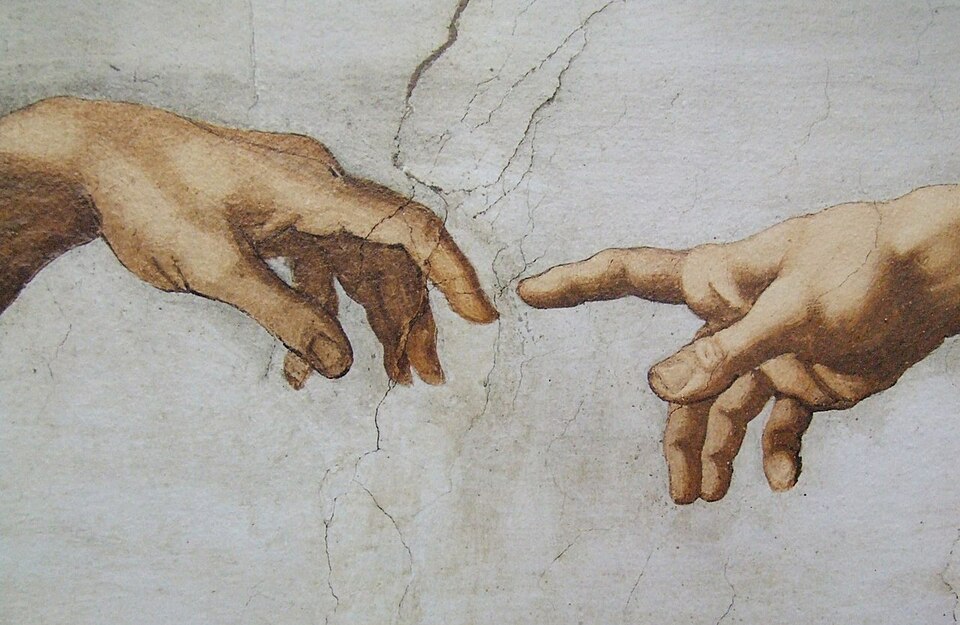
Made in the Image of Nothing

Carl R. Trueman's The Desecration of Man is a superb book which deserves wide readership.
Review of Carl R. Trueman, The Desecration of Man: How the Rejection of God Degrades Our Humanity (New York: Sentinel, 2026). 256 pages, $29.00. Reviewed by J. Budziszewski, author of Pandemic of Lunacy: How to Think Clearly When Everyone Around You Seems Crazy
Has Christianity been a good thing or a bad one? The culture is passing through a period of increased interest in faith, yet also a wave of increasingly frantic attacks on it. For a single example, consider the Charlie Kirk phenomenon. His movement, which was as much about faith as about politics, attracted an enthusiastic following among many young people. Yet an amazing number of other young people reveled in his assassination.
As Trueman points out, intervals of increased interest in faith have come before, for example, among intellectuals in the 1950s. No one knows whether anything will “take” this time, but those who pay attention to the human condition are taking note. Even some noted atheists, such as Richard Dawkins, have begun calling themselves “cultural” Christians. In other words, they don’t believe Christianity is true, but consider it the source of many good things in our civilization, and they desire, in some sense, to identify with it and even, perhaps, participate in some of its rituals.
Trueman argues that cultural Christianity is futile. Yes, Christianity should be enculturated, but it makes sense only if it is both true and believed to be true. Moreover, it is not just a set of beliefs, for it shapes the imagination, uniting creed, cult, and a code of life. Cultural Christianity is like the coyote in the roadrunner cartoons, poised in mid-air above an abyss, having nothing to hold him up, ready to plummet to his doom.
Why is cultural Christianity futile? According to Trueman, the gifts of Christianity to the culture have all been based on the recognition of human beings as bearing the image of God. To lose God, therefore, is to lose man. We no longer know what we are. We are the image of nothing in particular.
One aspect of this is that what Trueman calls the “cultural residues” of faith have been eroding as faith itself has waned. Consider just the state of the family. Vast numbers of children continue to grow up without the presence of a father. Increasing numbers of mothers say it doesn’t matter.
But that is not the worst of it. We don’t merely lack the knowledge of the imago Dei, we actively reject it. To reject God, we demand to become gods ourselves, denying all definition, rejecting all limitation. This is not only exciting, but in the original sense, ecstatic, and even sounds innocent: “You can be anything!” Yes, a man can be a woman, a “furry” can be an animal, and perhaps soon humans will be able to turn themselves into cyborgs. Pornography and hooking up are just as good as marriage.
There is no standing still. Consequently, as this dreadful logic works itself out, we not only desecrate man, but revel in the desecration. Hence the title of the book.
Trueman traces the course of desecration especially in two profound areas which are related to the unity of body and soul: The meaning of sex and the meaning of life and death. Both have lost their mystery. Both have been made objects of technical manipulation. Both are being emptied of transcendent meaning, often becoming loci of despair. He is especially good at calling attention to the resulting paradoxes. “So what is death?” he asks in one chapter. “Is it an unbearable reality from which we try to hide, or a staple of consumer entertainment, or a standard part of palliative care for the disabled or the depressed? The answer in today’s West is, apparently, all three.” He adds, “as with sex, we do not quite know what to do with it and end up being caught in contradictions that fuel the nihilistic malaise of our times.”
But why not desecrate man? Why not join so-called “cyborg feminists,” the tech bros, and the many other kinds of transhumanists? Why not enjoy the ecstasy of nihilism, the exhilaration of its sense of limitlessness? Because, argues Trueman, it is based on a lie. We do have limits, and every idolatry of ourselves ends in futility, for it is impossible for human beings to be to ourselves what God is to us. An exciting meaninglessness is still meaningless.
Couldn’t we find a basis for something like the Christian vision of the dignity of man made in God’s image – say, in Kantianism? Trueman answers: No. Such doctrines are thin gruel. At best, they are naked products of mere intellect, with no power to move our imaginations and take hold in our shared lives. “Where there is no vision, the people perish,” declares the Book of Proverbs. Interestingly, this line is a favorite of secular ideologues too, but vision is just what they cannot provide.
So far as it goes, Trueman’s argument is powerful. It will be especially eye-opening to intelligent general readers who recognize that something is wrong with the culture, but don’t quite grasp the big picture. Getting this across is very hard to do. I am tremendously impressed by this book, and I highly recommend it.
Yet in certain ways, the book is incomplete. It needs a sequel. Let me explain.
Though Trueman’s argument provides extremely strong civilizational motives to want Christian faith to be true, it stops short of providing reasons for believing that it is true. Motives and reasons are not the same thing. If my wife and I need five dollars to buy lifesaving medicine, but I have only two, and she has only two, then we have a strong motive for my two plus her two to make five, but we do not have reason to think they do make five. Suppose readers accept the book’s argument about what losing God does to us, individually and civilizationally. Such readers might go in either of two directions. Those who decide God is real and turn to faith may regain hope. Those who persist in believing that He isn’t may fall deeper into despair.
In itself, incompleteness is not a bad thing for a book. What it means is that the book needs a sequel. That is the way I view The Desecration of Man. As it stands, the book provided motives for faith, but a sequel is needed to provide reasons for it, grounds for thinking that Christian faith is, in fact, true. This book answers the question, “Civilizationally speaking, so what if Christianity is true?” The sequel would answer the question, “But is it?”
The book needs a sequel in other ways, too. To believe that we are the images of God, must we believe, specifically, that Christianity is true? Judaism, the older brother of Christianity, also affirms the imago Dei, and it presents essentially the same view of right and wrong. Moreover, it agrees that our ultimate end is in God Himself. However, there are important differences. So when Trueman says “Christianity,” does he mean, specifically, Christianity? Or does he mean something more like “biblical religion”?
Another reason for desiring a sequel is that Trueman embraces certain themes which are implied by Christian revelation but not fully spelled out in it, themes that have since been worked out by thinkers such as Thomas Aquinas. For example, Trueman repeatedly affirms the teleology of the human being, the ends and meanings built into our very nature. The end and meaning of sexual intercourse, for example, is turning the wheel of the generations and uniting the procreative partners. Of course, the activity is pleasurable too, but pleasure is only a motive for engaging in it, not what it is ultimately about. Now, as Trueman knows well, many today say that meanings and purposes in our nature are in the eye of the beholder. Since there aren’t any, motives are everything. One may reply to such people, “Scriptural revelation speaks differently,” but they consider Scriptural revelation nonsense. Can we provide grounds for thinking that it is unreasonable to view man as merely the meaningless and purposeless result of a process which did not have him in mind? This conclusion would render Scriptural revelation plausible after all.
Finally, I think Trueman pulls some of his punches. Consider his account of the teleology of sex again. As he points out, in vitro fertilization dehumanizes us by separating the conception of the child from the loving embrace of the child’s father and mother. This argument is not easy to dismiss, and it would remain valid even if a method of IVF could be developed that did not doom so-called “surplus” embryos to frozen limbo. Yet doesn’t the teleology of sex provide good reason to think that we are equally dehumanized by artificial contraception? After all, it too is anti-teleological, for it cuts sexual intercourse off from the possibility of new life. Wouldn’t this be something like cutting eating apart from nutrition, cutting reasoning off from the possibility of finding truth, and cutting speech off from the possibility of exchanging it?
Trueman gives a nod to Catholics who do think this way about artificial contraception, but then–– perhaps in the interests of speaking to the widest possible audience -- changes the subject. I am inclined to think that the subject cannot be changed. If a premise entails two conclusions, but one is convinced that either of the two conclusions is false, even if not both, then one is logically compelled to reject the premise too. So if sex really is about turning the wheel of the generations, then rejecting IVF while having no position on artificial contraception is not a stable strategy.
This is a superb book which deserves wide readership. In the meantime, I am waiting for the next one.
J. Budziszewski is a professor of government and philosophy at the University of Texas at Austin and, most recently, the author of Pandemic of Lunacy.

Adam Smith, Economist of the American Revolution
Clear-eyed economic thinking remains one of humanity’s most powerful instruments for understanding our problems and advancing our possibilities for improvement.
Made in the Image of Nothing
We need a sequel to Carl R. Trueman's 'The Desecration of Man: How the Rejection of God Degrades Our Humanity.'
Spielberg’s Empty Hope
'Disclosure Day' should have been called 'Hope and Change,' or rather 'Change and Hope.'
.jpeg)

.png)


Get the Civitas Outlook daily digest, plus new research and events.
Get the Civitas Outlook daily digest, plus new research and events.