
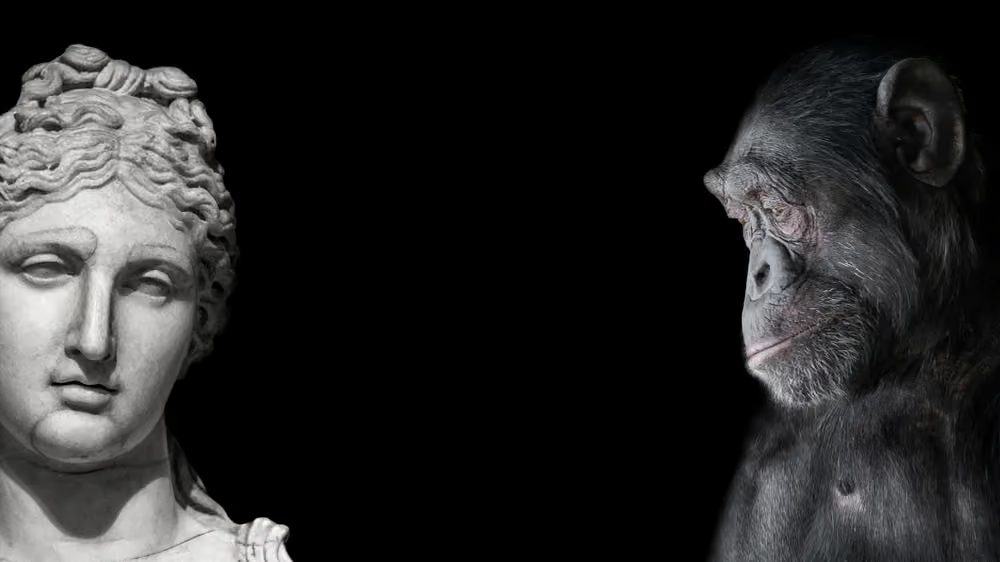
Why Humans Aren’t Clever Chimps

Jonathan Leaf's The Primate Myth cleverly refutes primatology on the grounds of science rather than philosophy.
What distinguishes human beings from animals? Philosophers have tried to answer this question. For Marx, it was people’s unique ability to make tools. For Hobbes, it was people’s irrational (as opposed to rational) desire for power. Both people and animals seek power to ensure their food supply, Hobbes said, but people also seek power because they are vain and love power. Rousseau preferred humanity when it was a little less civilized (i.e., less corrupt), so, for him, the closer to the jungle, the better. But he did posit a few differences: people, unlike animals, have free will; people, unlike animals, can perfect their societies; people fear death, because they can imagine what it is not to be, while animals fear pain, a much narrower fear.
Over the years, science has found fault with these distinctions. Some animals can make tools after all—crows shape leaves and twigs to gather insects; sea otters use stones to smash open shellfish. (Some Marxists invested in the debate argue back that though animals can make tools, only people can make complex tools.) As for free will, according to neuroscience and genetics, it’s not that animals have it so much as human beings lack it, thus putting both groups on the same level.
One line of attack against those who would draw sharp distinctions between humans and animals comes from primatology, which was formally established as a discipline in the mid-1950s. The field argues that human beings and apes share so much in common that not only should they be lumped together in the mammalian order known as primates, but we can also learn about human nature by studying ape nature.
Playwright and novelist Jonathan Leaf attacks this position in his interesting new book, The Primate Myth. Cleverly, he begins his saga a half-century before primatology became an established field, to show how bias can perturb science. Such bias eventually finds its way into popular culture, where it can stick around for generations.
Leaf introduces Theophilus Painter, a Yale graduate who went on to discover the Y chromosome that coded for maleness. His accomplishment brought him instant fame. But Painter also made a mistake rooted in bias—a mistake that seeped into the general culture. From his microscope slides, he couldn’t tell if human beings had 23 or 24 pairs of chromosomes. Since other scientists at the time had reported that chimpanzees and gorillas had 24 pairs, and since human beings and apes sort of look alike, Painter concluded that human beings must have 24 pairs, too. His mistake was accepted as fact for three decades, until the 1950s, when scientists did a proper recount and found that human beings actually had 23 pairs.
According to Leaf, bias along the same intellectual groove upheld Painter’s racist assumptions years later while serving as president of the University of Texas at Austin. Painter assumed that because Blacks and Whites looked different, they must differ in their fundamental biology. Indeed, Painter seemed almost surprised to learn that Blacks and Whites had the same number of chromosomes. Such faulty science, rooted in bias, seeped into the general culture and supported the cause of racial segregation for decades.
In primatology, the field’s bias that humans and apes are very much alike, with a common essential nature, permeated the general culture. Popular books, like Jane Goodall’s In the Shadow of Man, and popular movies such as Planet of the Apes and Gorillas in the Mist, promoted the view that people were not so different from apes. Researchers on apes became, in Leaf’s words, the “adored heroines of animal lovers,” merging in status with social scientists who studied people. The international best-seller The Third Chimpanzee (1991) even suggested that humans were just another species of chimp, and that chimps should be classified as Homo, like us.
Yet the notion that people resemble chimps in any profound way is false, says Leaf, a point that has gradually emerged. Chimps aren’t that smart; on the contrary, dogs are closer to people in their ability to grasp speech and language. Chimps aren’t that social; they have little interest in working together, unlike humans, who are very social, practically herd animals, and more like elephants and horses in this regard. Chimps are far more violent on an individual level than human beings are. People who bought into the belief that chimps are sweet and adopted them as home companions were sometimes seriously injured.
Even their shared physical nature is not as great as was once thought, says Leaf. Humans and chimps purportedly share 98 to 99 percent of their genome. But the issue is more complicated. A range of genes known as “indels” are excluded from the calculation to reach that high number. New data from the National Institutes of Health show the human genome varies from the chimp genome not by 1.4 percent but by closer to 13.5 percent, says Leaf. Nor are human and chimp brains all that similar. The cerebral cortex is the part of the brain involved in higher-order consciousness and thought. Chimps have a small cerebral cortex. Humans have a large one, as do whales and dolphins, who are, incidentally, also herd animals.
Important differences in other forms of behavior collectively negate primatology’s basic premise that humans and chimps share a common nature. Chimps do not commit suicide, unlike humans and other animals. Chimps differ in how much they sleep and what they eat. They rarely cooperate. They struggle to listen or follow directions. Unlike humans, they do not make war.
Why has primatology pushed the human-chimp connection? Why the bias? Leaf offers several explanations, including professional self-interest. The possible reasons inevitably lead one toward the conspiratorial. Yet conspiracy theories are probably unnecessary here. The simple fact that humans and chimps look alike and share a distant genetic lineage leads both researchers and laypeople to believe they are close kin.
Being swayed is easy. When I was a little boy, I saw a seahorse in an aquarium. I thought it must somehow be related to the horses that I had seen on a farm. I later learned about the concept of “convergent evolution,” in which two very different species evolve toward a shared characteristic despite having no relation to one another. I got over thinking that seahorses and horses were closely related. But the nature of my error probably explains, at least in part, why primatologists reflexively lump humans and chimps together.
It is important to understand where Leaf is coming from in all this. Leaf is not arguing against the theory of evolution. His book is not a variation on “creation science,” which uses scientific arguments to defend biblical interpretations of how living things came to be. Nor is he arguing that a great chasm exists between humans and other creatures, as Saint Thomas Aquinas did when articulating the great chain of being, or as Descartes did when arguing that only humans have minds. Leaf’s focus is narrower. He questions the claim that humans are sufficiently similar to chimps and gorillas to place them in the same family and order. In showing how humans differ from apes, he emphasizes how similar humans are to other animals. Primatologists may have made a mistake of classification, it seems, but not necessarily one of metaphysics. Humans and animals remain close, and studying animals to understand human behavior may be profitable after all, Leaf implies.
At first, Leaf’s narrow approach disappointed me. I had hoped he would wax poetic about the differences between humans and animals. I find the scientific tendency to reduce human inner life to that of an animal somewhat revolting. Anthropologists study pair bonding among animals to gain insight into the problems of marriage. Love, we are told, reportedly fulfills a utilitarian purpose, and science studies the courting rituals of chicken and fish to grasp its meaning. Loneliness, we learn, is mediated through neurotransmitters in both humans and animals, compelling them to affiliate. Many scientists believe that the instinctive lives of animals can teach us much about the inner lives of humans.
In the process, the inner life of humans follows one long chain of degradation. The whole medley of conditions and feelings known as “human behavior” loses its splendid pitch; the delicate sentiments, the exalted thoughts, and the urge to poetry are all viewed from the perspective of the animal, whose sole goal is to survive and reproduce. The scientific approach hardly inspires.
Nothing in Leaf’s work helps slow this process. Like others, he exposes the inner life of humans to science’s hyper-rational gaze. Yet upon finishing his book, I decided that on balance, he had accomplished much good.
First, the reader takes Leaf’s observation that primatology has a bias problem and naturally wonders if the same problem affects other areas of science. This breeds healthy suspicion—not paranoia, or hostility toward science, but, rather, vigilance, or just enough suspicion to be on one’s guard whenever experts pontificate. In a democratic republic, this is a useful stance to adopt toward most organized activities, and not only science.
Second, Leaf uses his attack on primatology to show how humans (unlike chimps) are very much social animals. Other people easily influence us, because it is in our nature to be influenced, which can be good, Leaf says, as when people feel pressured to behave honorably, or have a sense of duty. But it can also be bad, as when a demagogue takes power and sways people to commit horrible crimes.
Philosophers have long commented on this basic human trait. Aristotle called the human being “the beast with red cheeks,” or something like that. We are not just social but intensely so, manifested in our reflex to feel shame and blush. Indeed, this fact underlies an important part of the cosmetics industry: some people wear rouge not just to look young but to avoid looking like the kind of person who is so jaded that blushing has become impossible, which is embarrassing. Such a person somehow lies outside the bounds of society and has become vaguely less recognizable as a human being, or at least a healthy human being, as a result.
For his part, Marx said that it was not consciousness that determines life, but life that determines consciousness, meaning that how we live and work in daily life affects how we think, including how we think about politics. Marx would go too far by importing his own ideology into this observation, turning our thoughts and ideas into just an epiphenomenon of class. But the limited observation that we are social animals, and not little islands of existence in an archipelago, is true.
Sometimes we forget this point. For example, some social scientists think of people solely as individual rational actors. They think people’s thoughts are the product of their own cognitive agency. Such notions rise and fall in popularity over the years. But as Horace said, throw out nature with a pitchfork, and she will always return. We are much more herd animals than we want to admit. It is our nature. Best to work with this truth rather than try to ignore it. The fact has policy implications—for example, the benefit of restricting social media use in young adolescents.
By arguing this point not through philosophy, which gets little respect, but through science, which commands much respect, Leaf has done humanity an important service.
Ronald W. Dworkin, M.D., Ph.D is a fellow at the Institute for Advanced Studies in Culture. His other writing can be found at RonaldWDworkin.com.


The Smithsonian’s Revolutionary World View
The organization, sadly, needs to heal itself by starting over, and so too the academic history profession.

Nolan’s Odyssey and the Search for Wisdom
Nolan’s 'Odyssey' will be a tremendous success, but it is also a work of decadence.
Made in the Image of Nothing
We need a sequel to Carl R. Trueman's 'The Desecration of Man: How the Rejection of God Degrades Our Humanity.'

.avif)




Get the Civitas Outlook daily digest, plus new research and events.
Get the Civitas Outlook daily digest, plus new research and events.