

The Declaration as Law
What the revolutionaries did was extraordinary. They didn’t just “establish a new nation,” but instead a nation on new principles.
A century ago, Calvin Coolidge affirmed that the Declaration of Independence is “the most important civil document in the world.” Coolidge explained that “[t]he American Revolution represented the informed and mature convictions of a great mass of independent, liberty-loving, God-fearing people who knew their rights, and possessed the courage to dare to maintain them.” And what the revolutionaries did was extraordinary: They didn’t just “establish a new nation,” but instead a nation on new principles.” And because they built such a nation, Coolidge proclaimed that “every American can turn for solace and consolation to the Declaration of Independence and the Constitution of the United States with the assurance and confidence that those two great charters of freedom and justice remain firm and unshaken.”
I love reading Coolidge’s reflections on the Declaration—though not as much as I love reading the Declaration itself. As we approach the Declaration’s 250th anniversary, it’s useful to assess the Declaration’s actual legal status. Coolidge promised that whatever dangers may arise, “the ultimate application of the law of the land will provide an adequate defense and protection.” But does that “law” include the Declaration itself?
The short answer: sorta. Moreover, arguments in favor of a more definitive affirmative answer risk undermining the principles of the Declaration itself. Instead, the best way to honor the Declaration is by working through the democratic process to enact legislation that vindicates its principles.
To begin, the Declaration is not directly enforceable in court—no one can plausibly argue that “the government has deprived me of my right to pursue happiness, so give me an injunction.” While the Constitution is a legally operative document, the Declaration is not. As one court put it, “[t]he Declaration of Independence identifies the pursuit of happiness as an ‘inalienable right,’ but [it] is not binding law and cannot be enforced” in court. As another court explained, it would be “anarchy” if Americans could disobey other laws simply by asserting that they “retain the unalienable rights granted by God, as found and secured by the posititve [sic] law embodied in the Declaration of Independence (1776).”
Indeed, in my career, I believe I’ve cited the Declaration of Independence only once in any court. A couple of years ago, the State of Texas filed an amicus brief challenging whether Jack Smith was properly appointed as special counsel, and observed that “[t]he Framers’ decision to vest in Congress alone the power to create and fund executive offices was no accident,” explaining that the King’s profligate staffing “so enraged the Colonists that they included the King’s creation of a ‘multitude of New Offices’ in the Declaration of Independence itself.”
Although the Declaration is rarely cited in court, it does not mean it is irrelevant there. Instead—as with my “officer” example—the Declaration may be used as a tool to interpret specific constitutional provisions. For example, in recent years, the Supreme Court has cited the Declaration to help explain the meaning of Congress’s taxing power, criminal venue protections, and jury-trial rights. All of this is proper. As Justice Brett Kavanaugh has observed, “[t]he pre-ratification history of America’s many objections to British laws and the system of oppressive British rule over the Colonies—identified most prominently in the Declaration of Independence—can … inform interpretation of some of the crucial provisions of the original Constitution and Bill of Rights.”
But should the Declaration be used for more than just informing the meaning of other provisions? As Lee Strang, a prominent originalist scholar, has documented, because the Declaration “is one of the most revered documents in American history, … various political movements have appealed to it in order to garner support for the movement’s proposed reforms—especially when the Constitution is widely thought to be at odds with or indifferent to the political goals of the social reformers.” Abolitionists, for example, claimed the Declaration as their own and trumpeted it as “the ultimate expression of America’s founding principles.” Later, some suffragettes “saw it as an independent source of binding constitutional principles” and argued that no new constitutional amendment was required. Later still, the civil rights and pro-life movements claimed the Declaration as authoritative for the constitutional status of their positions. And today, “[d]eclarationist scholars of a liberal bent often argue that, properly interpreted, the Constitution protects rights to abortion, suicide, welfare,” and the like, while conservatives seek to use the Declaration the other way round.
Strang, echoing Justice Story, believes that “the Declaration [is] a source to which one refers in ascertaining the Constitution’s meaning,” but should not be used as a standalone basis of rights. After all:
Th[e] deep, continuing disagreement on the meaning of the terms in the Declaration’s rights phrase shows that judges could derive little, if any, interpretative guidance from them. This is because judges would first have to determine which of the competing interpretations of the right the judge finds persuasive—no small feat in itself—and then, within that interpretation, determine how the abstract term applies in the concrete case before him. Both of these determinations are complex and fraught with difficulty because they deal with the meaning of abstract, contested concepts. In addition, judicial use of contested concepts like “Happiness” would be extremely controversial in the broader society simply because of the fact that the meanings of the concepts are themselves controversial.
That view, of course, has detractors—much of the Declaration’s power comes from its language of rights. Indeed, most of us love reading the Declaration for the same reasons that the abolitionists and Coolidge loved reading it: Because it speaks of universal principles. As Coolidge put it,
If all men are created equal, that is final. If they are endowed with inalienable rights, that is final. If governments derive their just powers from the consent of the governed, that is final. No advance, no progress can be made beyond these propositions.
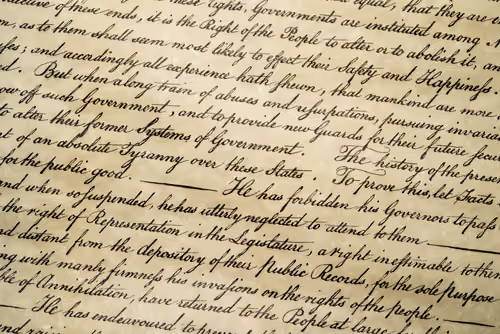
Strang, however, is not wrong that if judges could freely use abstract words like “happiness” from the Declaration to interpret abstract words like “liberty” from the Constitution, the risk of government-by-judiciary would be very real. One reason the Court today emphasizes history and tradition when interpreting abstract constitutional language is that it offers a more objective basis than personal views. Indeed, giving too much weight to a judge’s assessment of what the Declaration means by, say, “happiness” could well undermine a central reason why the Declaration is so powerful: democratic governance. If too many questions are decided by judges, the people may come to lament that the judiciary refuses “[a]ssent to Laws, the most wholesome and necessary for the public good,” blocks “Laws of immediate and pressing importance,” and strangles “[l]egislative powers.”
So I return to Coolidge: “Governments do not make ideals, but ideals make governments.” Although the Declaration is important because of the truths it reflects, ultimately “[t]he people have to bear their own responsibilities. There is no method by which that burden can be shifted to the government. It is not the enactment, but the observance of laws, that creates the character of a nation.”
Aaron L. Nielson is a senior fellow at the Civitas Institute and holds the Charles I. Francis Professorship in Law at the University of Texas at Austin School of Law.

The Declaration and the American Inheritance
In the spirit of America’s Semiquincentennial, let us temper our zealous tributes to “experiment” and amplify our appeals to “inheritance” when describing the political character of the United States.

The Declaration as Law
As we approach the Declaration’s 250th anniversary, it’s useful to assess the Declaration’s legal status.

.png)


.png)
Get the Civitas Outlook daily digest, plus new research and events.
Get the Civitas Outlook daily digest, plus new research and events.