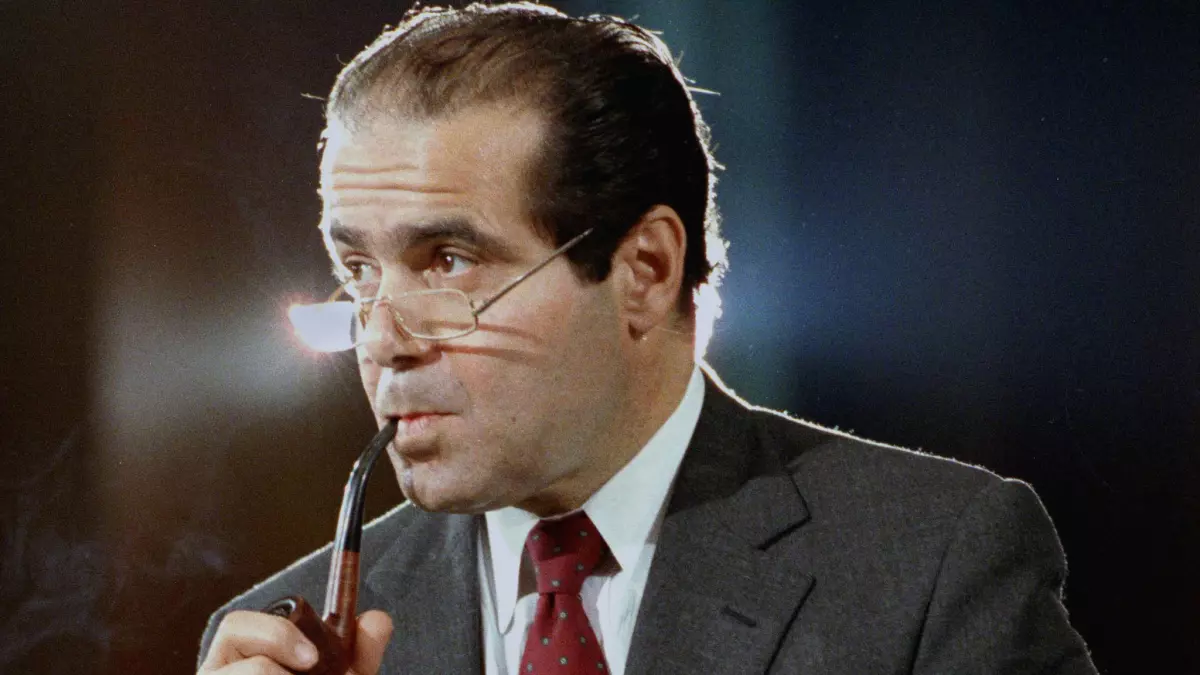
Getting Right With Scalia

Approaching the text of the Constitution with courage and intellectual honesty, rather than any case or doctrine, is Scalia’s true legacy.
At SCOTUSBlog, Richard Re offers the provocative take that the Supreme Court is not true to the late Justice Antonin Scalia’s legacy. He acknowledges that Scalia is invoked favorably by all the Justices, and that “[l]egal culture remains transformed by the legal movement he helped spearhead, as evidenced by the prevalence of textualism and originalism.” Yet he claims that “the surface celebration masks a deeper ambivalence and even repudiation,” and that “some of Scalia’s signature positions have been outright rejected by the justices who carry his banner.”
Re is a sharp observer of the Court, but I think he is mistaken. I’m going to focus on administrative law, but I have doubts about all his examples.
Re begins his analysis by noting that the Court overruled Chevron deference (that is, the idea that courts should defer to an agency’s reasonable interpretation of ambiguous statutory language) in Loper Bright v. Raimondo. Re observes that Scalia was a prominent supporter of such deference, “[y]et every conservative justice repudiated Chevron.”
Re’s account, however, downplays a key point: By the time Scalia was done on the Court, it was an open secret that he had turned on Chevron. Adam White explained this development a decade ago. At first, Scalia supported Chevron. Part of the reason, though, was that his version of Chevron was remarkably non-deferential. As Richard Pierce explains, “Justice Scalia’s consistent support for the highly deferential Chevron doctrine seems at first to be a poor fit with empirical studies of Justice Scalia’s patterns of decisions in administrative law cases. Justice Scalia voted to uphold agency actions less frequently than any other Justice.” Why is that? Scalia’s textualism meant that “he would rarely defer to an agency interpretation of a statute under Chevron because he rarely sees ambiguities in statutory texts.” To say that Scalia was a big supporter of Chevron is only partially correct; he advocated deference only in the very rare case where there was (by his textualist lights) ambiguity.
Scalia, moreover, eventually backed away even from that limited version of Chevron, especially as the doctrine metastasized over time. In 2015, Scalia wrote that “[h]eedless of the original design of the [Administrative Procedure Act], we have developed an elaborate law of deference to agencies’ interpretations of statutes and regulations,” and without even “mentioning [the APA’s] directive that the ‘reviewing court ... interpret ... statutory provisions,’ we have held that agencies may authoritatively resolve ambiguities in statutes.” Scalia cited Chevron as an example of such “heedless[]” disregard for the APA.
What’s more, the reason the Court gave in Loper Bright for overruling Chevron is quintessentially Scalia. The Court emphasized that Chevron is inconsistent with the APA’s language: “[B]y directing courts to ‘interpret constitutional and statutory provisions’ without differentiating between the two, Section 706 makes clear that agency interpretations of statutes—like agency interpretations of the Constitution —are not entitled to deference.” Of course, no one did more than Scalia to bring textualism to the Court. The idea that the modern Court’s commitment to textualism threatens Scalia’s legacy should seem upside down, because it is.
Re acknowledges much of this counterevidence but says that “[i]f Scalia had actually thrown overboard his decades of support for Chevron deference, that result would have diminished his legacy by striking at its core: a demand for intellectual integrity, independent of party politics.” But the problem with Chevron was it was bad law. Scalia’s initial support for Chevron was the mistake—not his reconsidered view. Re apparently thinks the explanation for Chevron’s demise is “party politics,” but I am unconvinced. My 2007 clerkship interview with Judge Janice Rogers Brown focused on why Chevron was bad law and conflicted with the APA. My generation—a generation that grew up reading Scalia—recognized the obvious mismatch between Chevron and textualism. The Court saw the problem too and thus eventually tossed the doctrine aside as an anti-textual mistake.
One of Scalia’s best qualities was a willingness to admit error. As he once put it, “[a]s for my own culpability” in a past mistake of the Court, “I must accept that and will take it with me to the grave. But its irrelevance to my vote in the present case has been well expressed by Justice Jackson …: ‘I see no reason why I should be consciously wrong today because I was unconsciously wrong yesterday.’” No one can know for sure how he would have voted in Loper Bright. What makes Scalia’s legacy so powerful, however, is that we do know how he would evaluate the textual case against Chevron: by reading it, by thinking about it, and by forming his own mind.
Next, consider Re’s discussion of the major questions doctrine. Here, Re is wrong from the start; even the “pristine” version of Scalia that Re seemingly has in mind embraced the major questions doctrine. A good candidate for the first major questions case is MCI v. AT&T, decided in 1994, which concerned whether an agency could eliminate tariff-filing requirements for nondominant phone companies. Yet, despite arguable ambiguity about the statutory word “modify,” the Court refused to allow an agency to massively expand its authority, reasoning that
“[i]t is highly unlikely that Congress would leave the determination of whether an industry will be entirely, or even substantially, rate-regulated to agency discretion—and even more unlikely that it would achieve that through such a subtle device as permission to ‘modify’ rate-filing requirements.”
Almost 30 years later, the Court in West Virginia v. EPA would quote MCI as barring an agency from “effect[ing] a ‘fundamental revision of the statute, changing it from [one sort of] scheme of ... regulation’ into an entirely different kind.” So, who authored MCI? Scalia.
Several years later, the Court decided FDA v. Brown & Williamson. The question there concerned the FDA’s authority to regulate tobacco. Although the literal language of the statute may have supported the agency, the Court—in an opinion written by Justice O’Connor—emphasized that “we must be guided to a degree by common sense as to the manner in which Congress is likely to delegate a policy decision of such economic and political magnitude to an administrative agency.” As support, the Court cited MCI. Scalia fully joined O’Connor’s opinion. The idea that those marching under Scalia’s banner cannot talk about “common sense” is thus hard to reconcile with Brown & Williamson, where the Court did just that.
If that evidence were not sufficient, what about UARG v. EPA? There, the question was whether EPA could “tailor” certain pollution limits in the context of greenhouse-gas regulation. Scalia, writing for the Court, rejected the effort on the ground of the major questions doctrine. Quoting Brown & Williamson and citing MCI, Scalia stated for the Court:
“When an agency claims to discover in a long-extant statute an unheralded power to regulate ‘a significant portion of the American economy,’ we typically greet its announcement with a measure of skepticism. We expect Congress to speak clearly if it wishes to assign to an agency decisions of vast ‘economic and political significance.’”
One more piece of evidence: Scalia personally voted to stay the Clean Power Plan in the case that eventually became West Virginia.
The evidence is straightforward. Whatever one thinks of the major questions doctrine, Scalia’s view was consistent: beginning in 1994, he announced that agencies cannot use small justifications to justify massive policy changes.
Similar analysis applies to the presidential removal power, i.e., meaning that Article II of the Constitution’s vesting of the entire “executive Power” in “a President” means that the President must be able to remove subordinate officers within the Executive Branch. Scalia championed this power in his dissent in Morrison v. Olson – famously warning that preventing the President from firing a prosecutor is a “wolf com[ing] as a wolf.” For decades, the Court rejected Scalia’s view, but it has now adopted it and is ready to overrule (or at least sharply limit) Humphrey’s Executor v. United States, the main case counter to Scalia’s view. No one can claim that this development contradicts Scalia’s views.
Instead, Re offers the Federal Reserve as proof that the Court isn’t faithful to Scalia. Granted, the Court appears prepared to treat the Fed differently from other agencies. From this, Re observes that “[o]ne might have thought, based on Scalia’s approach in Morrison, that the leaders of administrative agencies could be fired at will,” yet “the justices have signaled that the Fed is different. It seems that not all executive power was vested in the president after all, the Morrison dissent notwithstanding.”
But the reason why the Fed may be special is that conducting monetary policy through banking, which the Fed does, does not require executive power. I first learned this history from Aditya Bamzai (a Scalia clerk whose views on this subject closely match Scalia’s, I believe). As he explained in an important article on presidential control of financial policy during the nation’s early days, although “[t]o modern eyes, the Bank of the United States’ currency-making functions might seem quintessentially sovereign,” that “was by no means the orthodoxy at the time of the First and Second Banks’ establishment in the early 19th Century.” Indeed,
“[i]n recommending to Congress the creation of a national bank under private management, Alexander Hamilton’s 1790 report identified as a virtue a private bank’s ability to avoid the temptation to avoid unpopular taxes by excessively printing money.”
That idea carried through into early cases. This history matters because, quoting the Court from last summer, “[t]he Federal Reserve is a uniquely structured, quasi-private entity that follows in the distinct historical tradition of the First and Second Banks of the United States.”
For what it is worth, Bamzai and I have identified Article II problems related to other aspects of the Fed’s operations that the Court one day may have to confront, but Re is too quick to conclude that Scalia would disagree with Bamzai’s originalist analysis of monetary policy. If conducting monetary policy through open-market operations requires Executive Power, then the roles of the First and Second Banks are inexplicable. Scalia cared about such history and would have explored it. I can’t know for sure, but I strongly suspect he would have agreed with Bamzai.
In short, I don’t think that the cases support Re’s argument. True, there may be tension between (contested) implications of certain of Scalia’s theories and what the Court is doing, but that tension is not new: It existed while Scalia was on the Court. For example, John Manning questioned the Court’s fidelity to textualism in cases like Brown & Williamson a full 25 years ago. I suspect that Justices today would say that Scalia was right to believe in both textualism and the major questions doctrine and that critics who believe the two cannot be reconciled are wrong. That’s a question for another day; it is enough here to observe that Re’s version of Scalia does not match what the real Scalia did.
Certainly, some might prefer Re’s version of Scalia to the real one. Re’s version seems more literalist, more categorical, and less nuanced. In a word, Re’s version is more rigid. But although Scalia loved bright lines, the real flesh and blood Scalia was never as wooden as Re’s version of him. While I can’t give definitive evidence, I’m confident that Scalia would not have wanted his colleagues to worry too much about what he would have thought anyway. Instead, he would want them to do their best to get the law right by focusing on text and history, while acting with courage and intellectual honesty. That approach to the law, rather than any case or doctrine, is Scalia’s true legacy.

.jpg)
Our American Legal Tradition Is Not the Warren Court’s Tradition
Most Americans today have no living memory of the world before the Warren and Burger Courts.

How to Shorten SCOTUS Oral Argument
Why not give the Justices an allotment of “extra” time to spend as they will across the term?
The Fifth Circuit’s Chance to Expose the Inflation Reduction Act’s Unconstitutionality
Despite the mounting evidence of harm, the Medicare Drug Price Negotiation Program remains law — and the Justice Department continues to defend it in federal court.



Get the Civitas Outlook daily digest, plus new research and events.
Get the Civitas Outlook daily digest, plus new research and events.