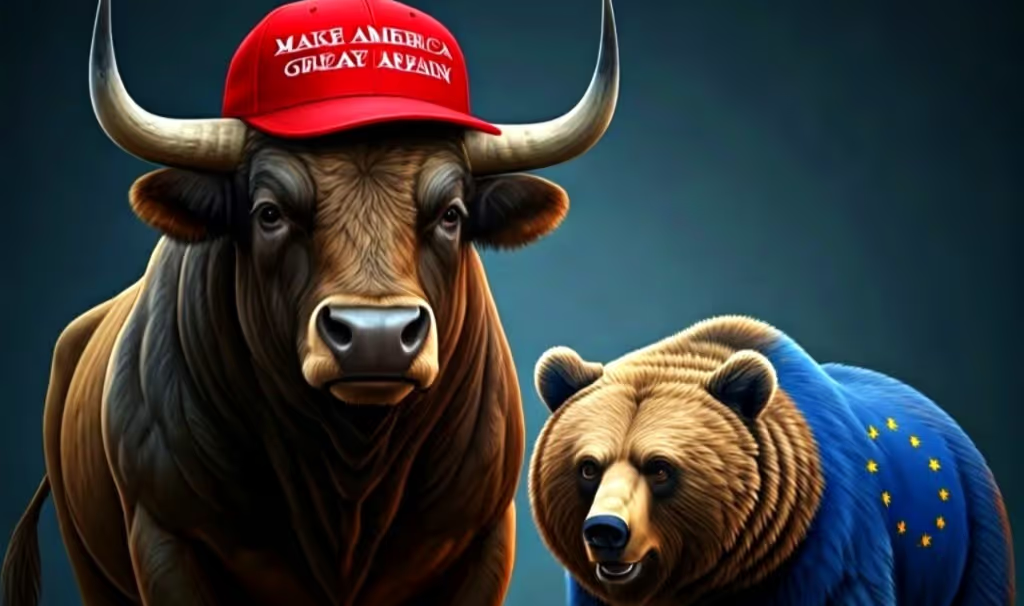
The EU Imposes Its ESG Agenda on American Companies

The most drastic of the E.U.’s restrictions on U.S. business are a pair of new ESG regulations: the Corporate Sustainability Reporting Directive and the Corporate Sustainability Due Diligence Directive.
President Trump’s announcement Friday that he would “absolutely” impose tariffs on Europe brings to the surface a frequently neglected fact about U.S. trade relations. America’s largest trading partner is not Mexico, China, Canada, or any other nation. It’s the European Union (E.U.). The 27 countries that make up the E.U. operate as one entity when it comes to trade and regulatory policy–often to the detriment of American farmers, ranchers, auto workers and equipment makers. E.U. tariffs on U.S. cars are four times those the U.S. places on cars made by German and Italian workers. Tariffs on agriculture, food, and chemicals are higher in the Eurozone than in the U.S. A reciprocal trade policy would benefit American workers in these industries, who are currently paying the price for E.U. protectionism.
The U.S. runs a trade deficit with the bloc–a fact that has drawn the ire of President Trump, who told an audience of global leaders at Davos in January that the E.U. treats American businesses “very unfairly, very badly.” Friday’s tariff announcement was based on the same grievance: “The “European Union has treated us so terribly,” as Trump said to the media.
This treatment is not limited to the E.U.’s tariff regime. The E.U. is bent on becoming the world’s regulator, the global setter of standards on everything from digital commerce to food safety and copyright law. Businesses have not been happy with the dictates coming from Brussels. Expect Mark Zuckerberg and Tim Cook to keep Team Trump in the loop on the E.U.’s prosecution of both companies under its new digital-competition law, which could lead to fines of up to 10% of their worldwide revenue. On an earnings call last week, Zuckerberg expressed his contentment that federal policy is in the hands of a new administration “that is proud of our leading companies, prioritizes American technology winning and that will defend our values and interests abroad.” The financial markets are relieved that the coordinated effort between E.U. and Biden administration regulators to suppress corporate mergers is over.
The challenge for U.S. companies is that they cannot ignore the Eurozone, given the market size. The value of goods exchanged between the U.S. and E.U. was 39 percent higher than that between the U.S. and China in 2023. When services and investment are considered, the importance of U.S. and E.U. commercial relations comes into even starker relief. Putting goods and services together, U.S.-EU trade equaled $1.3 trillion in 2022 versus U.S.-China trade of $758.4 billion. That’s not to mention that many businesses choose to open locations in foreign markets rather than export their goods or services there. As Daniel Hamilton from the Brookings Institute points out, U.S.-E.U. foreign affiliate sales were $4.1 trillion in 2021, three times more than U.S.-Canada-Mexico foreign affiliate sales.
The most drastic of the E.U.’s restrictions on U.S. business are a pair of new ESG regulations: the Corporate Sustainability Reporting Directive (CSRD) and the Corporate Sustainability Due Diligence Directive (CSDDD). Bear with me–Brussels derives its power from our acronym fatigue. The former is similar in intent to the Biden-era Security and Exchange Commission’s now-mothballed Climate Disclosure Rule, but it is exponentially more far-reaching. The latter goes even further, requiring companies to identify and remedy adverse environmental and human rights impacts across supply chains at risk of legal liability.
Most remarkably, CSDDD requires companies to adopt climate transition plans aligned with the Paris Agreement’s 1.5°C target. CSDDD applies to non-EU-headquartered companies that earn over 450 million euro annually or have significant franchising agreements in Europe. The effect will cause most major companies doing business in the E.U.–including U.S. companies–to audit their entire supply chains and potentially reshape business operations to align with global climate targets that the U.S. no longer endorses. The E.U. aims to export the same bureaucratic complexity that hampers its internal market to international operators.
Some European leaders are beginning to sound alarms over the stranglehold that E.U. red tape places on domestic companies. A report released last year by former European Central Banker Mario Draghi presents new evidence of how Europe’s costly bias towards overregulation, from ESG to antitrust, has limited the bloc’s ability to grow its industrial base and compete globally.
The results aren’t pretty: E.U. overregulation has diminished the E.U.'s economic power, plagued by declining growth, low productivity, energy dependency, and geopolitical instability. Draghi explicitly targets the E.U.’s complex and overlapping ESG reporting framework, which “entails a major compliance cost for companies in the EU” to the tune of EUR 1 million for publicly listed businesses. Unfortunately, the extraterritorial reach of Europe’s ESG requirements means that European companies will not only bear these costs.
U.S. policymakers should pay close attention to the broader consequences of the E.U.’s penchant for rule-makers over builders. Overregulation is not just a burden on the balance sheets of large companies. It also means lower economic productivity, reduced per capita incomes, and diminished living standards for middle—and lower-income wage earners. Since 2000, real disposable income per capita has increased twice as much in the U.S. than in Europe.
The Trump administration should pressure Brussels bureaucrats trying to make the U.S. pay the same price Europe has already paid in foregone living standards. The means for doing so vary. Trump's tariff threat against the E.U., after last Saturday’s imposition of tariffs on China, Mexico, and Canada, is no longer just a threat. The goal, however, in negotiating with the E.U. should be to secure the freer flow of goods, services, and investment, something in the interests of both America and the E.U.
Michael Toth is a resident fellow at the Foundation on Equal Opportunity (FREOPP) and a founding partner of PNT Law.


On Debt: Two Honest Measures, Two Different Questions
A response to Thomas Savidge's '“Full Faith and Credit” Means a Claim on America.'

Social Mobility Wins
When people live within an environment offering good jobs, good education, social networks, and a culture of self-improvement and hard work, they experience progress in a way that undercuts the philosophical rationale that socialists need to justify the policies they advocate.
Kevin Warsh and the Future of Fed Communication
Warsh is right that the Federal Reserve should not speak so loudly that it hears only its own echo.


.png)


Get the Civitas Outlook daily digest, plus new research and events.
Get the Civitas Outlook daily digest, plus new research and events.