The Geopolitics of Climate Continues

Domestic climate politics has nearly collapsed. What is left is a fight for credibility.
When The Liberal Patriot closed its shop, executive director John Halpin cited donor refusal to support critiques of Democrats’ climate policy. The philanthropic infrastructure behind climate discourse funds a narrative built around thresholds, scenarios that shape research agendas, regulatory tools, and generalized angst. In recent years, the narrative has shifted from an abstract planetary emergency into an explicit geopolitical claim that positions the “Global South” as a victim of Western extractivism and China as the enlightened energy savior.
The climate philanthropies are embedded in this global political project, leveraging China’s ambitions and partisan politics to strong-arm United States energy policy. Thus, there is more riding on climate politics at this moment than is frequently acknowledged — reasoned critique of the climate establishment at home has real stakes for the balance of power at a time when the credibility of the US is contested.
World Weather Attribution (WWA) became the technological engine of this project, aiming to link extreme weather events to anthropogenic warming and, as a broader endeavor, to specific corporate and national emissions. Its methodology has drawn sharp, extensive technical and ethical critiques, while its legal utility stalled as courts have dismissed climate liability cases before ever interrogating the methods.
As a narrative device for reawakening of Third World colonial grievances however, the soundness of WWA methods matter less than their ability to undermine the US international leadership.
This is consequential in a world where international public perception of the United States ranges from tepid to more negative than China.
WWA has always been an expressly political project that required philanthropic support. Nevertheless, Europe is set to officially embed WWA methods within formal weather-forecasting institutions. The new Extreme Event Attribution Office (EEAO) will deliver rapid climate attribution assessments and related communications. By doing so, the UK and EU are leveraging their renowned expertise in weather forecasting to advance an advocacy agenda built on the dubious use of climate models.
Optics matter here. While Europe is formally embracing the extreme weather event project against the backdrop of superior forecasting capabilities, the Trump Administration is very publicly bludgeoning its scientific enterprise and formally politicizing the grantmaking process.
The WWA core of the EEA literature is an overwhelmingly European endeavor in authorship and funding (shown below). However, WWA itself reports its funding from philanthropies with strong ties to the United States: Grantham Foundation, the European Climate Foundation (ECF), and the Bezos Earth Fund.
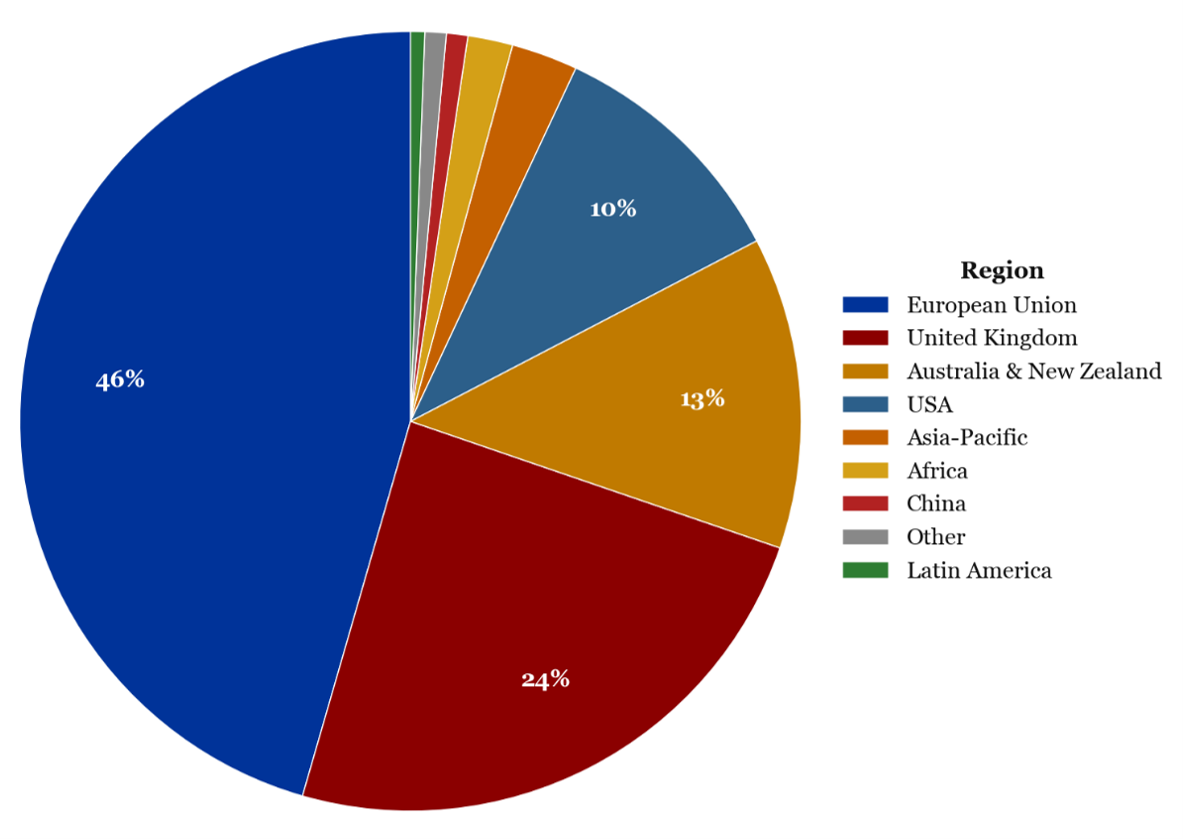
Author region by institutional affiliation for extreme event attribution literature with strong co-author ties to the WWA network
The ECF was founded as part of a broader US-based philanthropic “Design to Win” scheme, giving rise to the ClimateWorks Foundation. Inspiration for this international structure came from the philanthropic network’s perceived success with Energy Foundation China (EF China). ECF is the European regional hub of ClimateWorks. The two remain tightly aligned through a shared philanthropic funding network.
The Grantham Foundation is legally domiciled in the United States with university-based Grantham Institutes in the UK at the London School of Economics (LSE) and Imperial College London. The Grantham Institutes directly support WWA and the development of other climate litigation strategies, while the Institutes’ governing committees share personnel connections with the ECF, creating a tight institutional loop.
In late 2022, the Bezos Earth Fund announced a $10 million grant for strategic marketing of extreme event attribution on both sides of the Atlantic. Then, the Bezos Earth Fund brought extreme event attribution back into the National Academy of Science (NASEM), joining with other donors to sponsor a study vetting WWA’s significance for advocacy.
Personnel moves show a direct throughline in this coordination: The previous CEO of ClimateWorks moved to oversee the organization from a position at EF China, left ClimateWorks to oversee strategy at Bezos Earth Fund as Bezos funded WWA marketing, and also sat on ECF’s governing board alongside its then-director of strategic communications, who leads a global communications organization that also benefited from the 2022 Bezos Award.
The advocacy narrative surrounding WWA exploits times of crisis— immediately post-disaster. Increasingly, the group’s study focus shifted to events in developing regions.
By 2022, WWA’s work had taken on geopolitical significance as its attribution studies became a basis for framing North-South relations and cast as a tool to determine how wealthy countries would compensate developing countries for climate change through the Loss and Damage Fund mechanism. That same year, with Pakistan as chair of the Group of 77, of which China is not a member but a frequent supportive leader, the WWA spun dramatic global headlines with a study on tragic flooding in Pakistan.
In a 2022 interview about her book, the WWA lead researcher defines her use of the “colonial fossil narrative” as “a postcolonial world with a lot of wealth in the global north exploiting resources and people in the global south, based on extracting fossil fuels.”
Last year, the International Court of Justice (ICJ) released an opinion that states are obligated under international human rights law to “protect the climate system.” The separate opinion of the US representative, Judge Cleveland, extended these obligations to include addressing emissions “resulting from armed conflict and other military activities.” The UN General Assembly passed a resolution endorsing the ICJ opinion, in which the US was joined by 7 other nations in opposition.
Though these decisions carry no direct legal or policy implications for the United States, they carry reputational costs. The United States was joined in its vote of opposition only by governments widely regarded as authoritarian, lacking legitimacy, or facing legal actions in international courts for war crimes. Such company reinforces the narrative of an exploitive Global North. The framing gains further traction with President Trump’s style of speech: within weeks of the resolution vote, he warned that “A whole civilization will die tonight,” speaking of Iran. In a speech to the UN General Assembly the year prior, he called people “stupid” and labeled climate change a “con job.” Whatever one thinks of these issues on the merits, the rhetorical contrast creates a credibility contest — diplomatic speech aligned with prominent scientific and multilateral institutions against a dismissive, adversarial one. The dichotomy is easily exploited by those invested in the North-South conflict framing.
The colonial fossil narrative is disseminated as official messaging through the United Nations Department of Global Communications, a lead institutional partner in the strategic marketing campaign, Global Initiative for Information Integrity on Climate Change (GIIICC). The GIIICC upholds the Global South framing, rallying support in these regions against “orchestrated campaigns aimed at undermining established scientific knowledge.”
An advisor to the GIIICC, the International Panel on the Information Environment (IPIE), draws on the work of “climate obstruction scholars” who claim to discern legitimate debate from climate denial, and define what constitutes dis/misinformation about climate change. The IPIE argues that there is a global, politically conservative climate countermovement obstructing energy transformation through coordinated campaigns and attacks on scientists, and furthermore, the Global North has “neglected to assume financial responsibility” for climate change.
When launched, the IPIE co-director shared a video with a NASEM crowd uses misinformation tie together weather disasters, conflict, and civil unrest. What is happening, therefore, is a dissemination of a core advocacy narrative by the UN's central office that spreads the colonial fossil narrative and identifies alternative viewpoints as information threats. The same reasoning has appeared in front of the UN Human Rights Council to argue for the criminalization of climate dis/misinformation.
GIIICC also works closely with UNESCO, where China has a large foothold and is expected to harness the office to shape global internet governance. Indeed, China has explicitly stated its commitment to the UN infrastructure as the US has withdrawn from the multilateral institution.
The IPIE was developed under the auspices of the NASEM with support from the same philanthropic network that weighs heavily on climate politics and advances climate litigation. It follows that the removal of the climate chapter from the Federal Judiciary Center’s Reference Manual on Scientific Evidence, which brought in those pursuing climate liability litigation to legitimize WWA methods for use in the courts, was framed as an orchestrated attack on extreme event attribution.
The philanthropies are the least common denominator throughout the entire advocacy regime — and their interface with the Chinese government is non-negligible.
Last year, a subcommittee of the Senate Judiciary Committee questioned the millions of dollars flowing from EF China, headquartered in Beijing, to environmental groups in the United States that work to influence domestic energy policy. EF China is led by a former Chinese government employee, suggesting strong CCP affiliation. The same US philanthropic groups that fund ECF and ClimateWorks also fund EF China.
The EF China, Grantham Institute/LSE personnel, head of the ECF, and representatives of the climate philanthropies worked directly with the China Council for International Cooperation on Environment and Development (CCICED). The CCICED was flagged as a front group operation with intelligence ties used to influence elite academics and political actors including those in philanthropy. If true, these philanthropic groups directly advise the Chinese State Council on their activities and are vulnerable to elite capture by China’s intelligence apparatus.
The diagram below depicts the tightness of this coordination by showing connections between select philanthropic organizations and projects through direct funding or personnel relationships.
Meanwhile, researchers point to a global academic institutional network in partnership with China, led by the Grantham Institute/LSE in Europe and University of California Berkley in the US, targeting energy policies in both regions. This network is also tied to the philanthropic network and EF China.
The confluence of funding structures, personnel, and shared interests creates an international pressure system that circumvents US democratic process and disregards national security concerns. Though climate politics has all but collapsed domestically, its international infrastructure continues to provide a framework for grievance in a geopolitical power struggle. Good science stopped being the point long ago — not because science doesn’t matter but because the institutions became vehicles for political influence. What is left is a fight for credibility.
Jessica Weinkle is an associate professor in the Department of Public and International Affairs at the University of North Carolina Wilmington and a Senior Fellow at The Breakthrough Institute.


The Geopolitics of Climate Continues
There is more riding on climate politics at this moment than is frequently acknowledged.

The War on Israel
Jew-hatred and obsessive anti-Israel sentiment are manifestations of a sickness that will kill their host civilization if it is not treated.
.webp)
.png)


Get the Civitas Outlook daily digest, plus new research and events.
Get the Civitas Outlook daily digest, plus new research and events.