
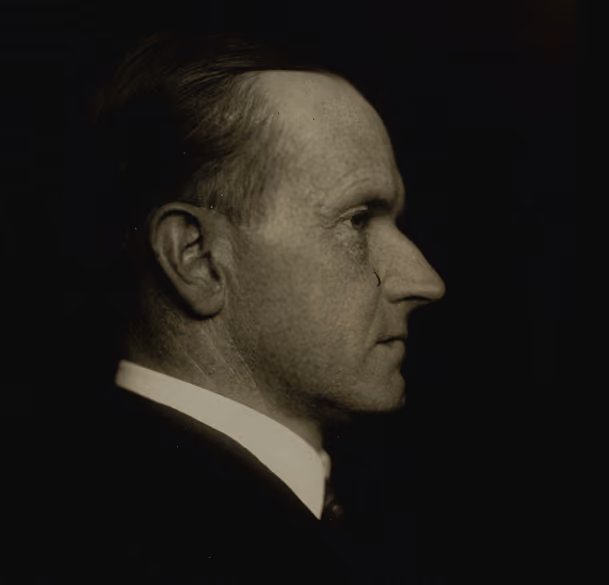
“Silent Clarence” Meets “Silent Cal”
Calvin Coolidge and Justice Thomas remind us that the connection between the Declaration and limited government rests on consent.
Calvin Coolidge was long and unjustly branded as “Silent Cal” for his supposedly taciturn ways. In fact, he was one of our most thoughtful presidents, and though he spoke less often than other modern presidents, when he did, he usually said something serious and important. His contemptuous critics perhaps came up with the “Silent Cal” sobriquet in the hope that Americans would ignore Coolidge’s deep attacks on Progressivism.
Though no one has labeled Clarence Thomas “Silent Clarence,” his critics have long implied that his restraint during Supreme Court oral arguments is a shortcoming, as if loquacity is the main benchmark of seriousness. But his written opinions speak to his distinctiveness, and recently Thomas has shown why he belongs alongside Coolidge for his grasp of the Declaration of Independence and the constitutional distortions wrought by a century of Progressivism.
On its sesquicentennial, Coolidge delivered an address that recalled the Declaration’s intellectual patrimony before culminating in a direct attack on Woodrow Wilson’s dismissal of the Declaration (though he omits Wilson’s name):
It is often asserted that the world has made a great deal of progress since 1776, that we have had new thoughts and new experiences which have given us a great advance over the people of that day, and that we may therefore very well discard their conclusions for something more modern. But that reasoning cannot be applied to this great charter.
A century later, Justice Thomas quotes parts of the next passage of Coolidge’s address in support of the argument that “Progressivism, in other words, is retrogressive.”
No advance, no progress can be made beyond these propositions. If anyone wishes to deny their truth or their soundness, the only direction in which he can proceed historically is not forward, but backward toward the time when there was no equality, no rights of the individual, no rule of the people. Those who wish to proceed in that direction can not lay claim to progress. They are reactionary. Their ideas are not more modern, but more ancient, than those of the Revolutionary fathers.
There is a second parallel between Coolidge and Thomas that reminds us that the connection between the Declaration and limited government rests on consent. Thomas takes aim at the Progressive presumption that the government the Founders designed allowed for “too little by expert rule.” As Wilson and later FDR both proclaimed, the “time for enlightened administration has come.”
In a 1922 address to the American Bar Association (“The Limitations of the Law”), Vice-President Coolidge delivered a powerful critique of the then-young administrative state that was remarkably prescient of today’s critiques. This revolution’s central defect, he argued, was “virtually a change in the form, and actually a change in the process, of our government. . . This is not the government which was put into form by Washington and Hamilton and popularized by Jefferson.” Likewise, Thomas argues that “Progressivism seeks to replace the premises of the Declaration of Independence, and hence our form of government.”
But the deepest parallel between Coolidge’s speech and Thomas’s is the exact point that agitates today’s Progressives: our inalienable rights and human equality are God’s gift, rather than government’s. Thomas: “These God-given or natural rights preceded and transcended governmental power or authority.” Coolidge: “The ultimate sanction of law rests on the righteous authority of the Almighty.”
Last fall, Virginia Senator Tim Kaine blasted this view as “extremely troubling,” adding that “The notion that rights don’t come from laws and don’t come from the government, but come from the Creator — that’s what the Iranian government believes.” Over at MS-NOW, Paul Waldman writes that “The idea that rights come from God, not government, couldn’t be more wrong.” Waldman then ridicules Thomas for embracing the Declaration’s “self-evident truths” as, according to a dictionary, “obviously true and requiring no proof, argument, or explanation,” making his own radical moral skepticism explicitly clear.
In their abysmal superficiality, Kaine and Waldman apparently don’t know that John F. Kennedy, who declared in his inaugural address that “the rights of man come not from the generosity of the state, but from the hand of God,” would agree with Thomas and Coolidge. Franklin Roosevelt and Harry Truman expressed similar sentiments, but Progressivism’s increasingly militant secularism demands shoving these liberal icons’ religious faith down a memory hole.
Not to be outdone is Robert Reich, whose primal scream about Thomas’s speech culminates:
“How can Americans be expected to believe in the impartiality of the Supreme Court in general and Clarence Thomas in particular when he condemns an entire philosophy of government — progressivism — and all the people who continue to call themselves progressives, in effect labeling them neofascists?”
Says the person who, in the same article, asserts we are living under "Trumpian neofascism." Clearly, Thomas has hit a nerve.
Steven F. Hayward is a senior fellow at the Civitas Institute and visiting professor at Pepperdine University’s School of Public Policy.
Read Justice Clarence Thomas’s full remarks here.

.jpg)
The Best Escape from the U.S. Attorney Mess
The process for appointing U.S. Attorneys is sputtering, but there is a way out of this mess.
Fighting Anti-Semitism from the Bench
Judge Roy Altman wrote "Israel on Trial" not as a judge, but as an American who loves this country.
Justice Gorsuch’s Warning
'Slaughter' may have rid us of the headless fourth branch of government, but it might end up leaving us with an all-powerful presidency.




Get the Civitas Outlook daily digest, plus new research and events.
Get the Civitas Outlook daily digest, plus new research and events.