
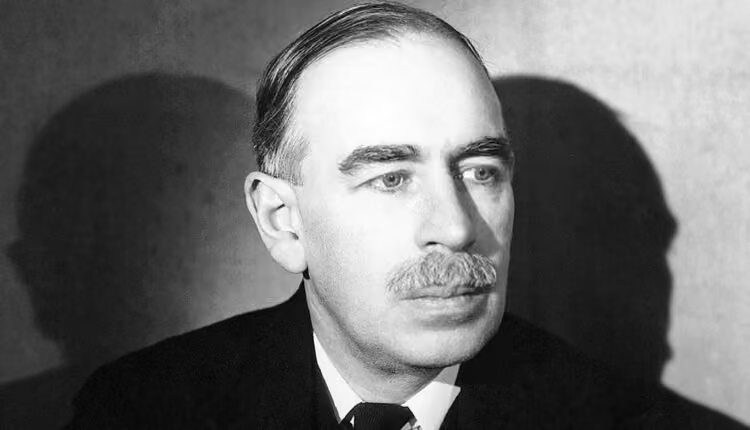
On Keynes, Coase, and Posner
The attention paid by Coase to common law rules, with which Keynes could not be bothered, shows how the two positions start from diametrically opposed points.
In 2009, I organized a Conference with Thomas W. Hazlett in honor of Ronald Coase. The conference volume contained a paper written by Richard A. Posner entitled “Keynes and Coase,” in which he compared the work of Keynes and Coase by noting, rightly, that the greatest contributions by both men did not depend on the use of sophisticated mathematical techniques. That proposition is as true as far as it goes, but it does not go very far. Indeed, the differences between the two approaches are as far as one could imagine. It is a commonplace statement of Keynes orthodoxy that “investment decisions are taken by comparing the marginal efficiency of capital (MEC) or the yield with the real rate of interest (r). So long as the MEC is greater than r, new investment in plant, equipment and machinery will take place.”
Coase on the other hand takes a different approach entirely when he insists as a general matter that the best way to maximize social welfare is to minimize transaction costs, which can be done by having efficient contracting, including registration systems for land titles, writing requirements for large transactions, and a parole evidence rule that generally blocks the use of collateral evidence to undermine the terms of self-contained documents, which is a term included in most contracts and a rule of positive law. In the former case, there is no regulatory imperative because the parties use their own best judgment to exclude those forms of evidence. When terms are introduced as a matter of public intervention, much depends on how this is done. In some cases, the proposition is intended to fill gaps in incomplete contracts in ways that best anticipate the intentions of the parties. Such devices are good because they are efforts to anticipate what informed parties will do. In other cases, the positive law is meant to displace, not approximate, private intention. At this point,the ignorance or bias of government officials tends to undermine the overall system. Coase is very much in the antiregulatory camp.
The attention paid by Coase to common law rules, with which Keynes could not be bothered, shows how the two positions start from diametrically opposed points. The most notable feature of the Keynesian position is that it is stated wholly in the passive voice, so that no one knows who is making these aggregate investments. Are they individuals, firms, governments, or some combination of the above? It is therefore difficult to determine whether they all view large social questions through the same intellectual framework, and there is a strong probability that there will not be a uniform view on what kinds of investments and in which industries they are prepared to make, given the massive uncertainties. It is, of course, assumed in both theory and practice that when individuals or firms commit assets to a single manager, the same decisions will bind them all, because a uniform approach is necessary at the firm level to ensure that the manager does not favor one class of investors over another. But there is no parallel imperative to follow identical policies across different firms, whose strategies are likely to differ from each other, given that nothing is more common than for different funds to offer different strategies to maximize investment choices, which explains the proliferation of countless mutual funds, each with its own investment strategies, which reflects the Coasean perspective that it is dangerous to trust public institutions to measure private returns. This approach leads in good Hayekian style, to decentralized decisions that generally outperform government ones. I can see all the low-level reasons why Coase would find this state of affairs attractive, even though he would disdain drawing a strong connection between any given investment and any broader claim about social welfare. This logic is why, moreover, in 2009 I took the position that I would never become a Keynesian—a view that I have kept faithfully to the present day—in part that I do not think, as the meddlesome Keynes urged for virtually every situation that “the authorities should pay close attention to the state of the balance of trade,” while at the same time flirting with the risk of some mercantilist policies.
I should add that lawyers always gravitate toward Coasean insights because they direct attention to the tools commonly used to structure our business relationships. It was a deep irony that Coase did not accept the most powerful implications of his own work, because of his fear of deep-seated generalizations, so that on more than one occasion, he was suspicious of broad readings that others gave of the role of transaction costs outside the nuisance cases at the boundaries of two or more properties that organizes his analysis through the Problem of Social Cost. Yet the real strength of Coase is that that framework was adaptable not only from the niceties of partnerships to the organization of property rights in rivers and lakes. Indeed, the feeling was so strong that the last time we had lunch together, when he was over 100, he announced that he had been a failure because too many economists pushed his work beyond its proper limit. My response was that if Coase became Coasean as a two-word worldview, he was up there with other one-syllable masters like Freud, Hobbes, Holmes, Hume, Locke, and Marx. Keynes did not live long enough to have such doubts.
In closing, though, it is important to note that Coase did not make a written contribution to the Hazlett and Epstein volume, and he was not strong enough to attend the conference in person. Coase never had the best of relationships with Posner, so it was not surprising that he did offer prerecorded remarks about his relationship with Keynes. It went something like this.
Mr. Posner has sought to demonstrate some relationships between myself and Mr. Keynes. Indeed, there was such a relationship, and here is what it was. After the Second World War, Mr. Keynes was sitting on a couch while I, a younger man, was standing behind him. Mr. Keynes asked me to get him a warm cup of tea, and of course I complied. And that ladies and gentlemen was the extent of the relationship between myself and Mr. Keynes.
Richard A. Epstein is a senior research fellow at the Civitas Institute. He is also the inaugural Laurence A. Tisch Professor of Law at NYU School of Law, where he serves as a Director of the Classical Liberal Institute, which he helped found in 2013.
On Keynes, Coase, and Posner
The differences between Keynes, a pioneer of government spending and intervention, and Ronald Coase, a pioneer of maximizing growth by minimizing transaction costs, are as far as can be.

What We’ve Learned About Fiscal Policy Since Keynes
Modern evidence suggests that reality is more restrained than Keynes thought: people’s propensity to consume, as well as fiscal multipliers, are generally much lower than previously thought.

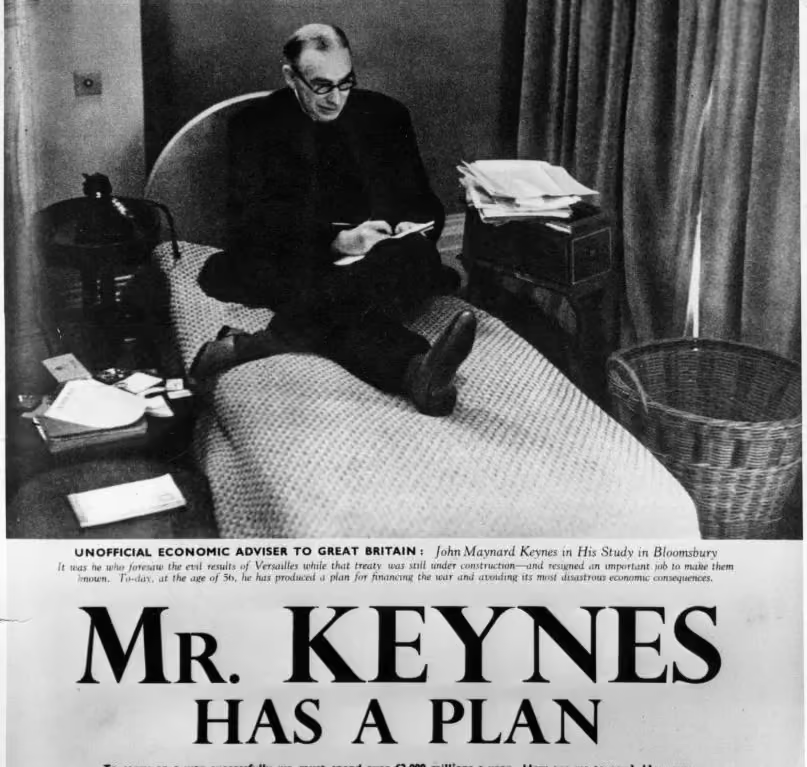
Keynes’s 'General Theory' as an Emergency Brief
The 'General Theory' was born from a specific historical emergency: the failure of postwar governments to deal with a depression rooted in the unimaginable destruction of wealth and the corresponding monetary disequilibrium.

.avif)

.jpg)
.png)