The Rebooted Animal Farm’s New Villain: Capitalism

We live in a brave new world nowadays, so this year on May Day, we received the first Animal Farm adaptation to completely betray Orwell’s story.
One of the strange political phenomena of our times is the return of socialism and Communism in our ideological discourse. Any number of attacks on property rights or other freedoms are justified by arguments for equality grounded in revolution, advanced by increasingly popular young politicians. Although America defeated the Soviet Union, we never really fixed the ideological problem, even though we successfully suppressed it during the Cold War. We’re moving toward a major crisis in our regime, at the core of which is our educational system.
Education is especially significant to a voluntary form of government because we believe that all human beings, by nature, can become reasonable and thus engage in the civic work of consensual government. To do that well, they need to learn a great number of things. We also depend on them to become productive workers and intelligent citizens. Our peaceful prosperity depends on this arrangement, but during periods of political crises and economic downturns, we are suddenly vulnerable to forces other than partisan quarrels over policy. We instead face fundamental attacks on our way of life.
Communism is such an attack. It’s part of an aggressive ideology that was allowed to spread for a generation within our institutions, leading to CRT, DEI, wokeness, and other projects that a growing number of individuals and institutions are now contesting. But they have far to go in rebutting these forms of illiberal ideology. We have, moreover, learned that only a few institutional leaders, from schools to the government, take their duties seriously. They are outmatched by the many who are part of the corruption. Worst of all, we are learning that a large minority of young Americans sympathize with socialism or communism.
We must therefore learn how to fight an ideological battle we had considered decisively won. It’s hard to do better than George Orwell, the most famous anti-Communist writer in the English language. Returning to him, we are immediately struck by the fact that he is as pessimistic as we are optimistic—he thought the fight needed to be fought but was likely to be lost, because people misunderstand the power of modern ideology to expose perennial human weaknesses.
Orwell’s fame rests primarily on Nineteen Eighty-Four (1948), which offered England a vision of a future of insurmountable tyranny, the ultimate victory of Communism in its ugliest Stalinist form. But before that, he offered a milder version of the story in Animal Farm (1945), a retelling of the history of Communism from the October Revolution through WWII, set on an English farm and intended to explain how naivety could bring on tyranny. The two stories seem fit to address adults and children, respectively. We should look to the influence of such storytelling to understand how our education about Communism has failed.
Animal Farm was first adapted into an animated film in 1954 in England. The CIA backed the movie, hiring English producers who were unaware they were playing a role in the Cold War propaganda battle. Although the movie has been an enormous success, combining artistic merit with brevity (72 minutes) and having been shown to untold millions of children, it was not a success at the time, perhaps because it was such a dark subject and came out during a bad economic moment. The propaganda modifications were significant but didn’t alter the overall story.
But first, the plot of Animal Farm. Farm animals, inspired by the revolutionary teaching of a dying boar, Old Major, revolt against the mistreatment of farmer Jones, and install rule by the animals themselves, based on the simple principle of animal equality, from which follow prohibitions to kill animals or act like man, the animal that sets itself above other animals (no clothing, alcohol, beds). But the new leaders, the boars Napoleon and Snowball, fight among themselves for supremacy and the winner Napoleon imposes tyranny by fear of, and the winner, Napoleon, imposes tyranny by fear of the dogs he’s bred in secret and made loyal to him, ferocious toward the other animals. The movie makes a very persuasive adaptation so far, with the minor addition of scenes in which animals from other farms refuse to revolt because their conditions are not cruel or harsh.
The most striking success of the movie, however, was introducing a young audience to the tyranny of Napoleon, which includes show trials with horrible executions, the propaganda of the porker Squealer, the gradual betrayal of every principle taught in Animalism, and ultimately the cult of personality around Napoleon. I cannot think of anything like this in our cinema, in its play upon a child’s sense of fairness and care for animals. I suppose it’s so rare or unique because we wish to protect children from the harsher realities of the world, but perhaps also because we do not wish to face the conflict between freedom and tyranny squarely ourselves. Then comes the other major change to the story for propaganda purposes, the hopeful conclusion. The tyranny is finally overthrown by another animal rebellion, in which the suffering beasts attack the pigs and their dog guards, who are drunk after revelry at the farmhouse.
Animal Farm was adapted again in 1999, this time in a strikingly different way. The new feature-length TV film was live-action and featured a remarkable cast. As for the villainous pigs: the Stalin-like Napoleon is voiced by Patrick Stewart; the Trotsky-like Snowball by Kelsey Grammer; the chief of propaganda, Squealer, by Ian Holm; and the Marx-Lenin-like Old Major by Peter Ustinov. As for the tyrannized beasts: Boxer, the hard-working shire horse, is voiced by Paul Scofield; Mollie, the vain mare, by Julia-Louis Dreyfus; Benjamin the donkey by Pete Postlethwaite (who also plays the wicked farmer Jones); and the border collie Jessie by Julia Ormond. It’s a beautiful piece of entertainment for children, but it was obviously taken very seriously as a production, given the level of talent involved.
One might have expected some kind of celebration of victory against Communism from this production. The Cold War was over! One could have recalled Orwell while also raising an eyebrow at his gloomy outlook. But this adaptation, although it’s more or less as faithful as the previous one, lacks earnestness and the appeal to the young. The clever animatronics and the cast seem to be there purely for entertainment. There is great moral appeal, but it is not justice or humanity. It’s animal rights. The deviations from Orwell—the most striking example being that Old Major is killed by the farmer—are almost always in the direction of emphasizing cruelty to animals as the most terrible evil.
The 1954 animation was not without its flaws, but it was faithful to the story’s tone, making it a remarkable opportunity to educate children. The 1999 movie, a much more successful production, seems like an advertisement for PETA. Still, it also reflects the post-Cold War moment. The whole story is narrated by Jessie, the collie, in a flashback, unlike in the novel. Jessie and some other animals had escaped the tyranny of Napoleon in disgust; years later, they return to the now-abandoned Animal Farm and try to restore it, along with new, kinder owners. One can easily think of reconstructing Russia after the fall of the USSR.
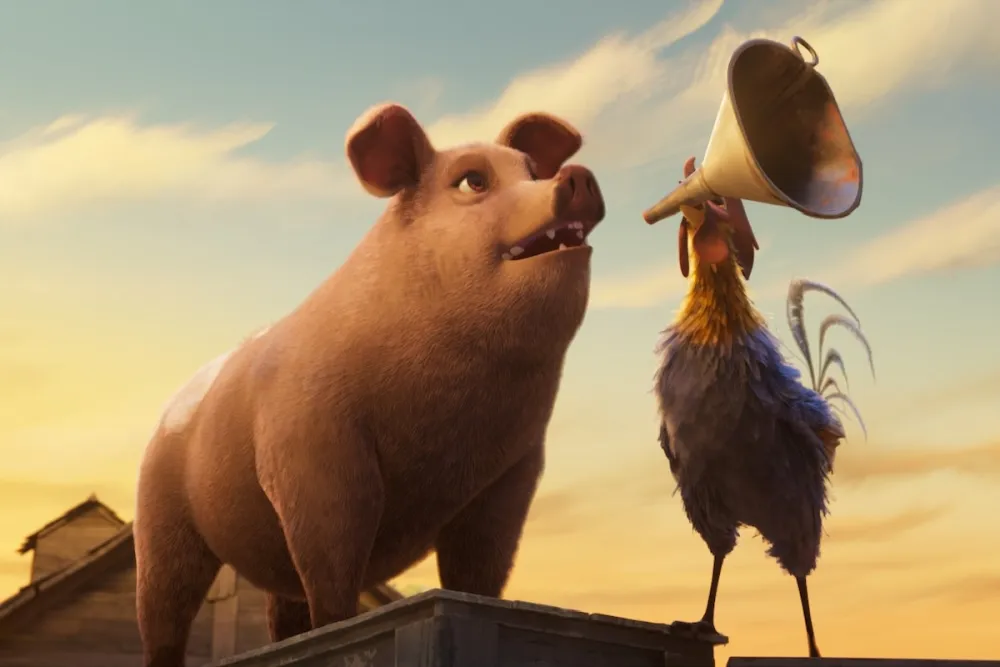
We live in a brave new world nowadays, so this year on May Day, we received the first Animal Farm adaptation that has completely betrayed Orwell’s story, to say nothing of yawning at the problem of Communism. In 1999, Communism and tyranny were at least the background of the story. In 2026, Andy Serkis, famous for playing Gollum in Peter Jackson’s The Lord of the Rings, directed a new story, written by Nicholas Stoller, in which the villain is capitalism, for its surveillance and corruption of the truth. A vulgar comic villain replaces Stalin. Serkis reportedly believes Orwell would think so today, so he wanted to update the story!
The animation even introduces a new protagonist to inspire the children: the piglet Lucky (voiced by Gaten Matarazzo, one of the boys in Stranger Things), who is led astray by “authoritarianism” but eventually finds his way back to the right and romance. The villain is not so much Napoleon (Seth Rogen) as the evil capitalist, Freida Pilkington (Glenn Close), and her minion, Whymper (Steve Buscemi), who represent techno-capitalism. The impressive cast includes a few more celebrities, like Woody Harrelson (Boxer), Kathleen Turner (the donkey Benjamin), Kieran Culkin (Squealer), and Jim Parsons, as well as transgender actor Laverne Cox, as the idealist revolutionary Snowball, excluded by the authoritarian Napoleon. This is the ideology of the times.
All of this is very bad news, but if I may imitate Orwell and close on a depressive note, the movie is distributed by Angel Studios, which markets itself to the public as a conservative Christian production house, yet seems more eager to corrupt children than most liberal studios. It’s very hard to explain how such a project was ever produced or distributed. Perhaps it was the climate of hysteria and wokeness after 2020. Then again, we are in the midst of hysteria and left-wing political violence nowadays, too, so this may be more a portent of the future than a relic of the past. We should restart reading Animal Farm with children and show them the old animation. We have a generational struggle ahead of us again if we are to defend the cause of freedom from tyranny.
Titus Techera is the executive director of the American Cinema Foundation and hosts the ACFpodcasts. He is a contributor to Modern Age, National Review Online, and University Bookman. He tweets as @titusfilm.

.jpg)
Elite Women and Title IX Transformation: A Cautionary Tale
All we can do is pay homage to each progressive Sisyphus who valiantly pushes her rock up the hill, only to have it roll back down for another inspiring but ultimately tragic story.
Immigration Indoctrination: Story Time For the Fourth of July
Liberal information asymmetries are difficult to break.
Introducing 'The Civitas Collection 250'
We hope that you, the reader, will deepen your understanding of the Declaration and develop greater devotion to this remarkable country we have been called to uphold and cherish.



.jpg)

Get the Civitas Outlook daily digest, plus new research and events.
Get the Civitas Outlook daily digest, plus new research and events.